Guide · Ring styles
What makes a ring Art Deco?
Nobody in the 1920s bought an “Art Deco ring.” The people who made and wore them called the new look modern, or Moderne; the name Art Deco was given to the style in the 1960s, long after it had gone out of fashion. What the rings of those years share is easier to pin down than the name.
What makes a ring Art Deco?
Geometry, precision and, very often, platinum. An Art Deco ring, made in the 1920s or early 1930s, sets its stones in straight lines, blocks and angular outlines, with as little metal showing as possible. Toward 1930 the palette turned white: diamonds, rock crystal and platinum.
Two rings at the Victoria and Albert Museum in London show what to look for. One, made in Europe or the United States between 1920 and 1930, packs a band of pointed baguette diamonds between lines of sapphires and emeralds, each stone cut to fit the jagged edge of the next and arranged “in blocks of colour.” The other, made in France about 1930, sets a dome of diamonds between two flat panels of rock crystal. The museum describes it by “the geometry and the minimalism” of its design.
The checklist that follows from them is short: a date between the two world wars, a white metal (usually platinum), a geometric arrangement of stones, and settings that keep the metal to a minimum. Each of those traits has a date behind it, below.
1922: where did the Art Deco look come from?
From almost everywhere at once. The V&A calls Art Deco a pastiche of styles: the late, geometric Art Nouveau of Vienna and Glasgow, avant-garde painting, the Russian ballet, and ancient art, given a new push when Tutankhamun’s tomb was excavated in 1922.
The museum traces the straight lines to the linear side of Art Nouveau, in the work of Josef Hoffmann in Vienna and Charles Rennie Mackintosh in Glasgow. In the 1920s designers also took the forms of Cubism, Futurism, De Stijl and Constructivism, which British and American critics lumped together, and called the result “Moderne,” “Jazz Moderne” or “Zigzag Moderne.” The excavation of Tutankhamun’s tomb in 1922, the V&A adds, set off a wave of Egyptian imagery: lotus flowers, scarabs, hieroglyphics, pylons and pyramids.

1925: what happened at the Paris exhibition?
Paris held the Exposition Internationale des Arts Décoratifs et Industriels Modernes, a show of modern decorative arts that gathered thousands of designers from Europe and beyond. It is the moment the style is named after, though at the time it was called Style Moderne.
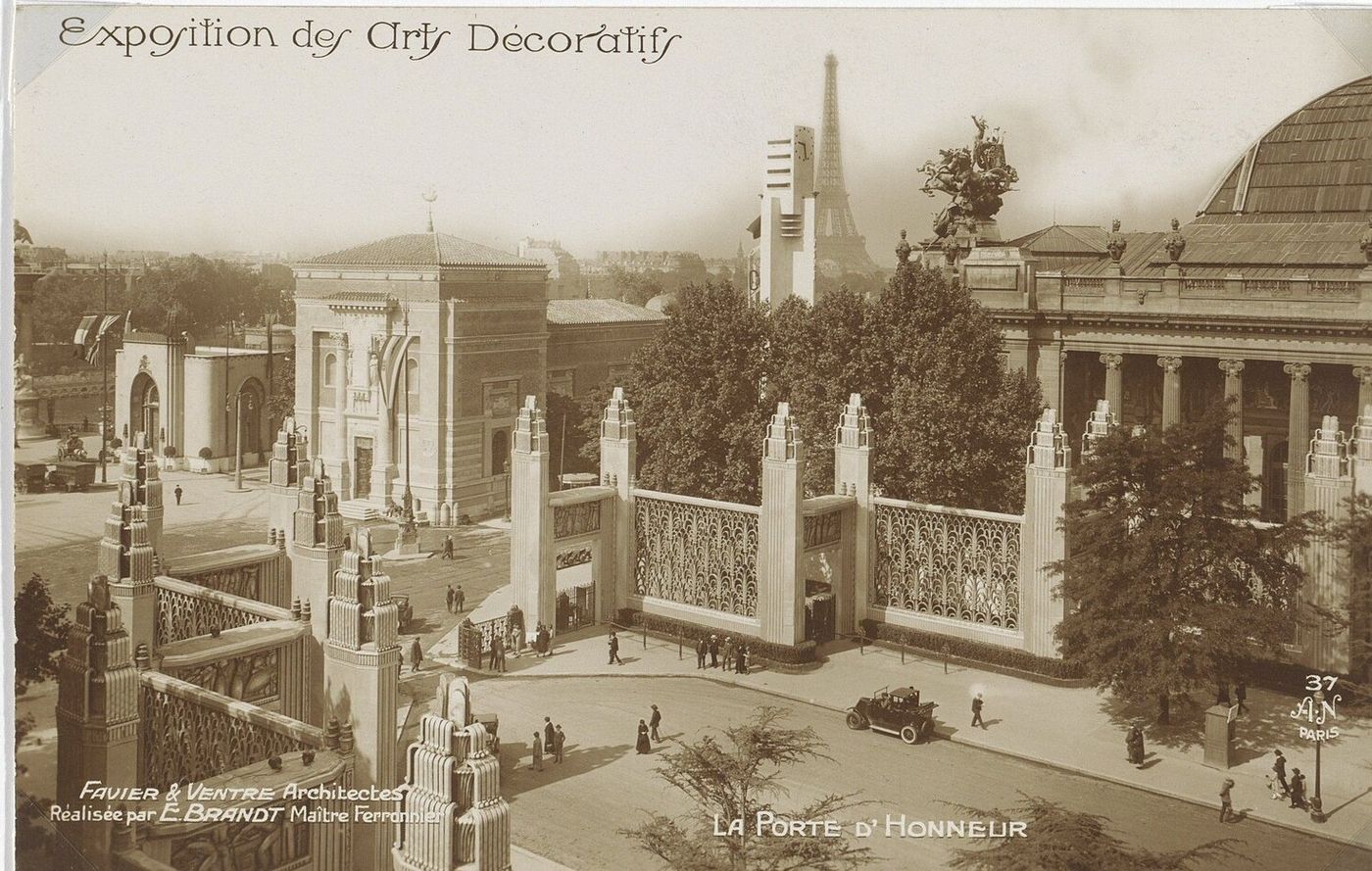
The V&A calls the exhibition “one of the most pivotal moments” for the style, and names two of its stars: the furniture maker Émile-Jacques Ruhlmann and the glassmaker René Lalique, both known for exquisite detail. A New York landmarks report on an Art Deco skyscraper lists the same exhibition first among the influences on American architects of the late 1920s, next to the Vienna Secession, the Wiener Werkstätte, Frank Lloyd Wright and Mayan forms.
1920s: why were Art Deco rings made of platinum?
Because platinum is strong. The V&A notes that it was favored in Art Deco jewelry because its strength allowed very little metal to be used, “giving the stones the greatest possible prominence.” The metal almost disappears.
On the 1920s ring of baguettes, sapphires and emeralds, the museum points to “the discreet platinum settings,” which let the “densely-packed gemstones and their precise geometric arrangement” carry the whole design. The ring is only 2.2 cm across and 0.6 cm high. Neither of the two museum rings lists any gold among its materials.
About 1930: why did Art Deco jewelry turn white?
Fashion moved from color to an all-white look at the end of the 1920s, the V&A says, and the “icy combination of diamonds, rock crystal and platinum came to the fore.” Its French ring of about 1930 has no colored stone at all.
That ring measures 2.4 cm deep, 2.0 cm wide and 1.3 cm high: a domed half-circle of pavé diamonds flanked by two panels of rock crystal, with more diamonds running down the shoulders along the line of the head. The museum sees in it “the severity and strength of Art Deco design.”
1929-1931: why do Art Deco buildings step back as they rise?
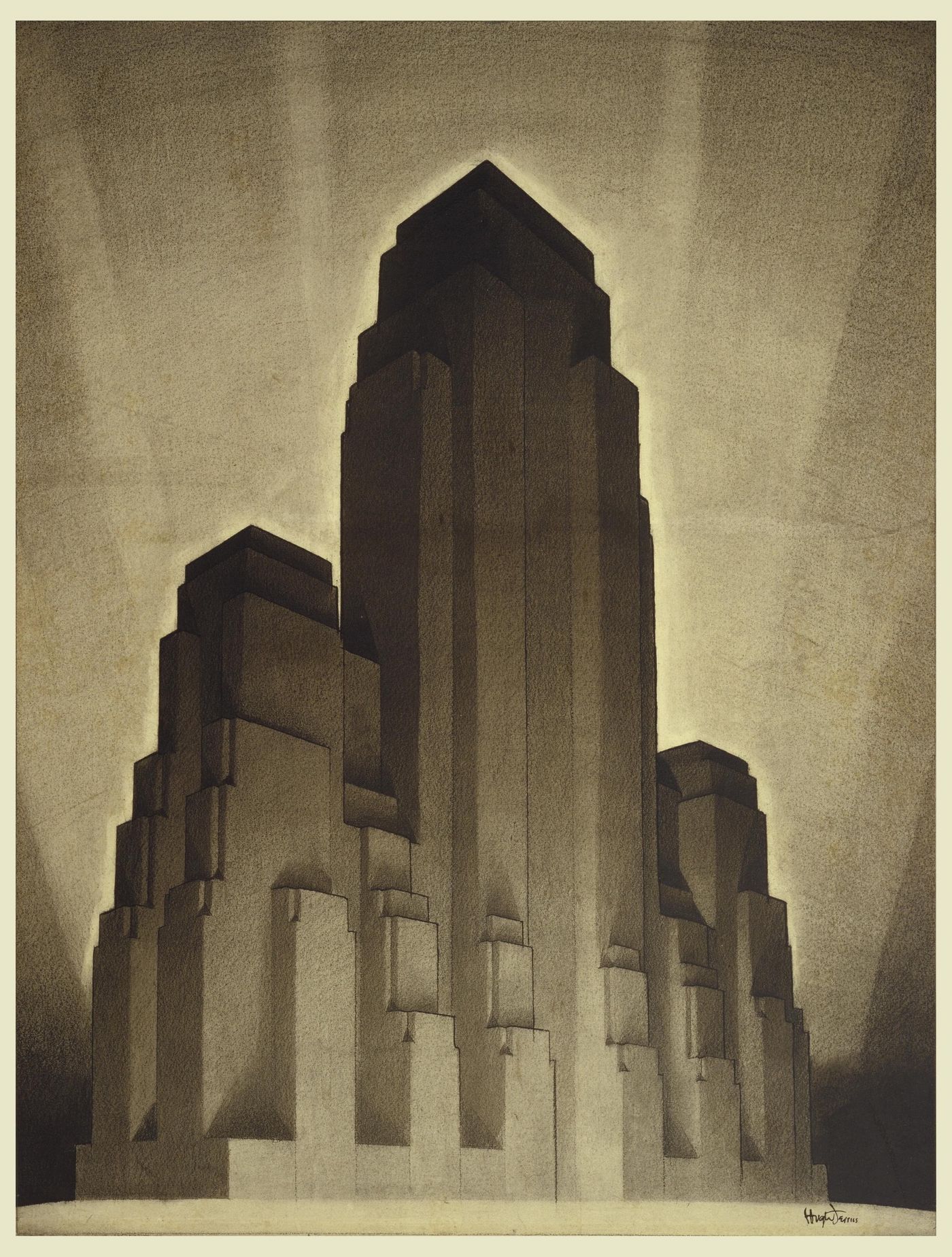
Because New York’s 1916 zoning law required setbacks at various levels, so that light and air could reach the lower floors. Architects turned the rule into a style: sculpted masses, bold setbacks, and ornament of ziggurats, zigzags and stylized flowers.
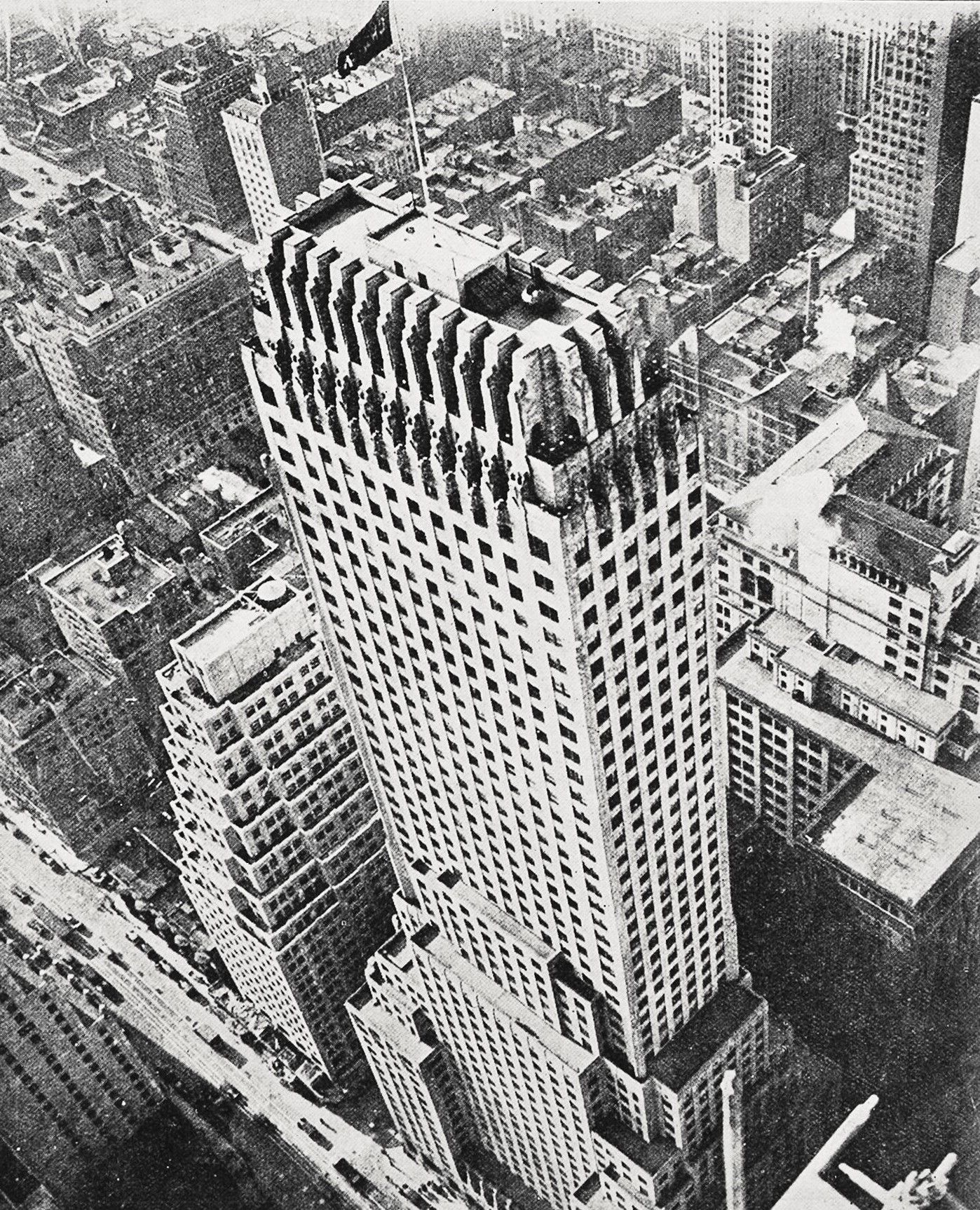
The New York City Landmarks Preservation Commission explains it in its 1998 report on 21 West Street, a 31-story brick tower of 1929-31 in Manhattan. In 1922 the architect Harvey Wiley Corbett and the illustrator Hugh Ferriss drew the shapes the zoning law allowed, stage by stage, and their drawings “significantly influenced architects of the period.” Ornament was usually in low relief and grouped around the entrances, “angular, geometric shapes such as ziggurats and zigzags, or simplified and stylized floral patterns, parts of circles, or faceted crystalline shapes.” The style reached its peak in New York between 1928 and 1931.
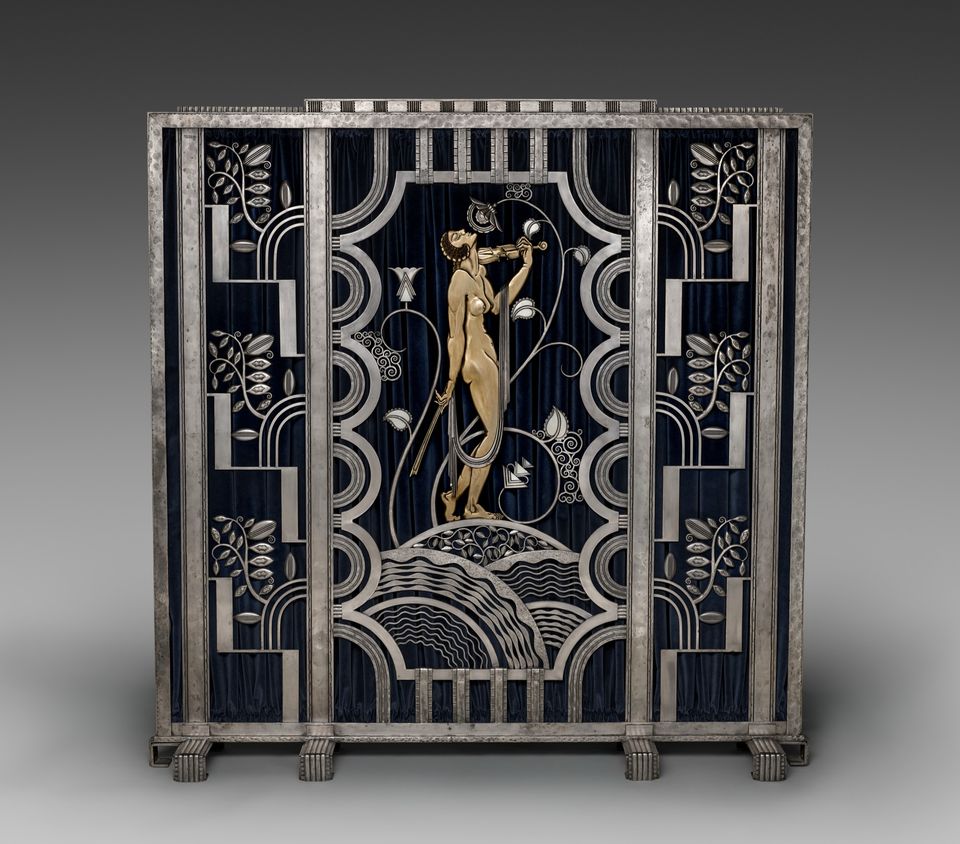
The same vocabulary went into metalwork. The Cleveland Museum of Art describes this 1930 screen, designed by Paul Fehér for the Rose Iron Works of Cleveland, by its “geometric patterning, highly stylized and abstracted natural forms,” and calls them the classic motifs of Art Deco design. Its side panels climb in zigzag steps.
1934: what happened to gold in the Art Deco years?
The United States fixed its price. Under the Gold Reserve Act, signed in January 1934, the government took over all monetary gold at $35 an ounce, the rate that tied the dollar to gold until August 1971. Jewelers could still obtain gold bars for their trade.
Federal Reserve History notes that the act required monetary gold to be held as bars and forbade gold coins, while bars could be obtained for industrial uses “such as the manufacture of dental appliances, jewelry, and electronics.” The $35 rate replaced the $20.67 an ounce set by the Gold Act of 1900. It held, as the anchor of the dollar’s link to gold, until President Nixon closed the gold window in August 1971.
By then the style itself had long fallen from grace. After the stock market crash of 1929, the V&A writes, the optimism of the 1920s gradually declined, and by the mid-1930s Art Deco was being derided as a gaudy, false image of luxury.
1960s: when did the style get the name Art Deco?
In the 1960s, when collectors and critics looked back at the 1920s and 1930s. The V&A calls Art Deco “a term coined in the 1960s”; the New York landmarks report says the style took the popular name Art Deco during its critical reassessment in the 1960s and 1970s, after the 1925 Paris exhibition.
So “Art Deco ring” is a label applied after the fact, to rings made under other names. When a seller uses it today for a new ring, it describes a look borrowed from those years: the geometry, the steps, the framed center. It is worth asking which one you are being offered, a ring made between the wars, or a new ring in their manner.
Which ring is named Deco?
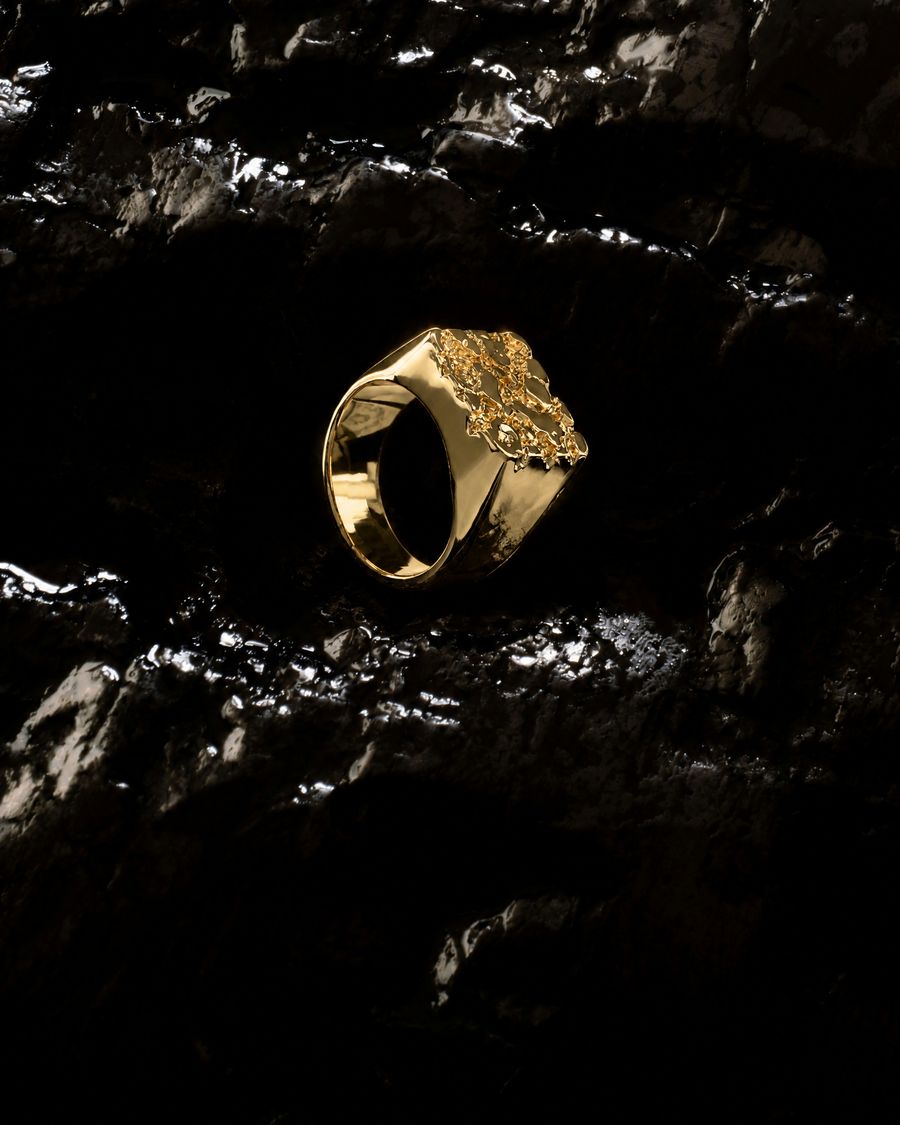
No. 534 Deco. It takes up the stepped architecture of those years: two polished steps lead down to a central square of nugget relief, so the nugget sits at the bottom of the last step.
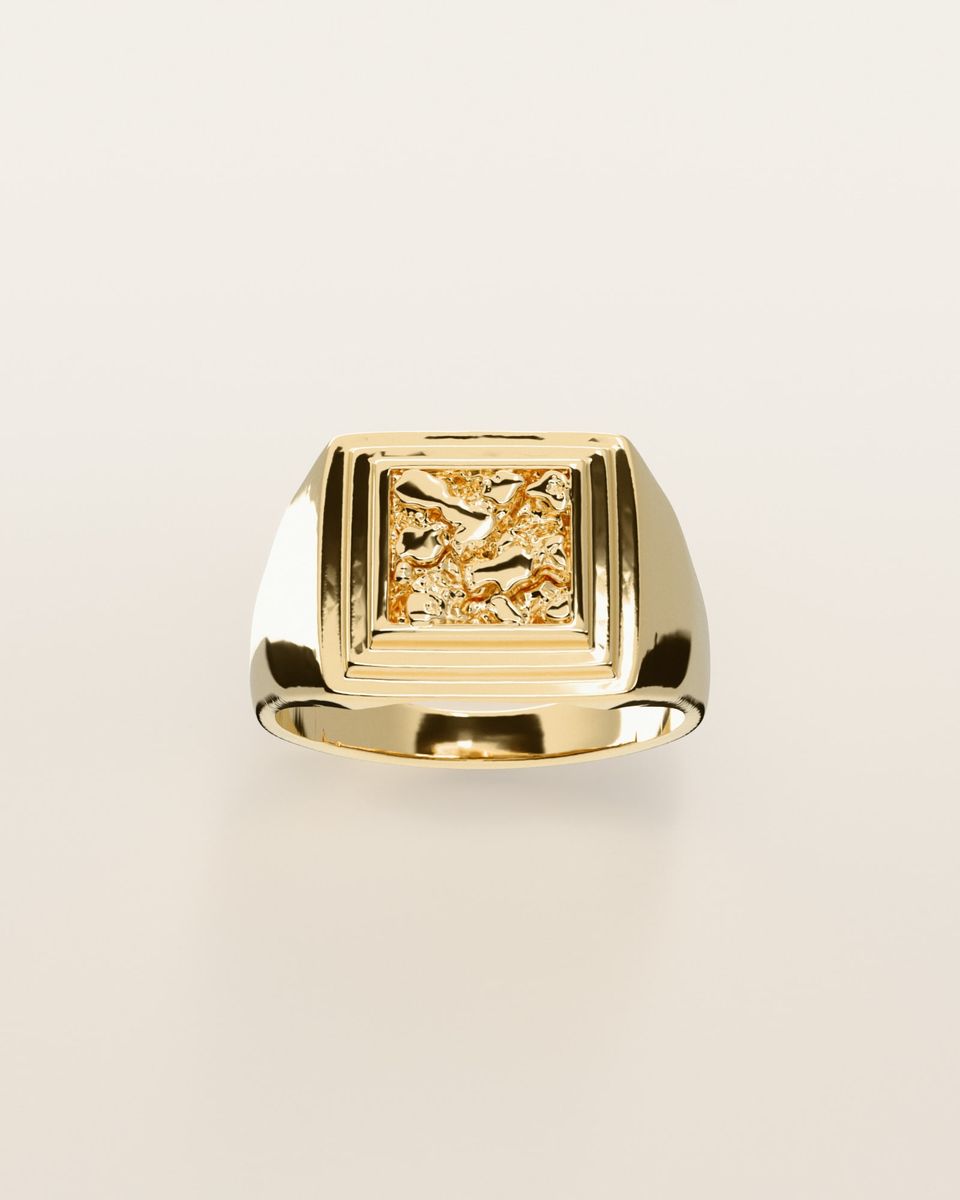
Its story is the date of 1934, when gold was fixed at $35 an ounce in the Art Deco years, a price that held until August 1971. The sides of the head are flat polished walls above a plain band. It is a low, flat ring: the head rises 2.64 mm off the finger and measures 13.8 mm along it, and the band narrows to 3.1 mm underneath. In sterling silver it is $360. Also in solid 10K and 14K gold, one price per metal at every size; in 14K at size 10 it weighs from 10.8 g.
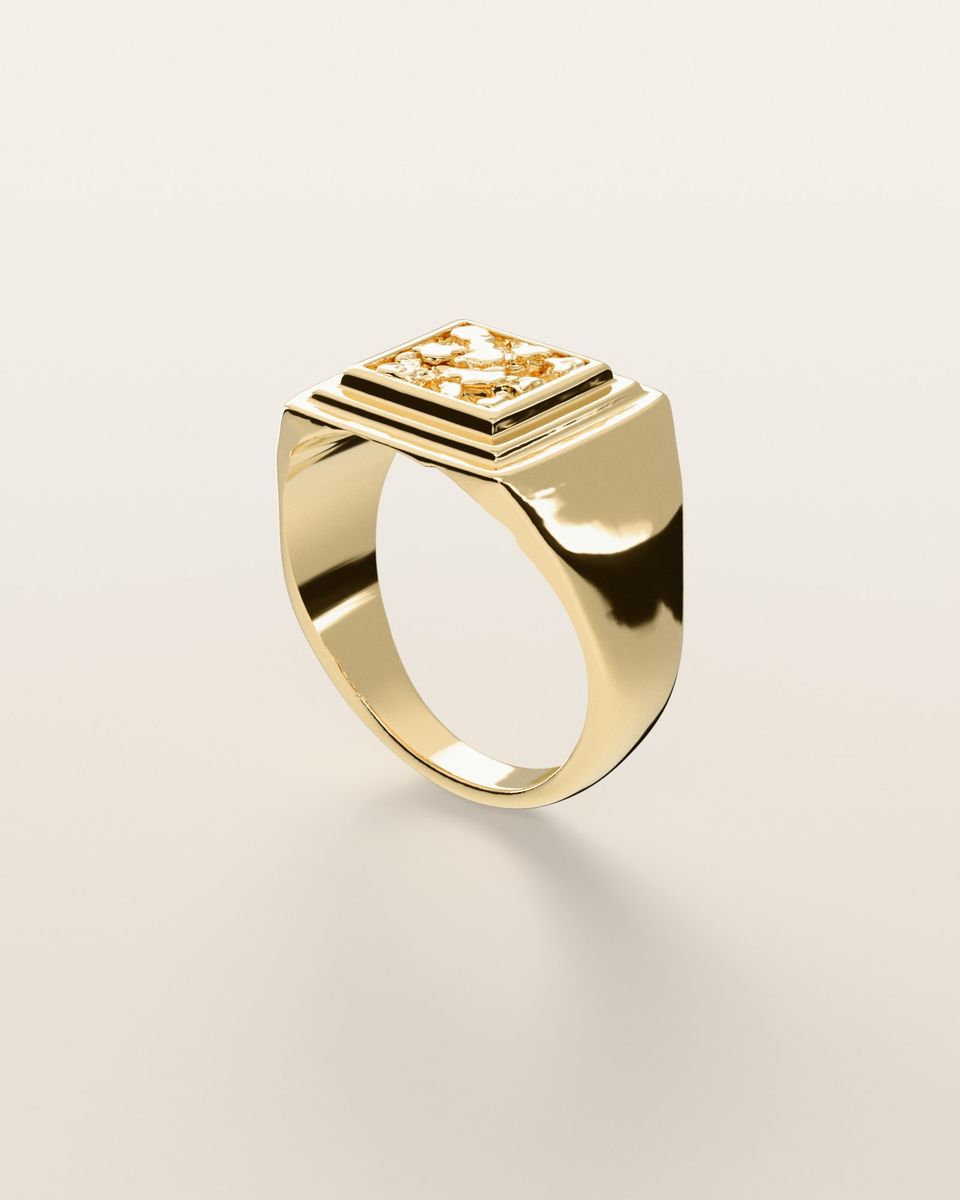
If you prefer the frame the other way round, No. 535 Inverse puts a flat polished square in the middle and the nugget relief around it. Both belong to The Assay Office collection, and each is cast to order in your size by our workshop. How a flat-topped ring like these differs from the other shapes is in what is a signet ring, and the full checklist for choosing one is in the nugget ring buying guide.
More on the same subject: nugget ring styles and icons.
Sources
- Victoria and Albert Museum, An introduction to Art Deco: term coined in the 1960s, sources of the style, Tutankhamun (1922), the 1925 Paris exhibition and “Style Moderne,” “Moderne,” “Jazz Moderne,” “Zigzag Moderne,” decline after 1929. Read 19 October 2026.
- Victoria and Albert Museum, Ring, platinum set with diamonds, sapphires and emeralds, Europe or USA, 1920-1930 (M.186-2007): description, dimensions and the note on platinum. Read 19 October 2026.
- Victoria and Albert Museum, Ring, platinum, rock crystal and diamond, France, about 1930 (M.127-2007): description, dimensions and the note on the white look. Read 19 October 2026.
- New York City Landmarks Preservation Commission, 21 West Street Building, designation report LP-1999 (June 16, 1998): the Art Deco style, the 1916 Building Zone Resolution, Corbett and Ferriss (1922), ornament, peak in 1928-1931, the name in the 1960s and 1970s. Read 19 October 2026.
- The Cleveland Museum of Art, Muse with Violin Screen, 1930, Paul Fehér, Rose Iron Works (2020.216). Open Access record and image (CC0), read 19 October 2026.
- Federal Reserve History, Gold Reserve Act of 1934 (signed January 30, 1934; $35 an ounce; $20.67 under the Gold Act of 1900; bars for jewelry and other industrial uses) and Nixon Ends Convertibility of US Dollars to Gold (the gold window closed in August 1971). Read 19 October 2026.