Guide · Ring styles
What is a signet ring?
Before a signature, there was a seal. For more than three thousand years people signed by pressing a carved stone or a piece of metal into clay, mud or wax, and many kept that seal on a finger. The signet ring is what is left of that habit.
What is a signet ring?
A signet ring is a ring with a flat top, the bezel, carved with a design that can be pressed into soft wax or clay to leave a mark. The design was a name, a crest, initials or a symbol, and the mark stood for its owner. Today a signet ring is often worn for that flat top alone, without sealing anything.
The word says what it was for. The American Heritage Dictionary defines a signet as “a seal, especially one used officially to mark documents,” and the impression it leaves. It came into English from Old French, where it was a small form of signe, sign. The Oxford Learner’s Dictionary keeps it short: a signet ring is “a ring with a design cut into it, that you wear on your finger.”
One detail gives a real signet away. The design is cut in reverse, so that it reads the right way round in the wax. The Cleveland Museum of Art points this out on a silver signet ring from Greece, made in the 300s BCE or later: when the ring was stamped, the image was reversed.
1300s BCE: why did Egyptian kings put their name on a ring?
Because a ring could sign for them. In Egypt a document could be closed with a lump of mud stamped with a name, and a gold ring carved with the king’s name made that stamp. Several of these royal signets survive, along with the dried mud they marked.
The Metropolitan Museum of Art in New York holds a gold signet ring carrying the throne name of Tutankhamun, dated about 1328 to 1318 BCE. Its oval bezel is 2.9 cm wide and the ring 3.3 cm across. The same collection has a gold signet from the reign of Akhenaten, about 1347 to 1330 BCE, a gold signet ring of Ramesses VI, about 1154 to 1146 BCE, and the other half of the system: a small piece of dried mud catalogued as a “document sealing” with the throne name of Amenhotep III, from about 1386 to 1347 BCE.
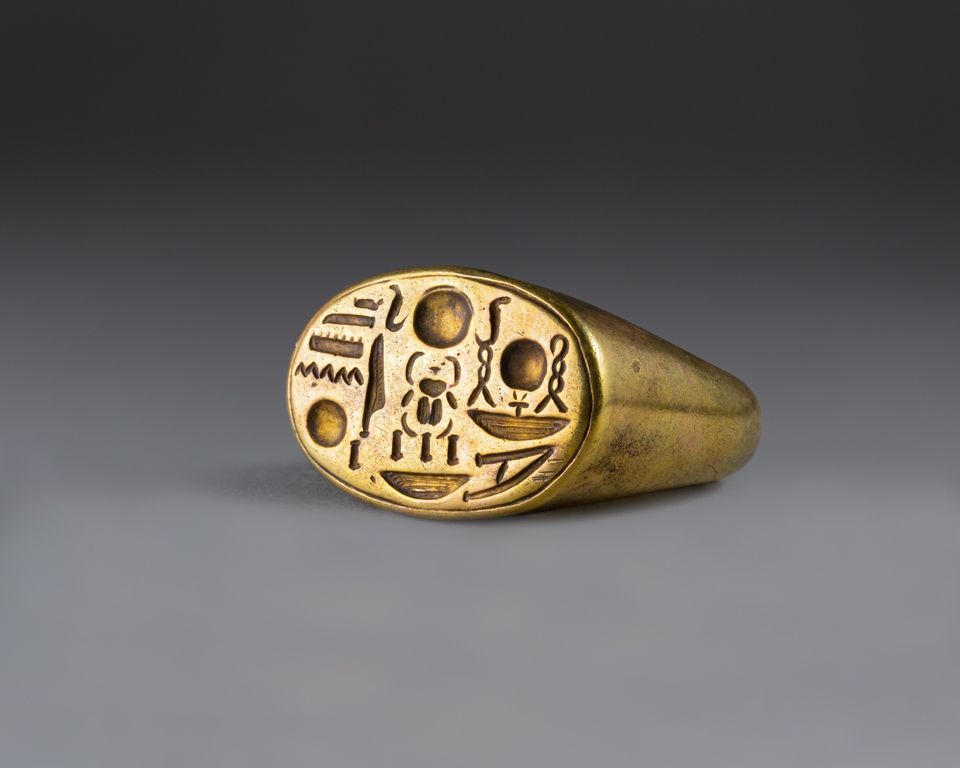
The ring and the sealing explain each other. The ring is thick and its signs are carved deep, to be pushed into something soft. The sealing is what was left on the document once it was closed, with the name of the person whose authority closed it.
What does a signet ring mean in the Bible?
In the Bible a signet stands for its owner’s identity and authority. Judah leaves his signet as a pledge in Genesis 38, a Persian king seals decrees with his ring in Esther, and in Haggai God promises to make Zerubbabel “as a signet.” Whoever held the ring could act in the owner’s name.
The passages, in the King James Version:
- Genesis 38:18 and 38:25. Asked for a pledge, Judah gives Tamar “thy signet, and thy bracelets, and thy staff.” When she later sends them back with the words “Discern, I pray thee, whose are these,” he has to acknowledge them as his: the signet works like a signature he cannot deny.
- Esther 3:10-12 and 8:8. King Ahasuerus takes his ring from his hand and gives it to Haman, and the orders are “written, and sealed with the king’s ring.” Later he allows a second letter, because what is “sealed with the king’s ring, may no man reverse.”
- Daniel 6:17. A stone is laid on the mouth of the lions’ den, and the king seals it “with his own signet, and with the signet of his lords,” so that nothing about Daniel could be changed.
- Jeremiah 22:24 and Haggai 2:23. The signet becomes a picture of closeness: a king worn “as the signet upon my right hand,” and a chosen servant made “as a signet.”
One verse is often quoted that does not use the word. In Genesis 41:42 Pharaoh takes off his ring and puts it on Joseph’s hand; the King James text says “ring,” not signet, though the gesture is the same handing over of power.
300s BCE to 1500s: who used signet rings, and for what?
Anyone who had to sign: officials, merchants, landowners and families. A medieval signet sealed letters and witnessed wills, deeds, loans and land agreements, and its design could be a coat of arms, an initial, a merchant’s mark or a personal symbol.
The Met’s collection follows the habit through the centuries: a Greek gold ring carved with a seated woman and a flying Eros, from the 400s BCE; a Frankish electrum signet ring with a monogram, from the 600s; and the gold signet ring of Michael Zorianos, made in the Byzantine world about 1300, which weighs 25 grams.
The Victoria and Albert Museum in London explains how one was used, on an English gold signet ring of the 1400s engraved with a falcon in a fetterlock, a badge used earlier by Edward IV. The ring was pressed into hot wax to seal a letter or packet. Personal seals “provided an essential legal safeguard” and witnessed wills, deeds of gift, loans, commercial documents, personal letters and land indentures. The museum adds that portraits of the 1500s and 1600s show signet rings worn on the forefinger or the thumb, probably so the ring could be turned onto the wax, and that the precious metals and carved stones made them signs of status as well as tools.
1864: what did an American signet ring look like?
Much like today’s: a gold ring with a flat, shield-shaped stone on top, carved in reverse. The Met keeps one made in New York in 1864 by the jewelers Ball, Black & Co., in gold with a bloodstone, a dark green stone flecked with red.
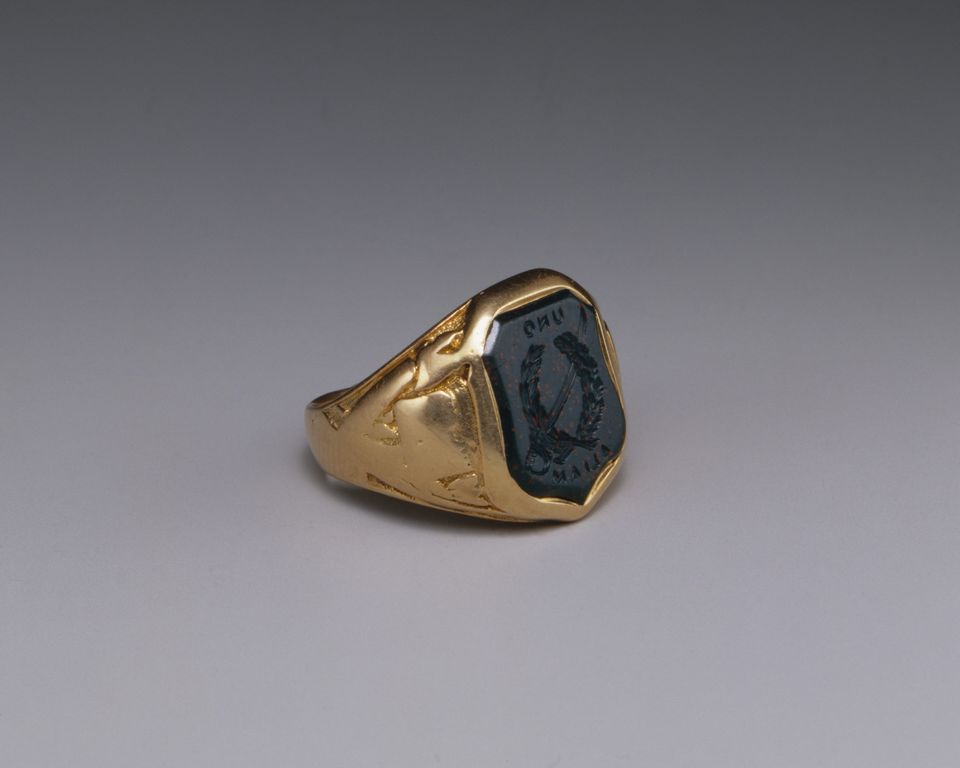
The ring is small, 2.2 cm long, and the design on the stone is still a working seal: lettering and a wreath cut backwards, so that they read the right way in wax. The gold around it is sculpted on both shoulders. It was a tool and an ornament at once, the double role the V&A describes three centuries earlier.
1971: when did a signet get a nugget face?
By 1971 at the latest. Kay Jewelers’ Christmas catalog that year sold a “rugged golden nugget style ring” in 14K gold at $69.95, on the same page as a 14K signet ring offered with free engraving at $49.95. The nugget face replaced the engraved design with the texture of raw gold.
That page is described in what is a nugget ring, and the rest of that decade, with the gold price that went with it, in our guide to the 1970s gold nugget ring. Our nugget signets keep the signet’s build, a broad head on a band that narrows under the finger, and give up the seal: relief of that kind would print as a shapeless lump in wax.
Which of our rings are signets?
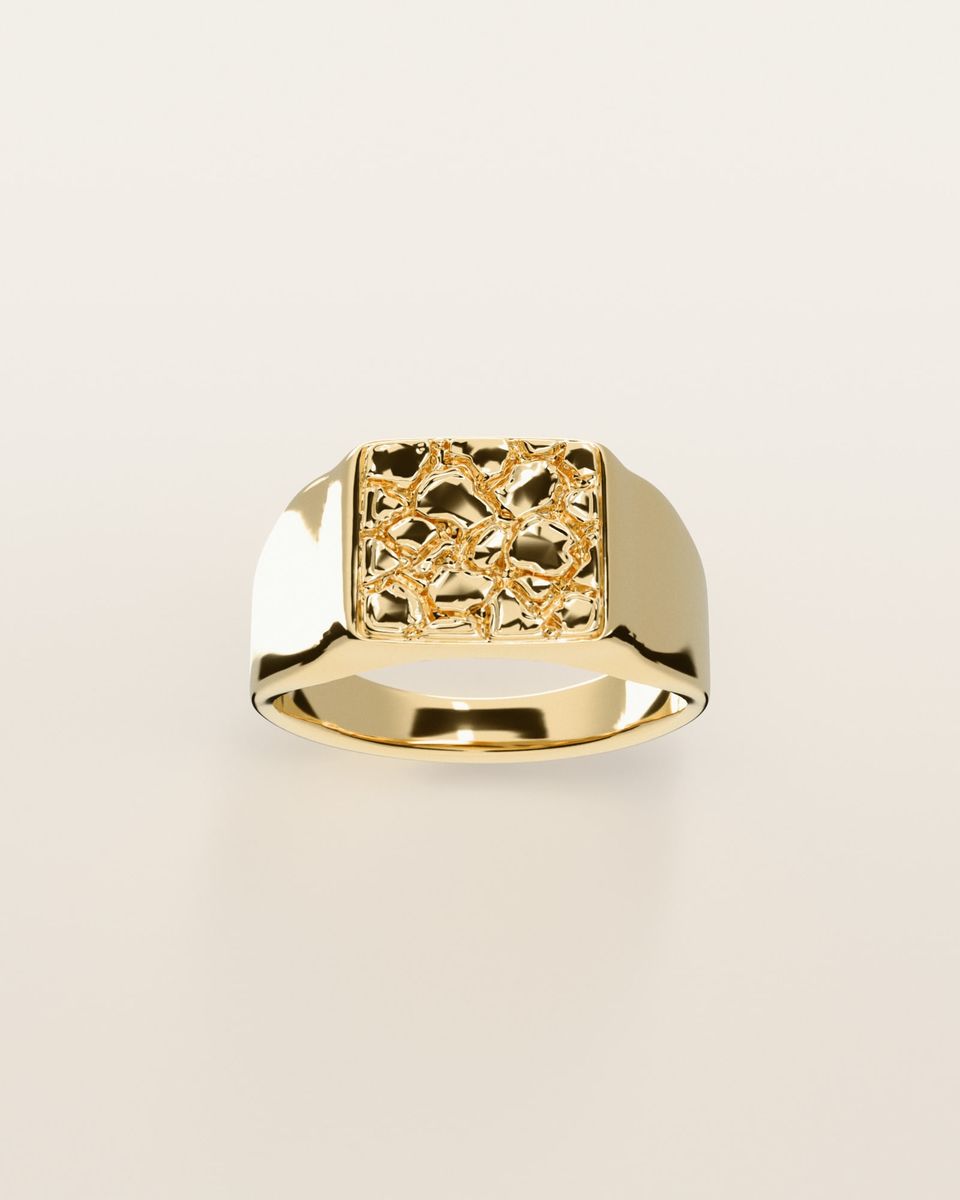
The rings of The Claim, our collection of nugget signets: a square, oval or wide face of nugget plates on plain polished shoulders. They run from No. 446 Signet XS, 7.6 mm across the face, to No. 1259e Big Smooth Signet, 21.65 mm.
The collection takes its name from the other document that counted on the gold fields. A signet was for signing; for a gold seeker, the paper that mattered was the claim, ground staked at the corners with a notice posted in the name of whoever took it. That story is in what is a mining claim.
No. 409 Signet M is the classic shape: a square face of nugget plates on broad, plain shoulders that taper into a polished band. The face is 10.95 mm across, the band 3.4 mm underneath, and the head rises 2.51 mm above the finger. In sterling silver it is $355. Also in solid 10K and 14K gold, one price per metal at every size; in 14K at size 10 it weighs from 10.5 g.
Each ring is cast to order in your size by our workshop. What to check before buying any nugget ring, from the karat to what is under the head, is in the nugget ring buying guide.
More on the same subject: how to wear a nugget ring.
Sources
- The American Heritage Dictionary of the English Language, 5th ed., signet(definition and origin); Oxford Learner’s Dictionaries, signet ring. Read 19 October 2026.
- The Metropolitan Museum of Art, Signet Ring with Tutankhamun’s Throne Name (22.9.3), Signet ring, reign of Akhenaten (24.2.8), Signet ring of Ramesses VI (26.7.768), Document Sealing With the Throne Name of Amenhotep III (12.180.685). Open Access records read 19 October 2026.
- The Cleveland Museum of Art, Finger Ring, Greece, 300s BCE or later (1963.98): silver signet, image reversed when stamped. Open Access record read 19 October 2026.
- The Holy Bible, King James Version, Project Gutenberg text: Genesis 38:18, 38:25, 41:42; Esther 3:10-12, 8:8; Daniel 6:17; Jeremiah 22:24; Haggai 2:23. Read 19 October 2026.
- The Metropolitan Museum of Art, Gold Signet Ring of Michael Zorianos, about 1300 (18.145.42, 25 g), Electrum Signet Ring with Monogram, Frankish, 7th century, and Gold ring with intaglio, Greek, 5th century BCE. Open Access records read 19 October 2026.
- Victoria and Albert Museum, Signet ring, England, 1400-1500 (M.205-1975): hot wax, personal seals as legal safeguard, designs, forefinger or thumb in portraits. Read 19 October 2026.
- The Metropolitan Museum of Art, Signet Ring, Ball, Black & Co., New York, 1864 (2000.552). Open Access record read 19 October 2026.
- Kay Jewelers, Christmas Catalog 1971, page 29, “Ring Ideas”. Internet Archive scan, read 19 October 2026.