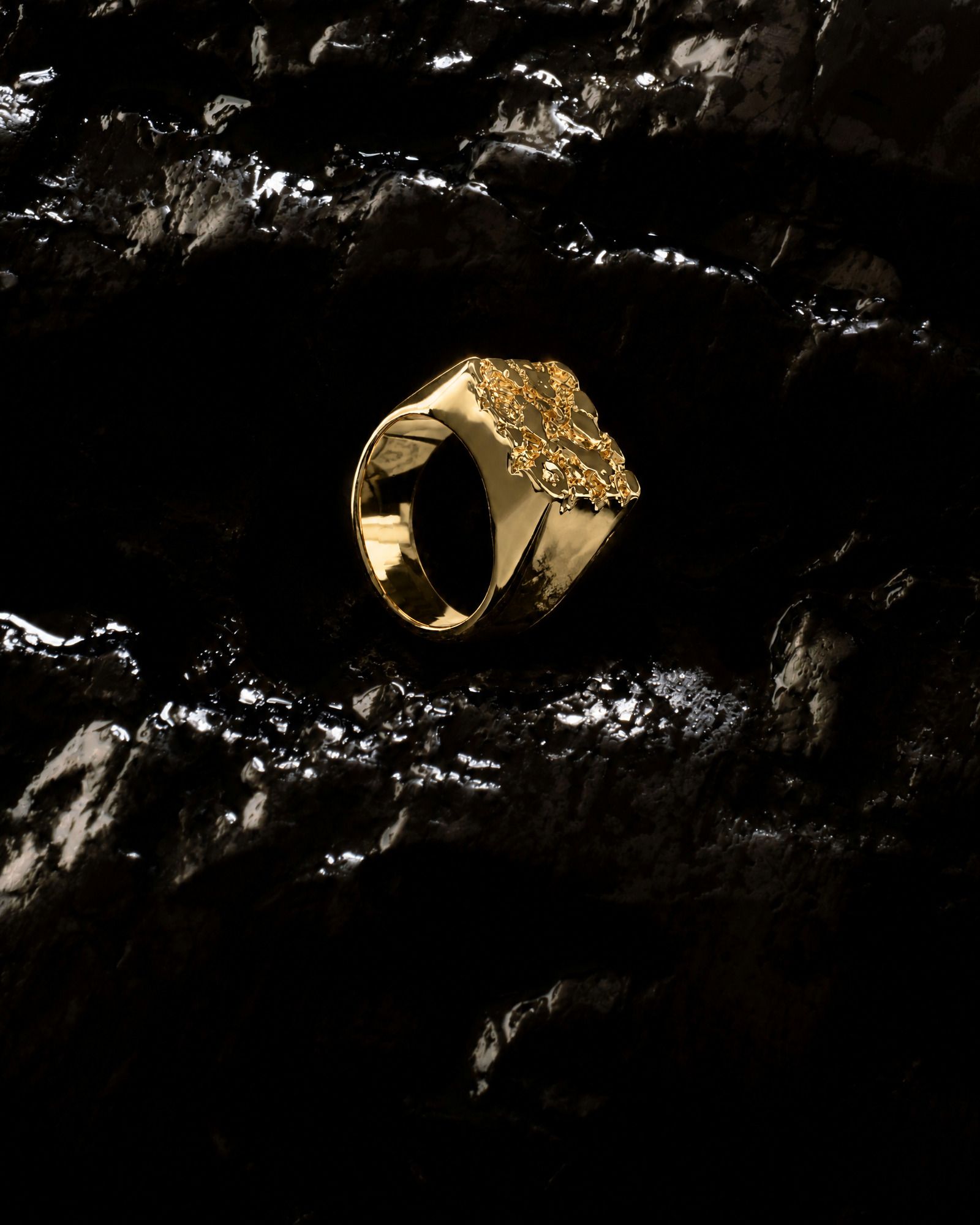
Guide · Gold explained
Why is the Webb telescope mirror gold?
The James Webb Space Telescope’s main mirror is 21 feet across and gold from edge to edge. All of that gold together weighs about 48 grams, roughly a golf ball. Here is why the mirror is gold, where the 48 grams comes from, and what the number teaches anyone who buys gold.
Why is the Webb telescope mirror gold?
Because gold reflects red and infrared light extremely well, and infrared is what Webb is built to see. NASA put a layer of gold 100 nanometers thick on each of the mirror’s 18 beryllium segments to make them better infrared reflectors.
NASA’s explanation starts with metals in general. A metal reflects light because its electrons move freely: when light hits the surface, they move in response and send the light back. How well that works depends on the element and on the wavelength. Gold, in NASA’s words, “just happens to reflect blue light very poorly but red and infrared light extremely well.” That is also why gold looks yellow to us: it gives back more of the red end of the light than the blue.
Webb needs that red end. The light of the first galaxies left them as ultraviolet and visible light, but the universe has been expanding ever since, and the stretch has pushed that light into the near and mid infrared by the time it reaches us. Infrared also lets Webb look inside the dust clouds where stars and planets are forming today. So the mirror is tuned to infrared, and gold is the metal NASA chose to do it.
Infrared is heat, which is the other reason Webb works far from Earth. Launched on December 25, 2021, it orbits the second Sun-Earth Lagrange point, about 1 million miles (1.5 million km) away, behind a sunshield the size of a tennis court. The telescope runs below 50 kelvin, about minus 370 °F, so that its own warmth does not drown the faint signals it is collecting.
How much gold is on the Webb telescope mirror?
About 48 grams, or just over 1.5 troy ounces. NASA calculates 48.25 grams of gold for the coating on Webb’s mirrors, and compares it to a golf ball, which weighs 45.9 grams.
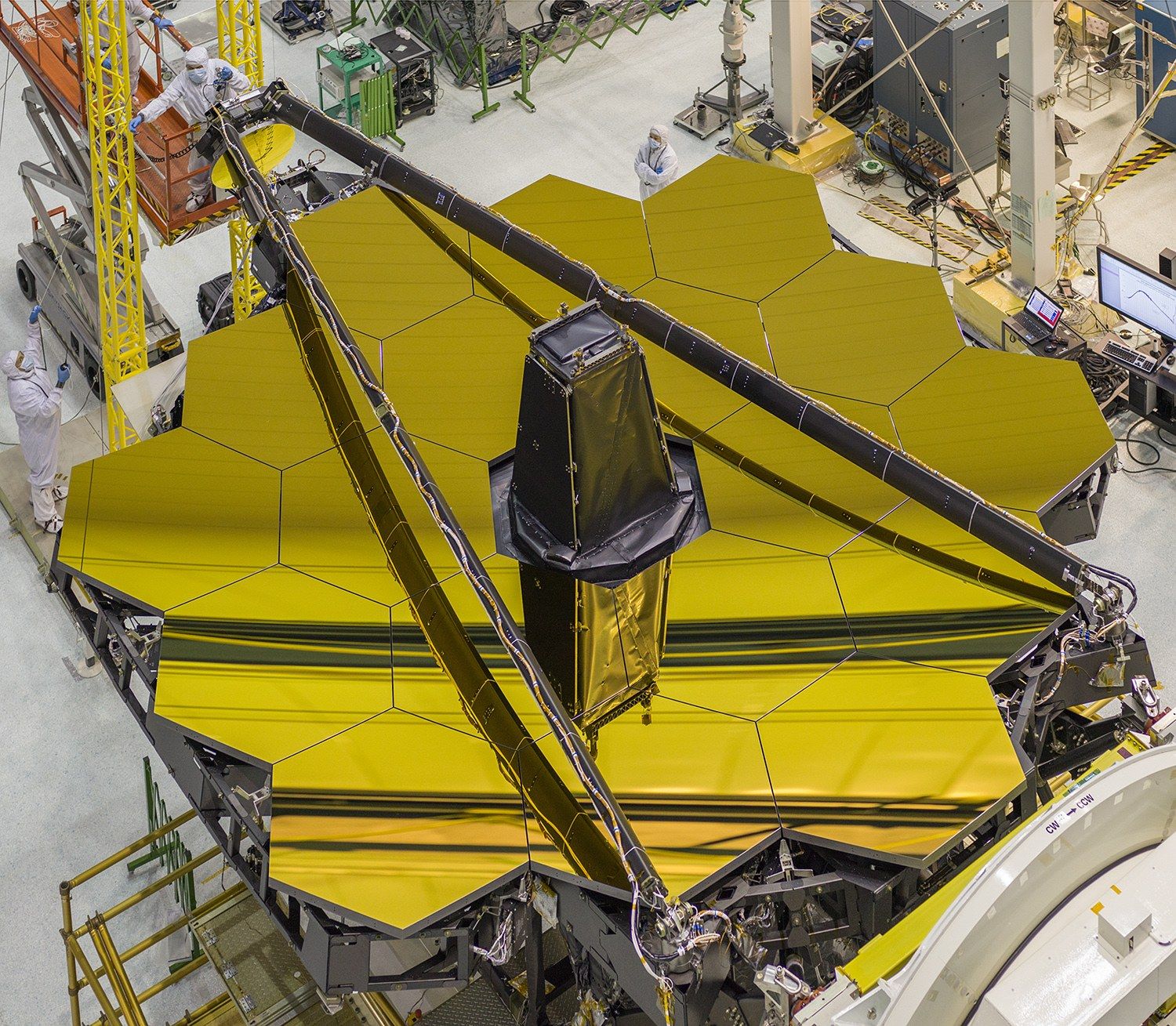
Pressed into one lump, 48 grams of gold would be a cube about 1.4 cm (just over half an inch) on a side: the gold on the whole 21-foot mirror would close inside your fist. Gold is that dense. The figure covers the coating NASA describes for Webb’s mirrors; it is a calculation, not a weighing. Nobody scraped the gold off and put it on a scale.
The comparison that surprises people is the other way round. The gold is so thin that a sheet of it covering 25 square meters still adds up to less than two ounces. Thin layers are how gold covers big areas cheaply, on a telescope and on jewelry.
Where does the 48 grams come from?
From three numbers NASA publishes: a gold layer 100 nanometers thick, a coated area of 25 square meters, and the density of gold, 19.3 grams per cubic centimeter. Multiply them and you get 48.25 grams.
Here is the arithmetic, step by step:
- Thickness. 100 nanometers is 1,000 angstroms, or 0.00001 cm. NASA’s Webb pages give both figures. For scale, NASA puts the average human hair at about 100 micrometers, so the gold is about a thousandth of a hair thick.
- Area. 25 square meters is 250,000 square centimeters. The mirror is 6.5 meters (21.3 feet) across, made of 18 hexagons, each 1.32 meters (4.3 feet) from one flat side to the other.
- Volume. 250,000 cm² times 0.00001 cm is 2.5 cubic centimeters of gold.
- Weight. 2.5 cm³ times 19.3 grams per cm³, the density NASA uses for gold at room temperature, is 48.25 grams.
Every step is easy to check, which is the point. If a jeweler tells you a piece is “gold,” the same three questions apply: how thick, over what area, or simply how many grams. We come back to that below.
How do you put 48 grams of gold on a 21-foot mirror?
In a vacuum chamber. Each segment went into the chamber, a small amount of gold was turned into vapor, and the vapor settled on the mirror as an even film. NASA calls the process vacuum vapor deposition; the company that did it was Quantum Coating Incorporated.
Everything that should stay bare, the back of each segment and its mechanisms, was masked off. Then a thin layer of amorphous silica, which is glass, was laid over the gold. NASA gives the reason plainly: the glass protects the gold “from scratches in case of handling or if particles get on the surface and move around,” because “the gold is pure and very soft.”
The primary segments were not alone in the chamber. Webb’s round secondary mirror, 0.74 meters across, went through a similar coating at Quantum Coating, and so did a flight spare, the segment NASA calls the engineering design unit. After coating, the segments went back to Marshall for a last check of their shape in the cold, then on to Goddard, where the first two flight mirrors arrived in September 2012.
Under the gold is beryllium, a light gray metal that is strong for its weight and holds its shape in deep cold. NASA traces each segment’s route: the beryllium was mined in Utah, purified as a powder by Brush Wellman in Ohio and pressed into blocks, then cut down to a thin rib structure by Axsys Technologies in Cullman, Alabama. The ribs are about 1 millimeter thick, and each finished segment weighs about 20 kilograms (46 pounds).

Polishing took years. SSG/Tinsley in Richmond, California, ground and polished the segments, sent them to NASA’s Marshall Space Flight Center in Huntsville, Alabama, to be chilled to about minus 400 °F and measured, then corrected the shapes they took in the cold. The final polish was finished in June 2011. Only then was the gold put on.
Has the gold held up since launch?
Mostly, yes. Tiny particles of space dust hit the mirror regularly, and almost all the damage is corrected by adjusting the segments. One hit in May 2022 changed the shape of a single segment for good, but the telescope as a whole still meets its image-quality requirement with room to spare.
The numbers come from the team’s report on Webb’s first months, published in 2023. Between March 2022 and January 2023, wavefront sensing recorded 25 small dents on the primary mirror caused by micrometeoroids, about 2.5 a month. “With one major exception,” the report says, those hits had no measurable effect once corrected.
The exception struck segment C3 between May 22 and 24, 2022. The segment’s wavefront error, the measure of how far its surface is from the ideal shape, went from 56 to 280 nanometers; moving and reshaping the segment brought it back to 178. Spread over the whole mirror, that cost about 9 nanometers, and the report notes it was more damage from one particle than engineers had expected before launch. Nothing in the report describes gold being scraped away: the hit changed the shape of the segment. After realignment the whole telescope sat at 59 nanometers, against a requirement equivalent to 150, and the team expects Webb to meet its optical requirements “for many years.”
As of October 2026, Webb is still observing. Its fifth cycle of science, began on July 1, 2026. For it, astronomers sent in 2,930 proposals, a record for any major observatory, and 254 were accepted: about 1 in 11.
What does gold-coated mean when you buy jewelry?
It means a layer, and the layer can be very thin. Under the Federal Trade Commission’s jewelry guides, a piece sold as “gold plate” needs a layer of at least 0.175 microns of fine gold, and vermeil, sterling silver with a gold coat, has a higher minimum. Webb’s gold, at 0.1 microns, would not qualify as either.
That is not a criticism of Webb: its gold is there to reflect light, not to be worn against skin and rubbed for years. But it shows what “gold-coated” can hide. The FTC guides set three marks worth knowing:
- Gold plate or gold electroplate: at least 0.175 microns, about 7 millionths of an inch, of gold of 10 karats or more, with the karat stated.
- Heavy gold electroplate: 2.5 microns or more, about 100 millionths of an inch.
- Vermeil: sterling silver coated with gold of 10 karats or more, with a minimum thickness set by the guides.
So when a listing says “gold-coated,” “gold-tone” or “gold finish” and gives no karat and no thickness, it has told you the color and nothing else. When it says “14K gold,” ask whether it is solid or plated, then ask for the weight in grams. A seller who knows will answer both.
A coating tells you the color. Only grams tell you how much gold. Solid gold is the other case, gold all the way through, and the karat says how much of it is pure: 14K is 14 parts gold in 24. That is the only gold we sell.
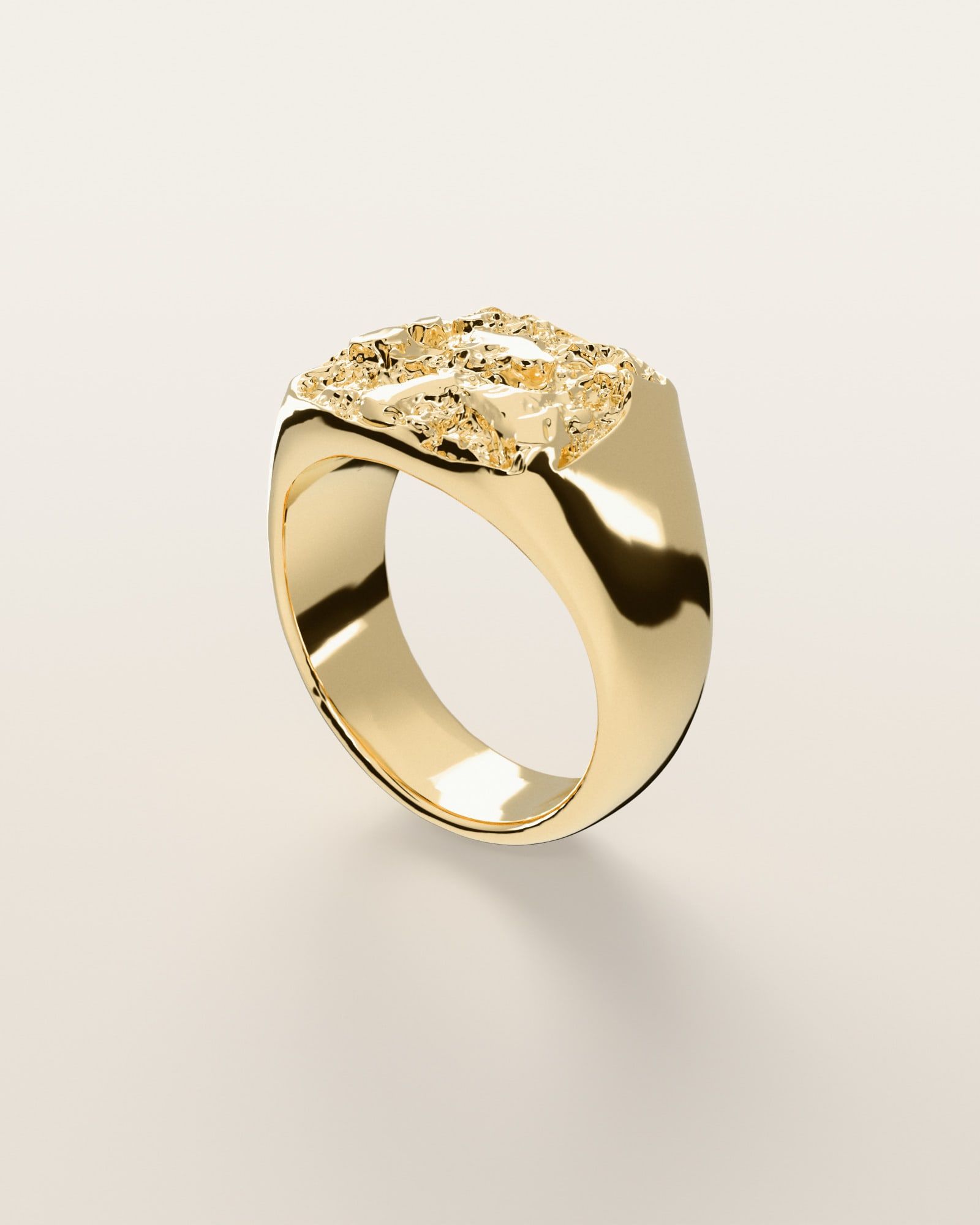
To put Webb’s 48 grams on a scale you can picture: our No. 014 The Block, in solid 14K gold at US size 10, weighs from 20.1 g (estimated). The pure gold in about 4 of those rings would coat the whole Webb mirror. The weight of a solid ring is what makes the difference between a gold surface and a gold object, and it is the first number to ask for. The solid vs hollow nugget ring guide explains how to read it.
Our rings in solid 14K gold, each with its estimated weight: 14K gold nugget rings.
More on the same subject: gold science.
Sources
- NASA Science, Webb FAQs (full): why the mirror is gold-coated and how much gold is used (100 nm, 25 m², 19.3 grams per cm³, 48.25 grams, golf ball 45.9 grams, glass overcoat); mirror 6.5 m; L2, 1 million miles; 50 K; hair about 100 micrometers; first galaxies and infrared. Read 18 October 2026.
- NASA Science, Webb’s Mirrors: segments of 1.32 m, beryllium, 1,000 angstroms of gold, vacuum vapor deposition by Quantum Coating Incorporated, glass layer, Brush Wellman, Axsys Technologies, SSG/Tinsley, cryogenic tests at Marshall, final polish June 2011. Read 18 October 2026.
- J. Rigby et al., The Science Performance of JWST as Characterized in Commissioning, Publications of the Astronomical Society of the Pacific 135:048001 (2023), section 4.7 (micrometeoroids, segment C3). Read 18 October 2026.
- Space Telescope Science Institute, JWST Cycle 5 Proposal Selection, STScI Newsletter 2026, vol. 43, issue 1 (2,930 proposals, 254 accepted, 1 in 11.2; Cycle 5 from July 1, 2026). Read 18 October 2026.
- Federal Trade Commission, Guides for the Jewelry, Precious Metals, and Pewter Industries, 16 CFR Part 23, §§ 23.3 (gold plate, gold electroplate, heavy gold electroplate) and 23.4 (vermeil). Read 18 October 2026.
- H. Cohn, McGill Office for Science and Society, The Gold Plating on the James Webb Space Telescope is Much Thinner than Human Hair (12 July 2022; launch on December 25, 2021). Read 18 October 2026.