Guide · Buying
Solid vs hollow nugget rings: how to tell
The top of a nugget ring is the part everyone photographs. How much gold you bought is decided underneath, inside the band, under the head: that is where a ring is solid metal or a shell.
Are nugget rings hollow?
Some are. A nugget head is a thick block of metal and gold is expensive, so there is a reason to take metal out of it. Sellers rarely say so: in the listings we read, none described a nugget ring as hollow or open-backed. The clue is a weight that is low for the width of the face, and the proof is a photo of the inside.
A member of the Pearl-Guide forum put the reason plainly: a ring made hollow at the back uses less gold, so it can be made and sold for less.
Two kinds of hollow
A hollow center. The metal forms a closed shell with air inside. You can’t see the cavity from anywhere. Tubing and some hollow chains are made this way.
An open back. The head is cast as a shell, and its underside, inside the band, is left open or scooped out. You can see it by looking into the ring. Some light signet and nugget rings are built like this.
What the law says
The FTC’s Jewelry Guides cover the first case. An item of karat gold with a hollow center may mislead buyers unless the hollow center is disclosed next to the karat mark, for example “14 Karat Gold-Hollow Center”, and it should not be marked or described as solid.
The note does not mention open backs. An open-back ring can be 14K all the way through and correctly stamped 14K. So on a nugget ring, “solid” in a listing usually speaks about the alloy, not about metal under the head. Ask.
Why it matters
It bends and breaks. A shell under a heavy-looking top is thin metal. Breakage is the most common one-star complaint on light nugget rings: one snapped in two after three weeks, another broke after two wears, a third was called “very bendy”. Not all of those rings were hollow; all of them were light for their size.
It is less comfortable. The open edges of a scooped-out back press into the finger. The same Pearl-Guide member wrote that hollow rings left grooves in their finger.
It sells for less. A gold buyer pays for weight and purity. Less metal, less money back; more on that in are gold nugget rings worth anything.
Four checks before you buy
1. Ask for a photo of the inside
The most direct check. Ask for a photo looking into the ring, straight at the underside of the head. A solid ring shows a smooth, continuous inner band. An open back shows a pocket, a cut-out or ribs. If the seller won’t send one, that is an answer.
2. Compare the weight with the face
A solid head 15 mm across is a lot of metal. Two public 14K listings with a face of 15 to 16 mm, as listed on 8 October 2026, next to ours:
| Ring | Face | Size | Listed weight |
|---|---|---|---|
| Direct Source | 16.4 mm | US 9.5 | 10.8 g |
| Jahda wide face | 14.8 mm | US 9.25 to 10 | 9.1 g (average) |
| No. 014 The Block (ours) | 15.3 mm | US 10 | 21.4 to 22.2 g |
That doesn’t prove a lighter ring is hollow: its head may be lower and its band thinner. It shows how far apart rings with a similar face can be. When a wide face weighs only a few grams, go back to check 1.
3. Weigh it and test its density
Once you have the ring, a scale that reads to 0.01 g and a cup of water give you its density. A closed hollow center pulls the result below the alloy’s figure, because the air counts in the volume and weighs nothing. An open back doesn’t change the result, since the water fills it, so check 1 is the test for that. Step by step, with the figures for each metal: how to tell if a nugget ring is real.
4. Get it in writing
Ask two questions by message, so the answers are on record: “Is the head solid under the top, with no cavity or open back?” and “What does it weigh in my size?” A listing that says “solid 14K” answers a different question.
What we do
I design the rings in 3D, and each file is checked for any air pocket under the head before it goes to the workshop; a pocket is filled with metal before casting. Our 14K gold and sterling silver rings are cast solid, with no hollow center or scooped-out back under the head. Our vermeil is solid 925 sterling silver covered with a layer of 18K gold. On the master file of The Block, the thinnest wall around the middle of the ring measures 1.85 mm.
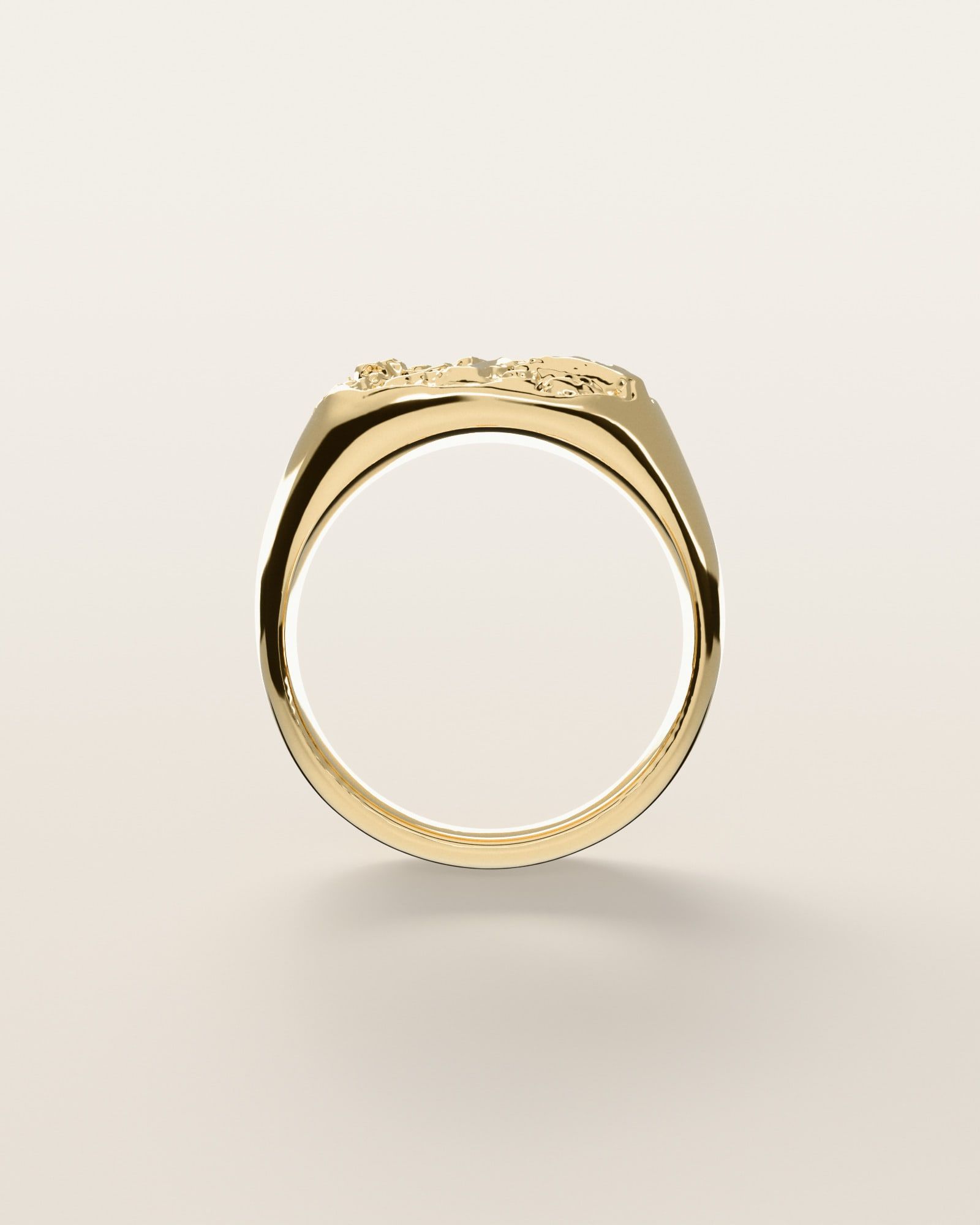
Every ring page shows the 14K weight range at your size before you order. The weight is estimated from the 3D file we cast from. A cast ring comes out 2 to 3% lighter than its file, and the range shown already includes this. Your price is fixed when you pay and is never adjusted to the weight; your certificate records the actual weight.
Everything else to check before you buy is in the nugget ring buying guide.
Sources
- FTC, Guides for the Jewelry, Precious Metals, and Pewter Industries, 16 CFR 23.3, note to paragraph (c)(1) (hollow centers; not marked or described as solid).
- Pearl-Guide forum, thread “The Bain of Sellers - Buyer Remorse”, post on hollow-back rings.
- One-star reviews read on 8 October 2026: NoltersGold listing (snapped after three weeks), BOSPHORUSGOLD listing (broke after two wears), Fran & Co 14K classic (“very bendy”).
- Listings read on 8 October 2026 and checked again on 17 October: Direct Source (14K, 16.4 mm face), Jahda wide face (14K, face 14.8 by 20.3 mm, average weight by size).
Our weights come from the volume of each design’s 3D file and the density of the metal, scaled to US 10. The air-pocket check is our own script, run on the files before casting.