Guide · Buying
How to tell if a nugget ring is real
“Nugget” names a shape, so it says nothing about the metal. Below: which home tests can rule a ring out, and when to ask for a professional XRF reading.
Are gold nugget rings real gold?
The word “nugget” only describes the shape. A nugget ring can be solid gold, gold over sterling silver, or gold-plated base metal. To know which one you have, read the quality mark and the maker’s mark inside the band, then test its density at home or ask a jeweler for an XRF reading.
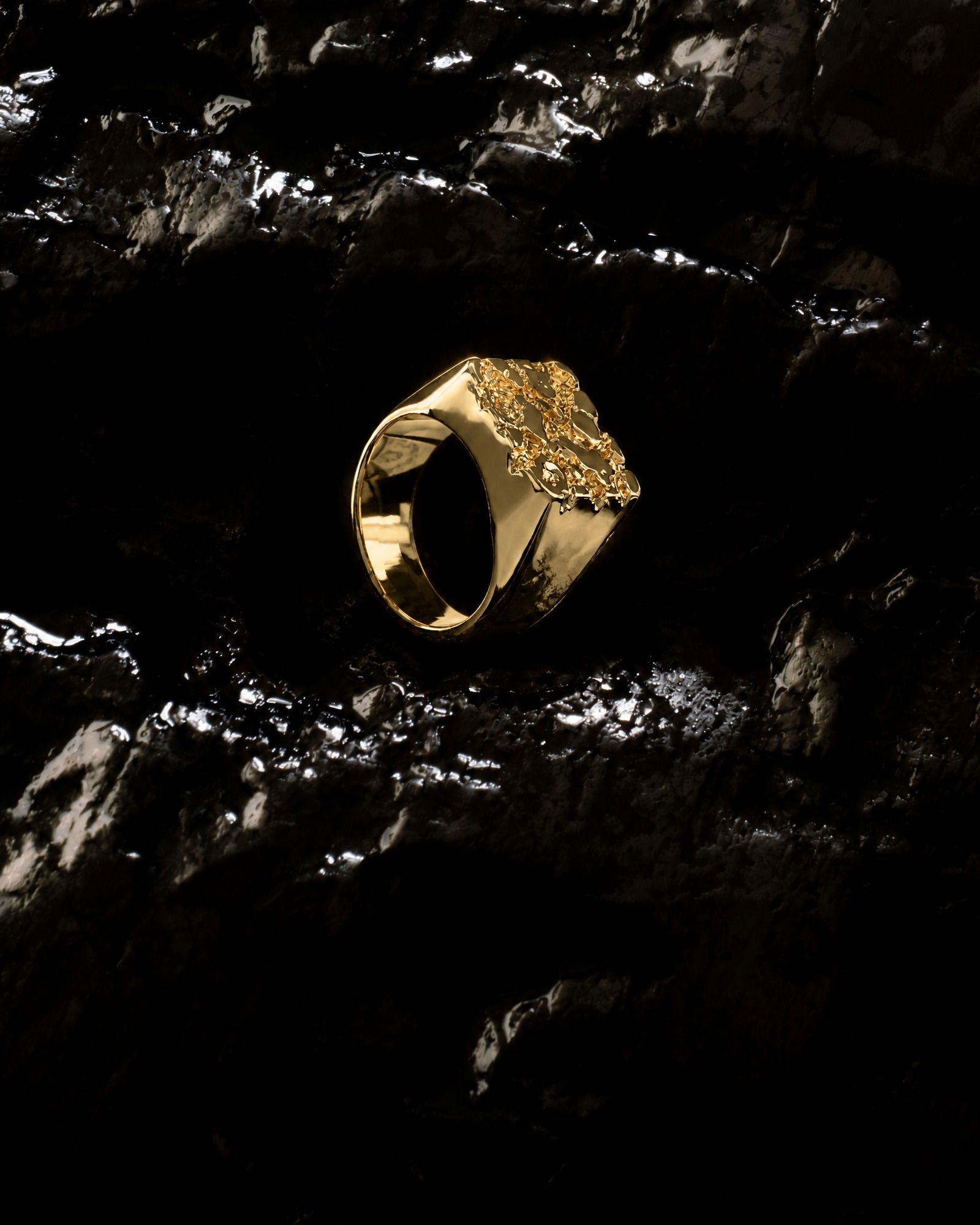
Ours are cast to order in 14K yellow gold, in vermeil or in sterling silver. The nugget texture is part of the design. The metal is a jewelry alloy; none of it is a natural nugget.
Are natural gold nuggets pure gold?
No. A US Geological Survey review of native gold says it commonly contains 10 to 15% silver, and cites a 1940 study noting that pure gold has not been found in nature. The purest native gold that study reported came from the Great Boulder mine in Western Australia: 999.1 parts per thousand.
Can gold be fake if it says 14K?
Yes. A stamp is a claim by whoever struck it. Federal law bars shipping gold marked finer than it is, beyond a tolerance of 3 parts per thousand (7 counting solder). It also requires the maker’s trademark or name as close as possible to the mark. If there is no maker’s mark, the FTC’s advice is not to buy.
A 14K quality mark can read 14K, 14KT, 14 Karat or 585, the parts-per-thousand standard for 14 karat. Federal law requires the responsible person’s name or a qualifying trademark, applied in the same way, at least as large and as close as possible to the quality mark. The trademark must be registered in the US or applied for within 30 days after the marked item enters commerce or is imported; a symbol alone does not establish compliance.
Plating can fake a karat too. GIA’s lab in Carlsbad reported a rose gold piece submitted as 14K that was 9K under a 13.5K yellow gold layer.
Can fake silver have a 925 stamp?
Yes, for the same reason: anyone can strike 925. The FTC Guides reserve “sterling” for silver of at least 925 parts per thousand. The Stamping Act allows a shortfall of 4 per thousand (10 counting solder) and bans “sterling” and “coin” on silver-plated inferior metal. A gold coating over a sterling silver base is different. As with gold, look for the maker’s name or trademark beside the 925.
Vermeil has a sterling silver base and at least 10K gold on all significant surfaces, with reasonable durability and a minimum thickness throughout equivalent to 2.5 µm of fine gold. Any intervening base-metal layer must be disclosed. Our vermeil is 925 sterling silver covered with a layer of 18K gold; your order details identify the selected metal.
How to test gold at home
Read the marks, try a magnet, then measure density with water and a precise scale. These checks can rule a ring out; none of them proves it is the karat stamped inside. Vinegar, toothpaste and ceramic scratch tests are unreliable, and the scratch test takes metal off your ring. For a firm answer, get an XRF reading.
1. Read the marks
Use a loupe or your phone’s camera zoom on the inside of the band. Look for a quality mark (14K, 585 or 925) with a maker’s mark next to it. A quality mark with no maker’s mark is the warning sign the FTC points to.
2. The magnet test, and its limits
Gold isn’t magnetic. A ring that clings to a magnet has a magnetic metal in it, such as iron, nickel or cobalt: that is a fail. A ring that ignores the magnet hasn’t passed anything. Silver, copper and aluminum ignore magnets too, so a gold-plated ring made of them gets through.
3. Density: the water test
Gold is heavy for its size, and each alloy has its own density. You need a scale that reads to 0.01 g.
- Weigh the ring dry, in grams. Call it A.
- Put a cup of water on the scale and press tare.
- Hang the ring from a thread so it sits fully underwater without touching the cup. The new reading is B: the weight of the water the ring pushes aside, which in grams is close to its volume in cubic centimeters.
- Divide A by B and compare.
| Metal | A ÷ B (g/cm³) |
|---|---|
| Fine gold (24K) | 19.3 |
| 14K yellow gold | about 13.1 |
| Sterling silver (925) | about 10.4 |
Alloy recipes vary, so expect small differences. A 10 g ring in 14K pushes aside only about 0.77 g of water, which is why a scale that reads to 0.1 g is too coarse for this test. Stones, hollow parts and air bubbles lower the result. A vermeil ring reads like sterling silver, because its gold layer is microns thick.
Can vinegar tell if gold is real?
No. Vinegar is a weak acid: the FDA expects at least 4 grams of acetic acid per 100 mL. It only touches the surface. A gold-plated ring has gold on all its significant surfaces, which the FTC requires before anything can be called plated. So a plated ring passes the vinegar test, and passing proves nothing about the metal underneath.
Does the toothpaste test work?
No. Toothpaste is a mild abrasive paste, usually hydrated silica or calcium carbonate, made to polish teeth and lift stains. Rubbed on a ring, it polishes the surface, and the surface is all it reaches. A gold-plated ring comes through the same way a solid gold one does, so the result tells you nothing.
Is the ceramic scratch test safe?
No. Rubbing a ring on unglazed ceramic copies the jeweler’s touchstone, where GIA’s method rubs off “a thin, but clearly visible, metal sample” from a hidden spot and reads it with nitric acid. At home there’s no acid, a plated ring leaves a gold streak from its gold layer, and every streak is metal taken from your ring.
When to ask for an XRF test
XRF (X-ray fluorescence) reads a metal’s composition without taking metal off. The Goldsmiths’ Company Assay Office in London says it gives the fineness in under 30 seconds. GIA calls it one of the most reliable metal tests in the jewelry trade, with a known weak spot: gold plating over lower-karat gold can read high.
For that reason GIA says a microscope check is essential, looking for discoloration, plating damage or marks from earlier destructive tests. The London assay office says it sometimes has to remove the surface layer to read the alloy underneath. Ask for XRF at a jeweler or lab that has an analyzer.
Can a ring be 100% gold?
Close, never exactly. 24 karat is fine gold, marked 999 (99.9%) in UK hallmarking standards; the US Mint’s 24-karat American Buffalo coin is .9999 fine. A 24K ring can be made, but the FTC notes pure gold is soft, which is why jewelry gold is mixed with other metals. Our gold rings are 14K (58.5%).
For how 14K, vermeil and sterling silver compare in weight, gold content and price, see 14K gold vs vermeil vs sterling silver.
What you can check on our rings
Your order details identify the selected metal. A stamp is not independent proof of composition. Each ring page shows the ring’s weight range in every metal and size before you order, from the 3D file we cast from. For 14K, the page also shows the gold price used and its date.
When the ring arrives, you can weigh it and run the density test above against the metal you chose. If you later sell or trade it in, here is how its gold is valued.
Sources
- National Gold and Silver Stamping Act: 15 U.S.C. 294 (false fineness marks), 15 U.S.C. 295 (gold tolerance: 3 parts per thousand, 7 including solder), 15 U.S.C. 297 (trademark or name next to the quality mark; no “sterling” or “coin” on silver-plated inferior metal).
- FTC, Guides for the Jewelry, Precious Metals, and Pewter Industries, 16 CFR 23.3 (gold marks, plating on all significant surfaces) and 16 CFR 23.5 (sterling at 925, silver tolerances).
- FTC Consumer Advice, Buying Platinum, Gold, and Silver Jewelry (maker’s mark next to the karat mark; 24K is soft).
- Hallmarking Act 1973 (UK), Schedule 1 (14 carat is 585) and British Hallmarking Council, guidance on fineness (2014: 999 is fine gold, 24ct).
- C. Bautista, Gold-Plated Gold, Gems & Gemology Lab Notes, Summer 2025 (GIA).
- GIA, Bench Tip #9: Use the Touchstone Method for Testing Purity in Karat Gold.
- The Goldsmiths’ Company Assay Office, Our hallmarking methods (XRF).
- University of Illinois Physics Van, Is Gold Magnetic? and How do you know it’s silver? (density by displaced water); HyperPhysics, Georgia State University, Magnetic Properties of Solids.
- Stuller, Where can I find the specific gravity of various materials? (2012): 14K yellow 13.07, sterling 10.40.
- R. S. Jones and M. Fleischer, Gold in minerals and the composition of native gold, USGS Circular 612 (1969).
- U.S. Mint, American Buffalo Coins (24-karat, .9999 fine).
- FDA, CPG Sec. 525.825 Vinegar (4 grams of acetic acid per 100 mL).
- A. T. Hara and C. P. Turssi, “Baking soda as an abrasive in toothpastes,” Journal of the American Dental Association 148(11), 2017, doi:10.1016/j.adaj.2017.09.007.
The 0.77 g figure is our arithmetic: 10 g ÷ 13.07 g/cm³ = 0.765 cm³ of water displaced.