Guide · Buying
Solid gold vs gold plated: what makes a nugget ring look rich
I design our nugget rings, and the ones that look rich on the hand share six things. None of them is the nugget shape itself, and each one can be seen on a listing, or asked of a seller, before you pay.
What makes a nugget ring look rich?
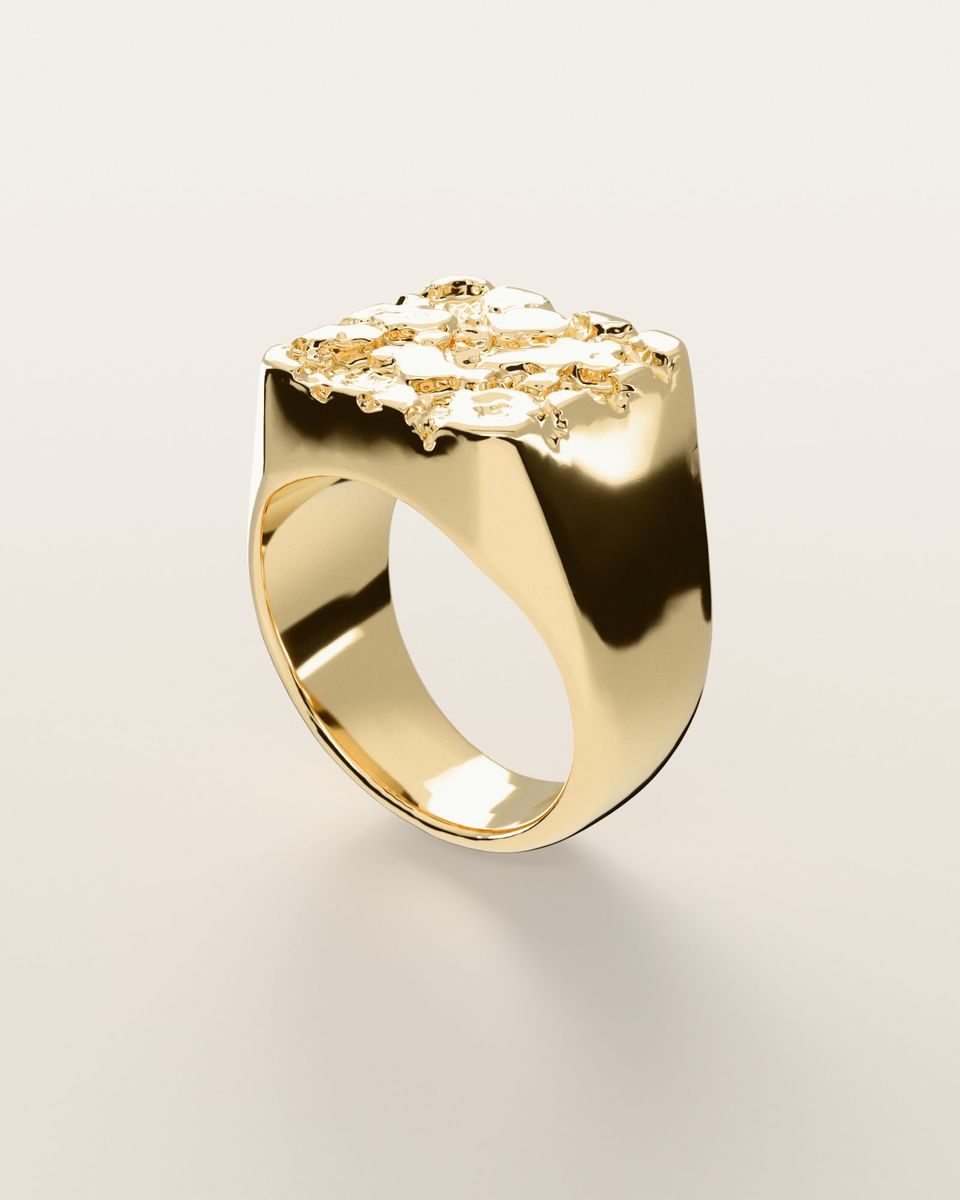
Six things you can see: the color, the band, the back, the relief, the weight and the polish. When all six are right, the ring reads as one piece of gold from the top, from the side and from the palm.
Each one is below, with what to look at and why it works, then our own figures for four rings. Every question to ask a seller is in our nugget ring buying guide.
Solid gold vs gold plated: what is the difference?
A solid gold ring is the same gold alloy from the surface to the inside of the band, so the color you see is the metal itself. A gold plated ring is another metal with a layer of gold on its surface.
The FTC’s Jewelry Guides give each one its own words. A ring made all the way through of a gold alloy is described with its karat right before the word gold, as in “14K gold”. A plated ring is described with a term such as “gold plate” or “gold electroplate”, next to the karat of its layer. So the karat and the word gold, side by side, are the first thing to read on a listing.
Vermeil is a layer of gold over sterling silver; how sterling silver compares with 14K is in 14K gold vs sterling silver. Our rings are solid 14K gold, solid 10K gold or sterling silver, the same metal all the way through. 10K is solid gold too, at a lower karat; the two side by side are in the guide 10K vs 14K gold nugget ring.
How should the band look under a big head?
Wide and thick at the bottom, in proportion to the head, so the ring reads as one heavy piece from the side and from the palm. The band is the part people see when your hand rests on a table or holds a glass.
Two numbers describe it: the width of the band at the bottom of the ring, and the thickness of its metal. Both are worth asking for, in millimeters.
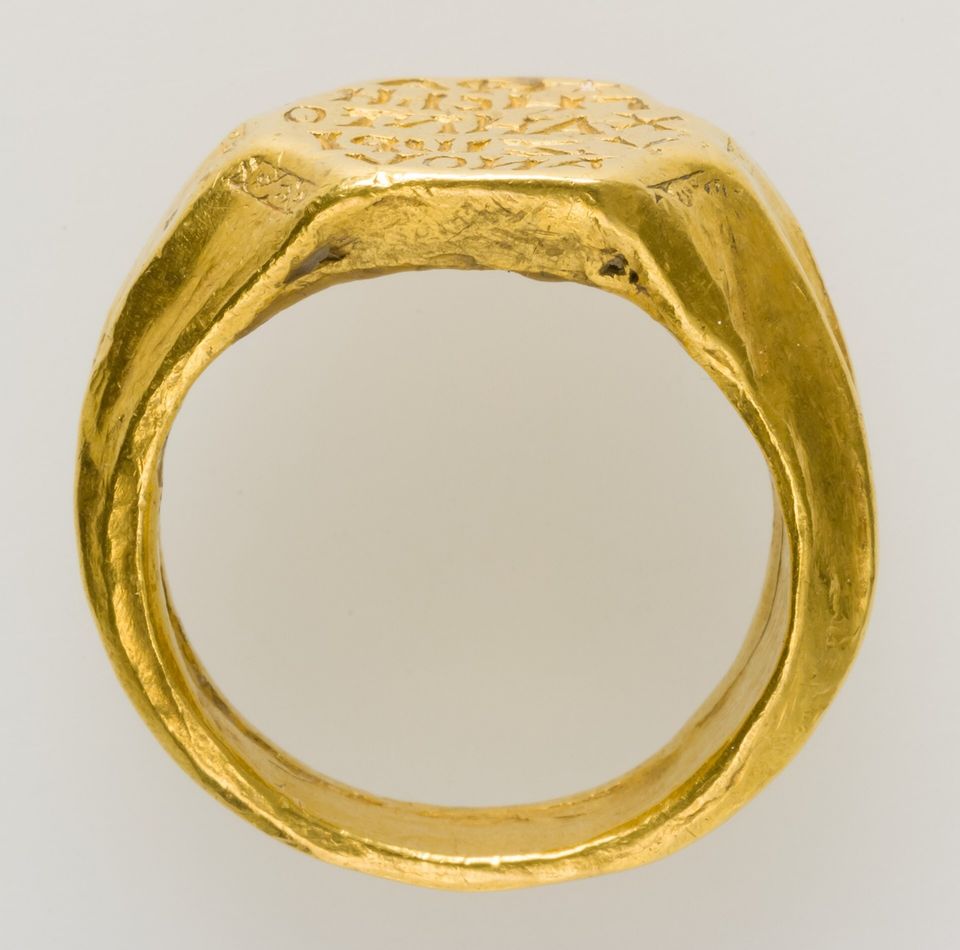
Our No. 502 Bullion carries its 16.4 mm face on a band 7.2 mm wide at the bottom. Its metal is at least 2.0 mm thick, all the way round.
What should you see under the head?
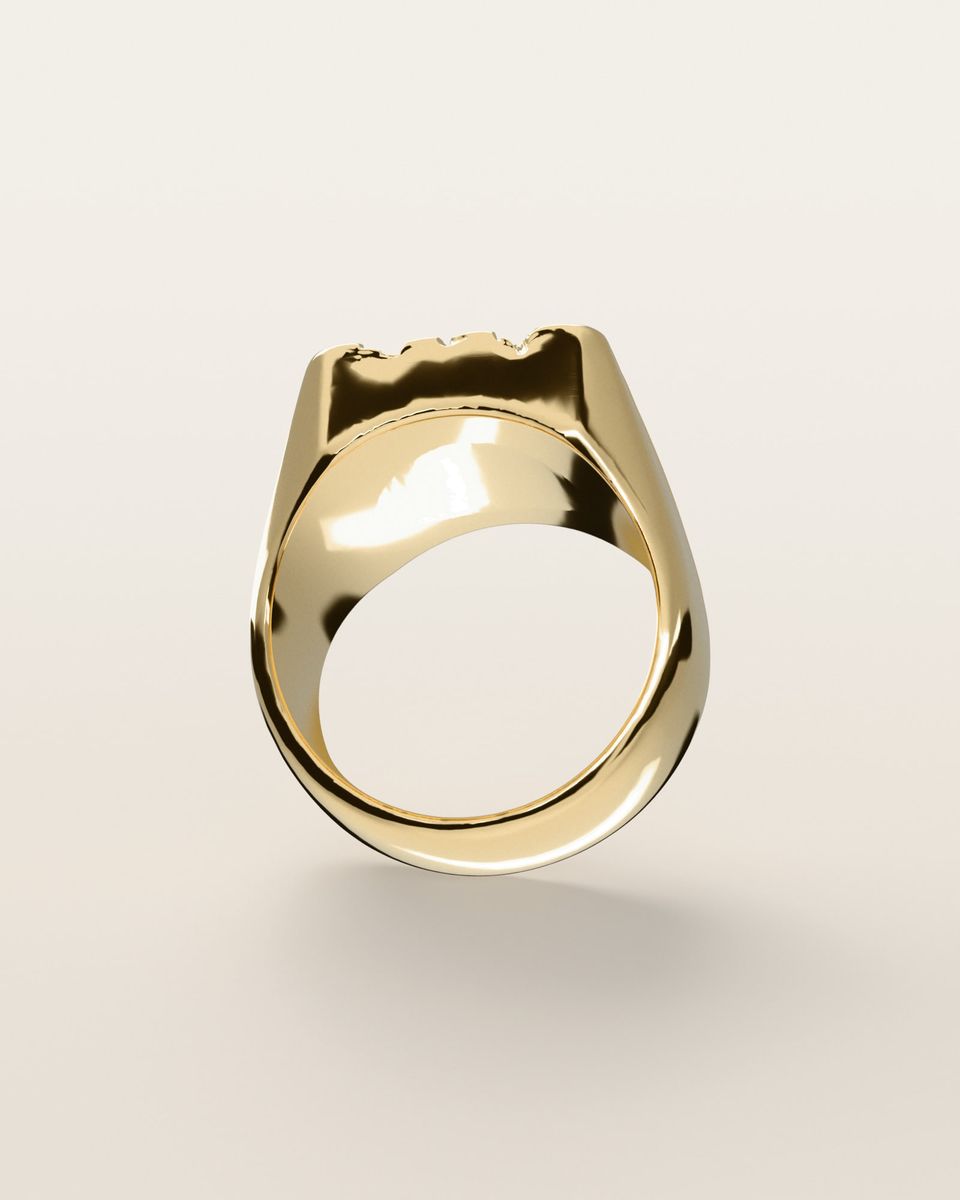
The inside of the band, smooth and unbroken under the head, in the same gold as the top. A picture looking into the ring shows it at a glance: the metal you see on the face goes all the way through.
That picture is worth asking for when a listing shows only the top. In the FTC’s buyer advice, “solid gold” means the piece is not hollow inside. How a solid ring is built, what the FTC says, and four checks are in the guide solid vs hollow nugget ring.
What does a natural nugget texture look like?
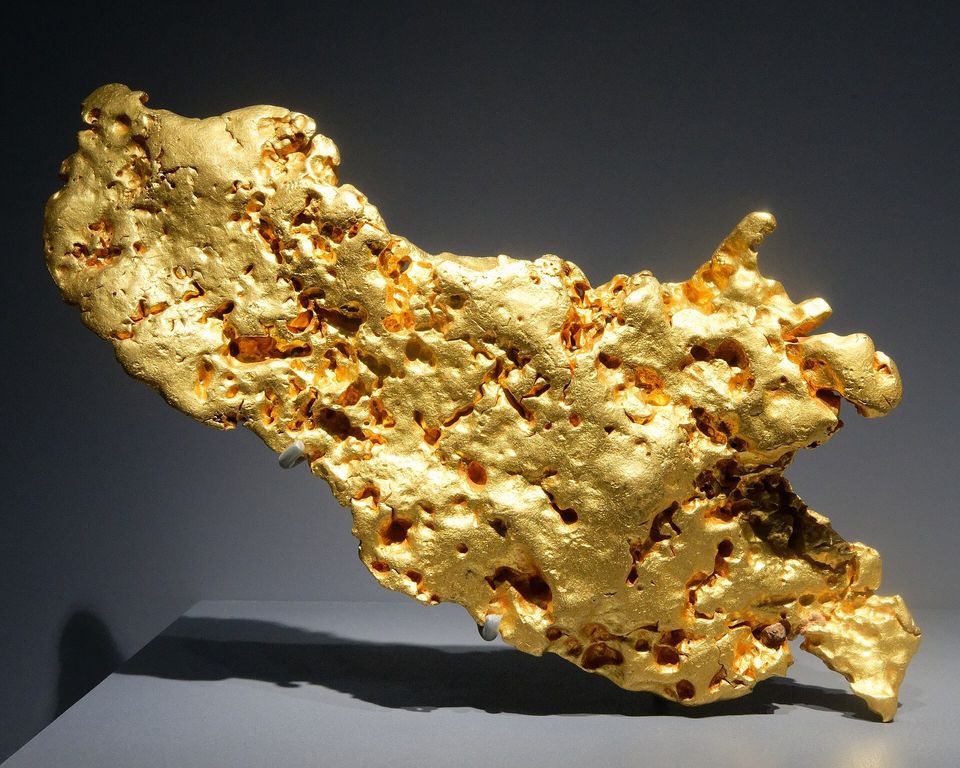
Like a real gold nugget: lumps of every size, deep pockets between them and cracks that wander, with no pattern that comes back around the band. That irregular relief is what makes a ring read as a piece of gold rather than a print of one.
Look at a nugget in a museum case, like the one below from Kalgoorlie-Boulder in Western Australia: rounded swellings, deep pockets, a ridge that runs off one edge. That is what I look for when I draw a ring: our reliefs are designed from references of real gold nuggets. Turn No. 011 Channel in the hand and no two lumps of its dome are the same.
Does the weight suit the size of the face?
On a solid gold ring it does: gold is one of the densest metals in a jewelry case, so a wide gold face comes with real weight in the hand. The weight in grams, at your size, is the number that shows it.
Stuller, a jewelry supplier, lists a specific gravity of 13.07 for 14K yellow gold and 10.40 for sterling silver. Our No. 014 The Block has a face 15.3 mm wide and weighs from 20.1 g in 14K at US size 10.
What nugget rings of each size weigh is in the guide how much does a nugget ring weigh. How to tell gold from a gold color is in how to tell if a nugget ring is real.
What gives a polished nugget its shine?
Its relief: the high points catch the light and the hollows between them stay darker, so the head flashes as the hand moves. A deep relief gives the polish more to work with, and the head reads as a nugget from every angle.
So look at the head from the side as well as from the top. You want high points that stand clear of the hollows between them, and hollows that are clean. Our No. 011 Channel is a wide dome of nugget relief crossed by a smooth polished groove, and No. 021 Crest rises 6.2 mm above the finger. I design each ring; our workshop casts it in your size and polishes it by hand, the high points polished and the recesses cleaned.
What should you check before you buy?
Six things a seller can show you: the karat, the band width, the inside, the texture, the weight at your size and the head from the side. Each one is a word, a number or a picture.
Here are those numbers for the four rings at the end of this guide, at US size 10.
| Ring | Face | Band at the bottom | Wall | 14K weight |
|---|---|---|---|---|
| No. 502 Bullion | 16.4 mm | 7.2 mm | 2.0 mm | from 30.6 g |
| No. 014 The Block | 15.3 mm | 7.0 mm | 1.9 mm | from 20.1 g |
| No. 011 Channel | 14.7 mm | 6.8 mm | 1.5 mm | from 22.9 g |
| No. 021 Crest | 17.5 mm | 6.7 mm | 2.2 mm | from 29.7 g |
In sterling silver Bullion is $445. Also in solid 10K and 14K gold, one price per metal at every size; in 14K it weighs from 30.6 g at US size 10. Not engraved? Return it within 60 days of delivery for a full refund. Engraved rings are final sale, except for a defect. Wrong size? We resize it for free.
Quick answers
Is 14K gold solid or plated?
A ring sold as 14K gold is 14K alloy all the way through. Under the FTC Jewelry Guides, a plated ring is described with a term such as “gold plate” or “gold electroplate”, next to the karat of its layer.
What does “solid gold” mean on a ring?
The same gold alloy from the surface to the inside of the band, with its karat written right before the word gold, as in “14K gold”. In the FTC’s buyer advice, “solid gold” also means the piece is not hollow inside.
Everything else to check before you buy is in the nugget ring buying guide.
Sources
- FTC, Guides for the Jewelry, Precious Metals, and Pewter Industries, 16 CFR 23.3 (paragraph (b)(2): a product made throughout of a gold alloy is described with its karat right before the word gold; (b)(5) and (b)(8): gold plate and gold electroplate described with the karat of the layer), read 8 November 2026.
- FTC Consumer Advice, Buying Platinum, Gold, and Silver Jewelry, updated November 2024 (“solid gold” means the item isn’t hollow; vermeil is gold over sterling silver), read 8 November 2026.
- Stuller, Where can I find the specific gravity of various materials? (2012): 14K yellow 13.07, sterling 10.40, read 8 November 2026.
- The Metropolitan Museum of Art, Gold Signet Ring of Michael Zorianos, 18.145.42: gold, about 1300, 25 g, public domain (CC0).
- Muséum national d’Histoire naturelle, Paris, Galerie de Minéralogie et de Géologie: native gold nugget from Kalgoorlie-Boulder, 5.024 kg, as described on its Wikimedia Commons page, photo by Marie-Lan Taÿ Pamart (2020), CC BY 4.0.

Our figures come from the catalog: face and band widths, the wall thickness and the 14K weight at US size 10.