Guide · Famous nuggets
The Welcome Stranger: the largest gold nugget on record
On February 5, 1869, two miners in Victoria, Australia, dug up a lump of gold so heavy that no scale in the nearest town could weigh it. Four days later it had been cut into pieces on a blacksmith’s anvil. The gold was melted, and nobody had made a cast or taken a photograph first.
What was the Welcome Stranger nugget?
The Welcome Stranger was a mass of gold found near Moliagul, Victoria, on February 5, 1869, by John Deason and Richard Oates. Melted down, it gave 2,268 troy ounces of gold, and more than 2,280 ounces counting the pieces the finders gave away: about 71 kilograms, or roughly 156 pounds. It is the largest alluvial gold nugget on record.
The best record of it is a report printed the same year by R. Brough Smyth, Victoria’s Secretary for Mines. The nugget was about 21 inches long and 10 inches thick, “mixed with quartz,” but “the great body of it was solid gold.” It lay in loose, gravelly loam over stiff red clay, within two feet of the sandstone bedrock, and was “barely covered with earth.”
Alluvial means it was found in loose ground, not dug out of a vein in solid rock. That distinction decides which record it holds, and it comes back below.
How heavy was the Welcome Stranger?
No one weighed it whole, so every figure is a reconstruction. The melted gold weighed 2,268 ounces 10 pennyweights 14 grains, and Brough Smyth put the total, with the pieces given away, at 2,280 ounces. Later plaques give 2,316 and 2,332 ounces.
The ounces are troy ounces, the unit gold is still weighed in. One troy ounce is 31.1034768 grams, about 10 percent more than the ounce on a kitchen scale. So 2,280 troy ounces come to about 70.9 kilograms, or 156 pounds: our arithmetic, from the figures above.
The real weight was higher, and it can’t be recovered. Before they took it to the bank, the finders put the nugget in the fire in their hut to burn off the quartz and make it lighter to carry. Brough Smyth noted that more than a pound of specimens was broken off before the bank manager saw it, “and what was broken off in the hut whilst it was on the fire, it is useless to guess.” Local accounts say about 26 kilograms of quartz came away and was crushed at a nearby battery for the gold still in it.
The gold itself was very fine. The assayer, a Mr. Birkmyre, found it to be 98.66 percent pure gold, the rest mostly silver and iron. That is far purer than the 14K gold of a ring, which is 14 parts gold in 24.
Who found the Welcome Stranger, and how?
Two Cornish miners, John Deason and Richard Oates, working a claim at Moliagul, about 12 miles from Dunolly. Deason struck it with his pick at the roots of a tree, just below the surface, on a slope called Bulldog Gully.
Both men had worked the tin mines of Cornwall: the 1851 census lists them there, according to the BBC’s account of the find’s 150th anniversary. Deason sailed for Australia in 1853 and Oates a year later. They reached Moliagul in 1862 and spent seven years making a modest living before the strike.
Deason later described the moment: “I tried to prise the nugget up with the pick but the handle broke. I then got a crowbar and raised the nugget to the surface.” By the local accounts, the two men covered it again and kept working, so as not to draw the neighbors, until they could move it without being seen.
The local paper, the Dunolly & Bet Bet Shire Express, gave its verdict on February 12, 1869: “We are glad that the monster has fallen to the lot of such steady and industrious men.”
Why was it broken on an anvil?
Because it was too big for the scales at the London Chartered Bank in Dunolly, where the finders took it to sell. The town blacksmith, named in local histories as Archie Walls, cut it into pieces on his anvil, and the bank weighed the pieces. The plaque now on the anvil gives the date: February 9, 1869.
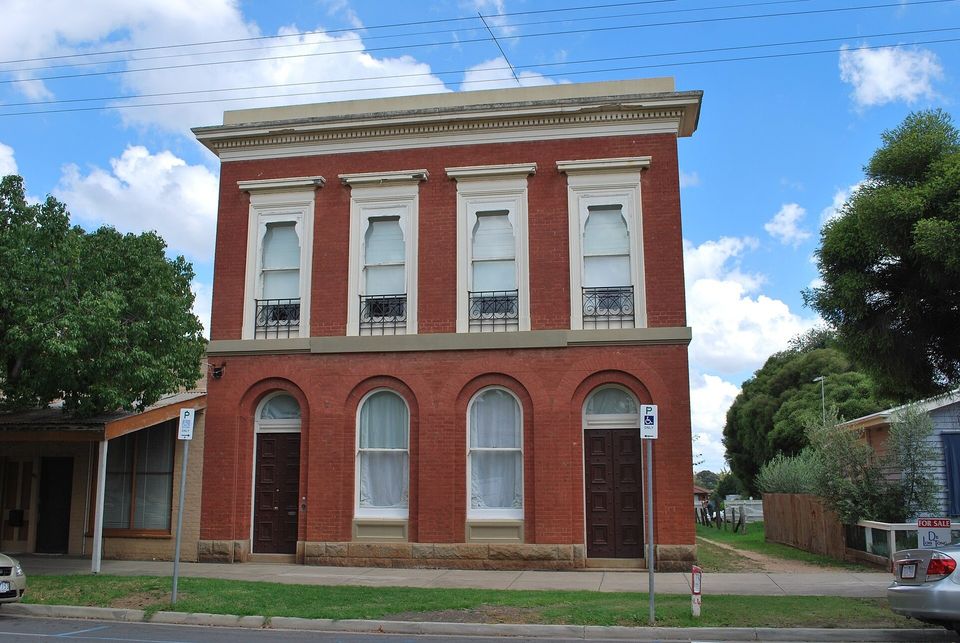
The bank bought the gold. The finders were paid about £9,381, according to Australian Geographic. Brough Smyth gives the value of the gold at the Bank of England as £9,534, and the obelisk later raised at the site says £9,553. The three figures are close; none of them is a price for the nugget as an object, because no one bought it as one. It was bought as metal, and the metal was melted.
That was the normal fate of big nuggets in the 1860s. The Welcome Nugget, found at Ballarat in 1858 and only a little lighter at about 68 kilograms, was sold, shown in London, and bought by the Royal Mint in 1859, which turned it into gold sovereigns.
Why does nobody know its exact shape?
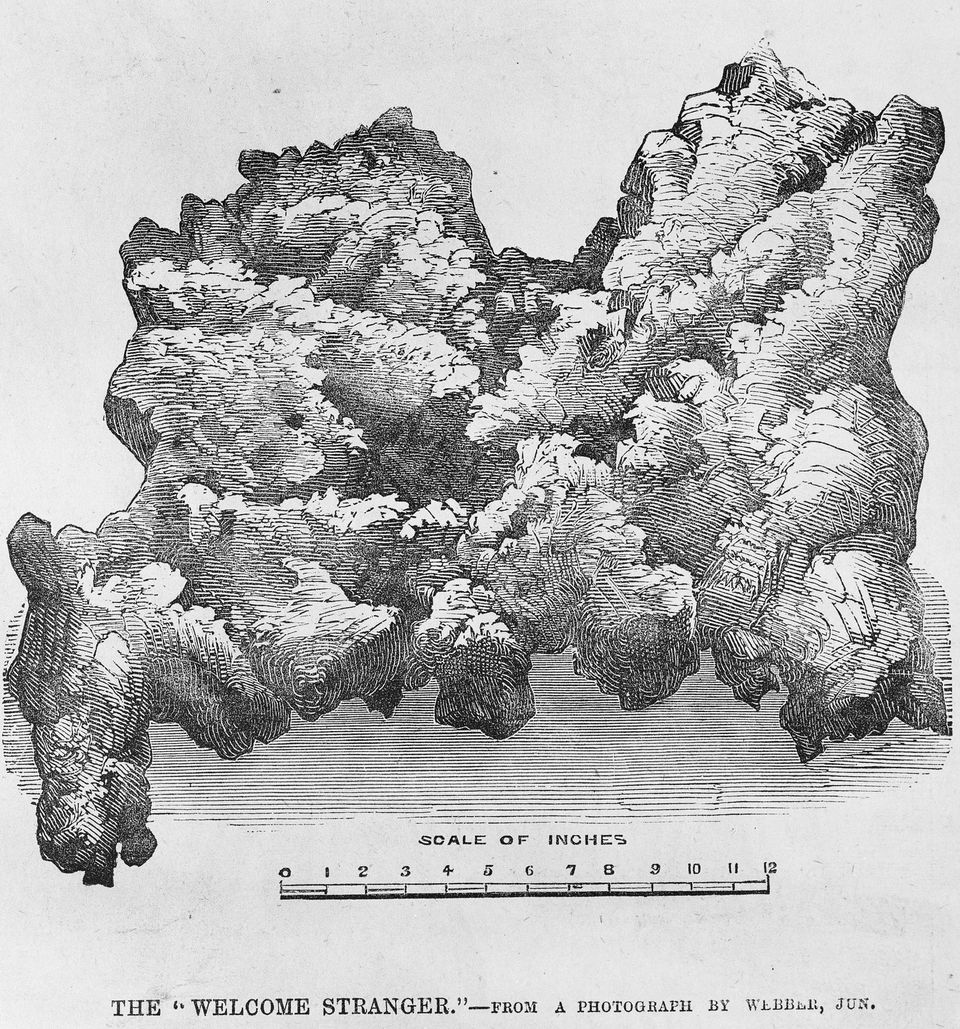
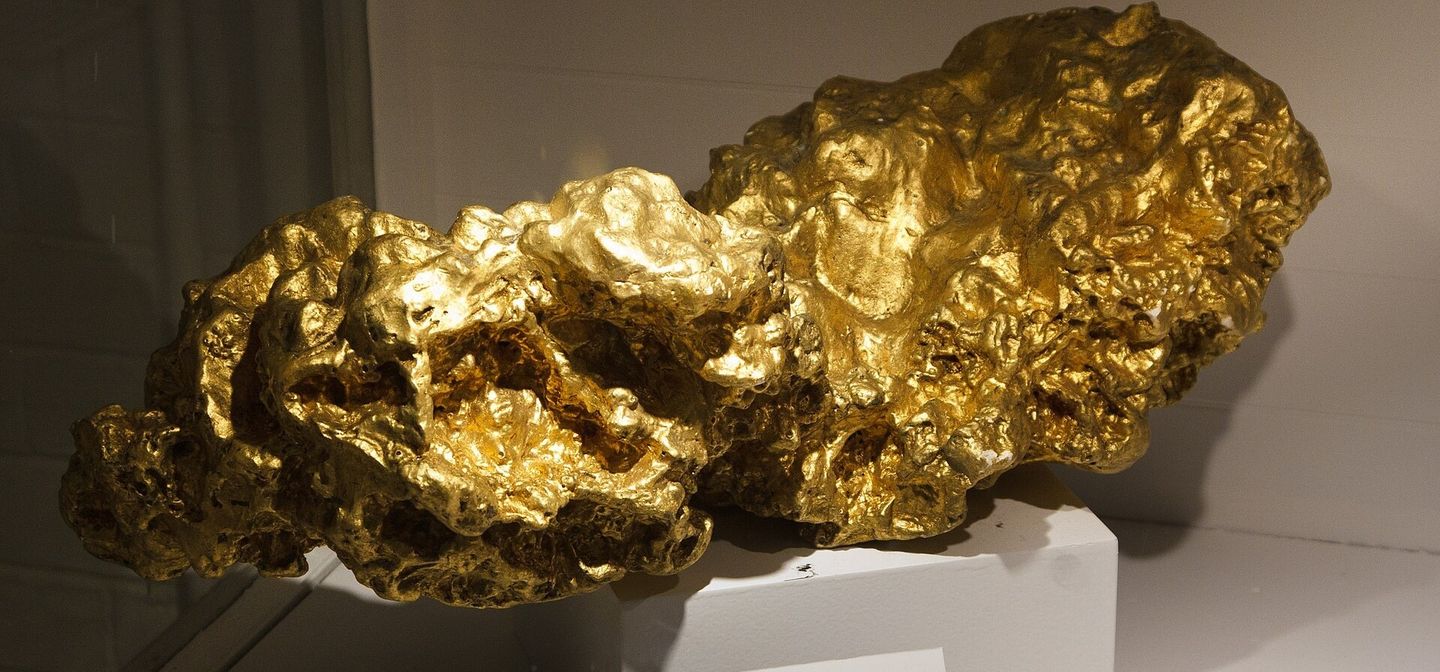
Because it was cut up before anyone made a cast or took a photograph of it. Every picture and replica comes from sketches. Brough Smyth wrote in 1869: “It is to be regretted that a cast or a photograph was not made.”
The engraving in his report was reduced from a large sketch by Francis Fearn, which the discoverers signed off as a fair likeness. Brough Smyth compared it with a photograph of another sketch, drawn from memory by Charles Webber, and judged that it showed the outside of the nugget “not incorrectly.” The newspaper engraving above credits a photograph by Webber: a photograph of a drawing, not of the gold.
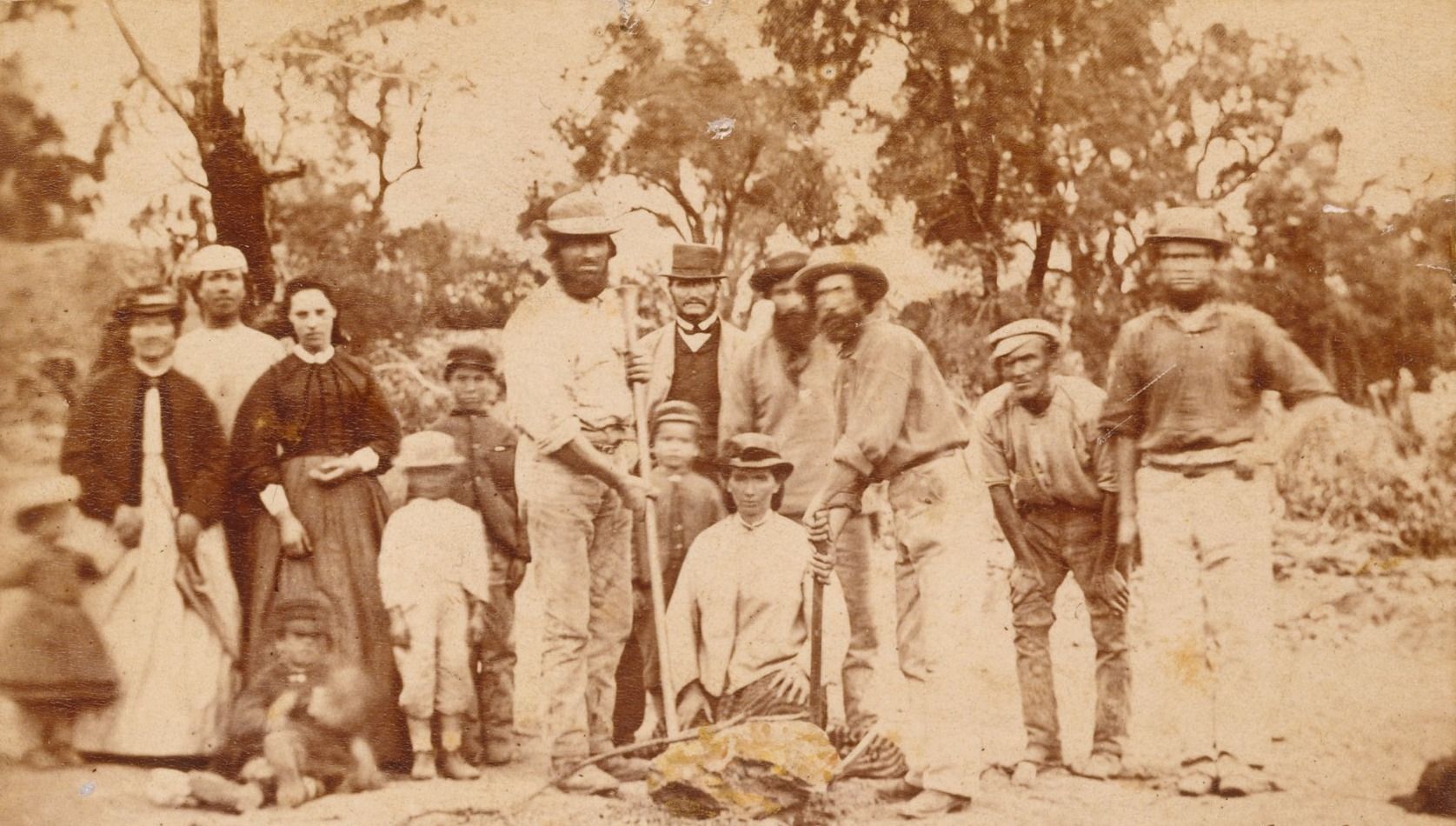
The best-known photograph of the find is not of the nugget either. It was taken by William Parker at the site, after the event. The State Library of Victoria describes it as miners and their wives posing with the finders, Richard Oates, John Deason and his wife. Goldfields Guide, a regional history site, notes that the large piece on the ground in front of them is quartz, standing in for the gold.
Is it really the largest gold nugget ever found?
It is the largest alluvial nugget on record: a single lump found loose in the ground. Bigger masses of gold have come out of veins in solid rock, but those are counted as specimens, gold still attached to its rock, not as nuggets.
In 1869 Brough Smyth wrote that the Welcome Stranger exceeded in weight and value any nugget “yet recorded.” Three years later, at 2 a.m. on October 19, 1872, miners in the Star of Hope mine at Hill End, New South Wales, broke into the Holtermann specimen: 285 kilograms of gold, quartz and slate, holding about 93 kilograms of gold. The Australian Museum explains why it is not called a nugget: it came from a quartz reef, not as a water-worn lump. It was crushed and melted too.
That line between gold loose in the ground and gold still in the rock is the oldest distinction in prospecting. It has its own guide: lode vs placer gold.
The largest nugget still in one piece is younger and lighter. In 1983, at the Serra Pelada gold rush in Brazil, a miner dug out a mass that broke as it was hauled up. Its largest piece, the Pepita Canaã, weighs 60.82 kilograms gross, about 134 pounds. Brazil’s central bank bought it in 1984 instead of melting it, and keeps it in its Museum of Values in Brasília, according to Brazilian press reports of 2026.
Where is the Welcome Stranger now?
The gold no longer exists as a nugget: it was melted in 1869. What is left is the anvil it was cut on, outside the Dunolly Museum, a granite obelisk at the place it was found near Moliagul, and replicas made from the old sketches.
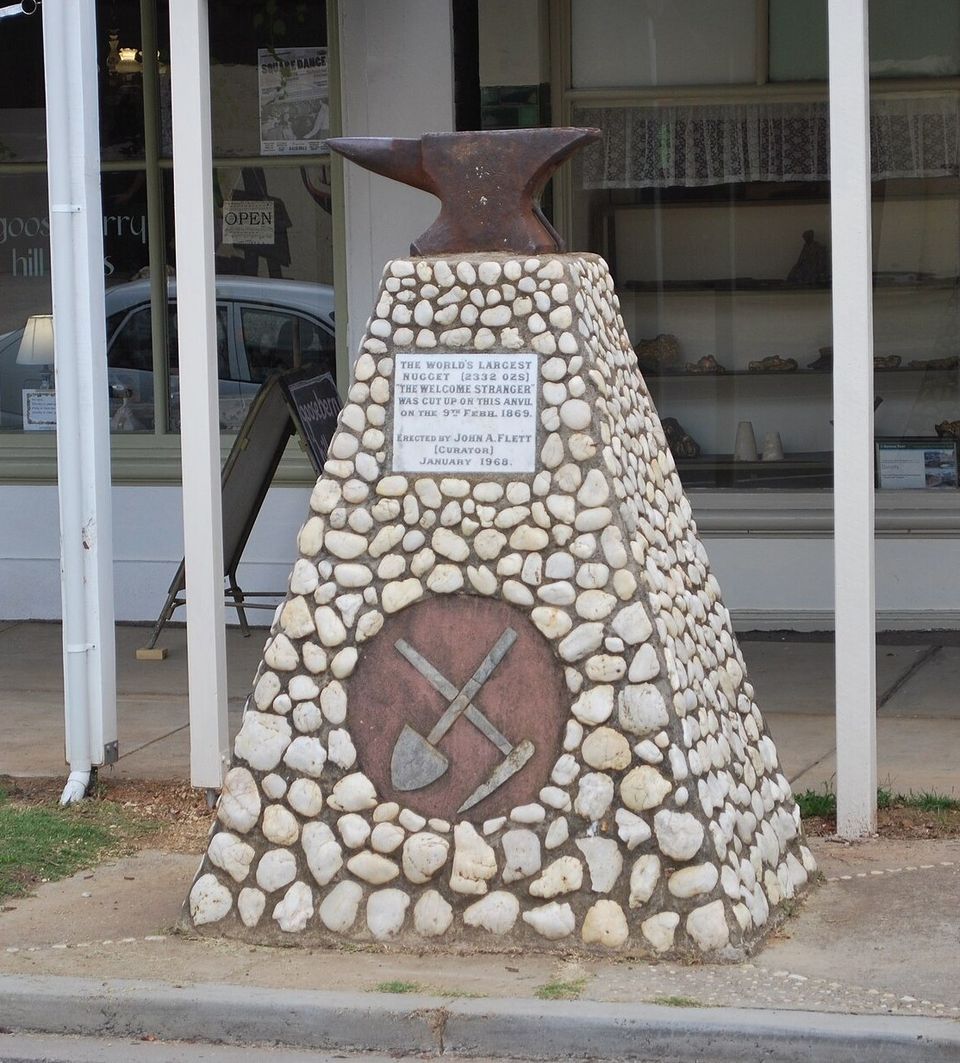
The anvil. It stands outside the museum at 75 Broadway, Dunolly, on a memorial put up around 1968 by the museum’s curator, John A. Flett. Its plaque reads: “The world’s largest nugget [2332 ozs] ‘The Welcome Stranger’ was cut up on this anvil on the 9th Febr. 1869.”
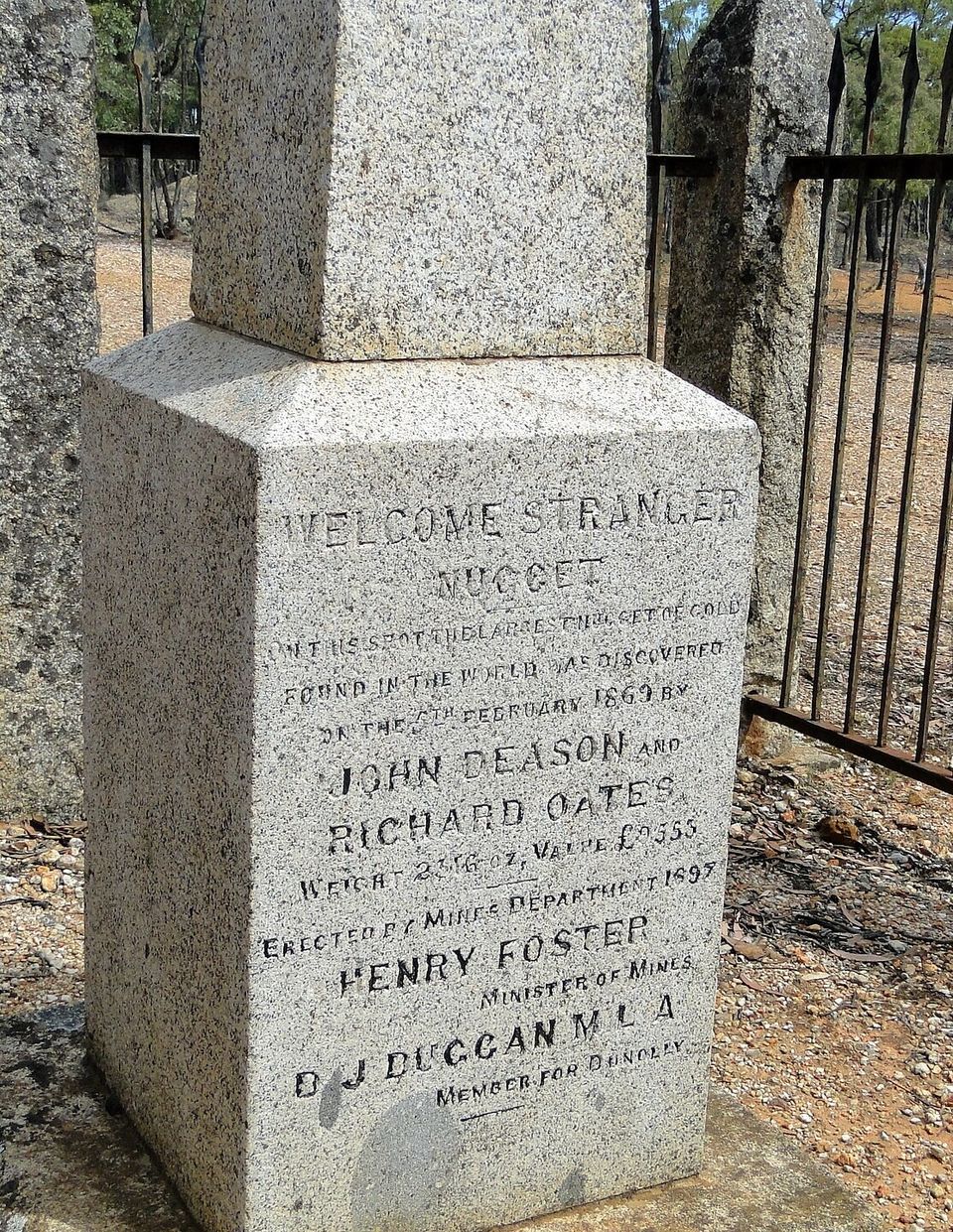
The obelisk. The Mines Department dedicated it on November 19, 1897, on Welcome Stranger Road, about 2 kilometers from Moliagul. It reads in part: “On this spot the largest nugget of gold in the world was discovered on the 5th February 1869 by John Deason and Richard Oates. Weight 2316 oz, Value £9553.”
The replicas. Australian Geographic lists one at Melbourne’s City Museum and one held by Deason’s descendants; the BBC reported another at the Dunolly Museum. All of them follow the 1869 drawings, so all of them are interpretations.
Moliagul. In the 1850s and 1860s it was a busy gold town with 11 pubs. In 2019 the BBC found a farming community with no shop, no hotel and a handful of houses, still visited by people trying their luck for gold. Deason stayed in the district and died in 1915, aged 85; he is buried at Moliagul. Oates died in 1906, aged 79. Deason’s great-great-great-granddaughter, Suzie Deason, told the BBC that people always ask her where the gold is: “we haven’t even got any jewellery made from the Welcome Stranger.”
Which of our rings come from this story?
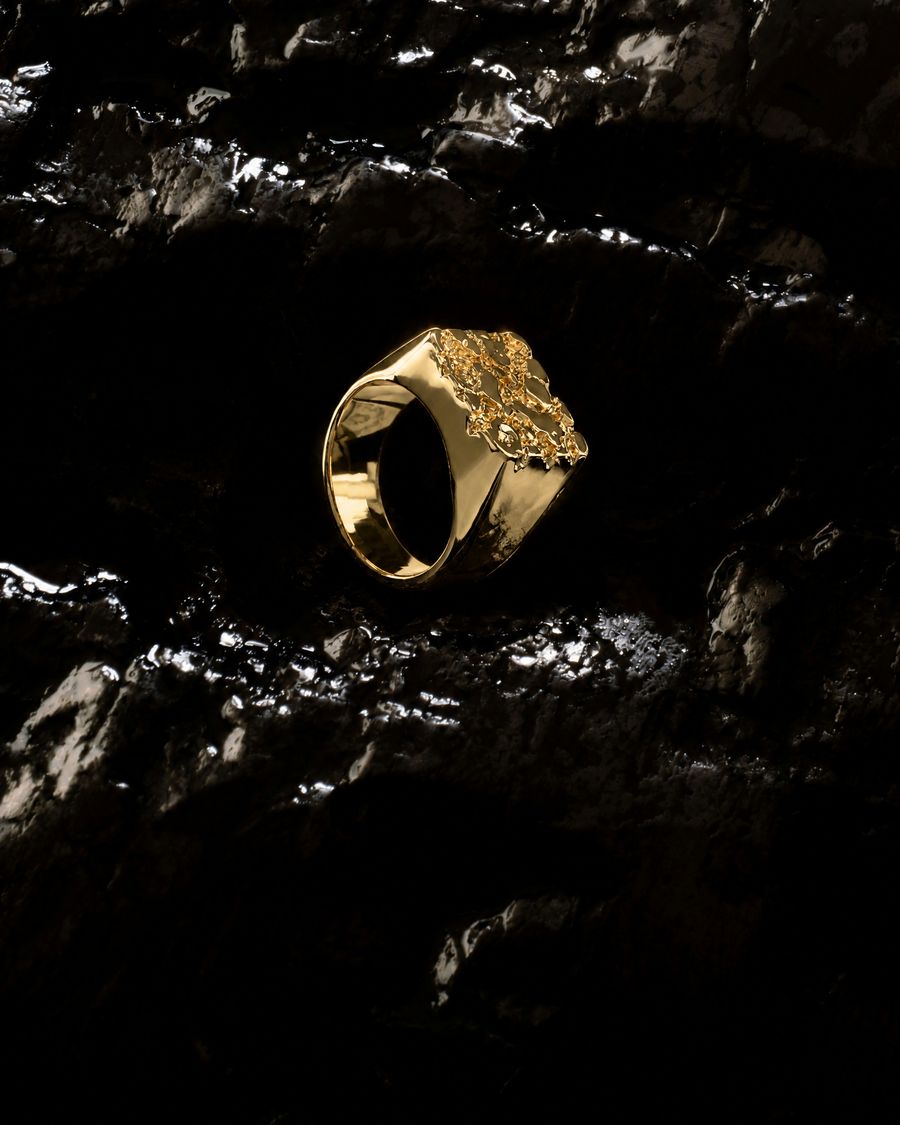
Two of our designs start from the Dunolly anvil: No. 501 Anvil and No. 536 Triptych. Each takes one fact of the story and turns it into a form.
No. 501 Anvil takes the anvil itself: a thick rectangular head with flat polished sides, and nugget relief on its face, inside a polished rim.
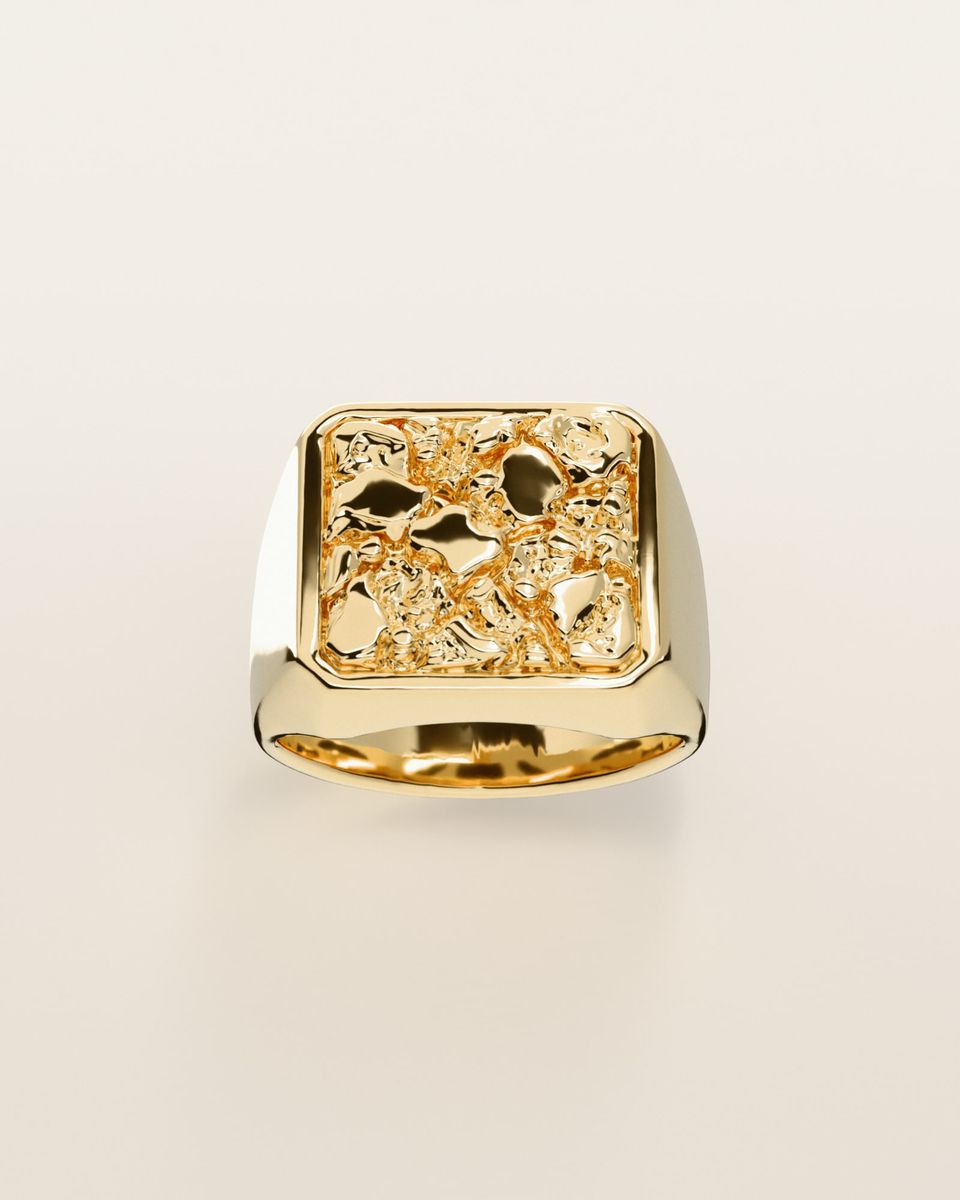
No. 536 Triptych takes the three pieces the blacksmith made: three square windows of nugget relief side by side on a wide band, separated by polished bars.
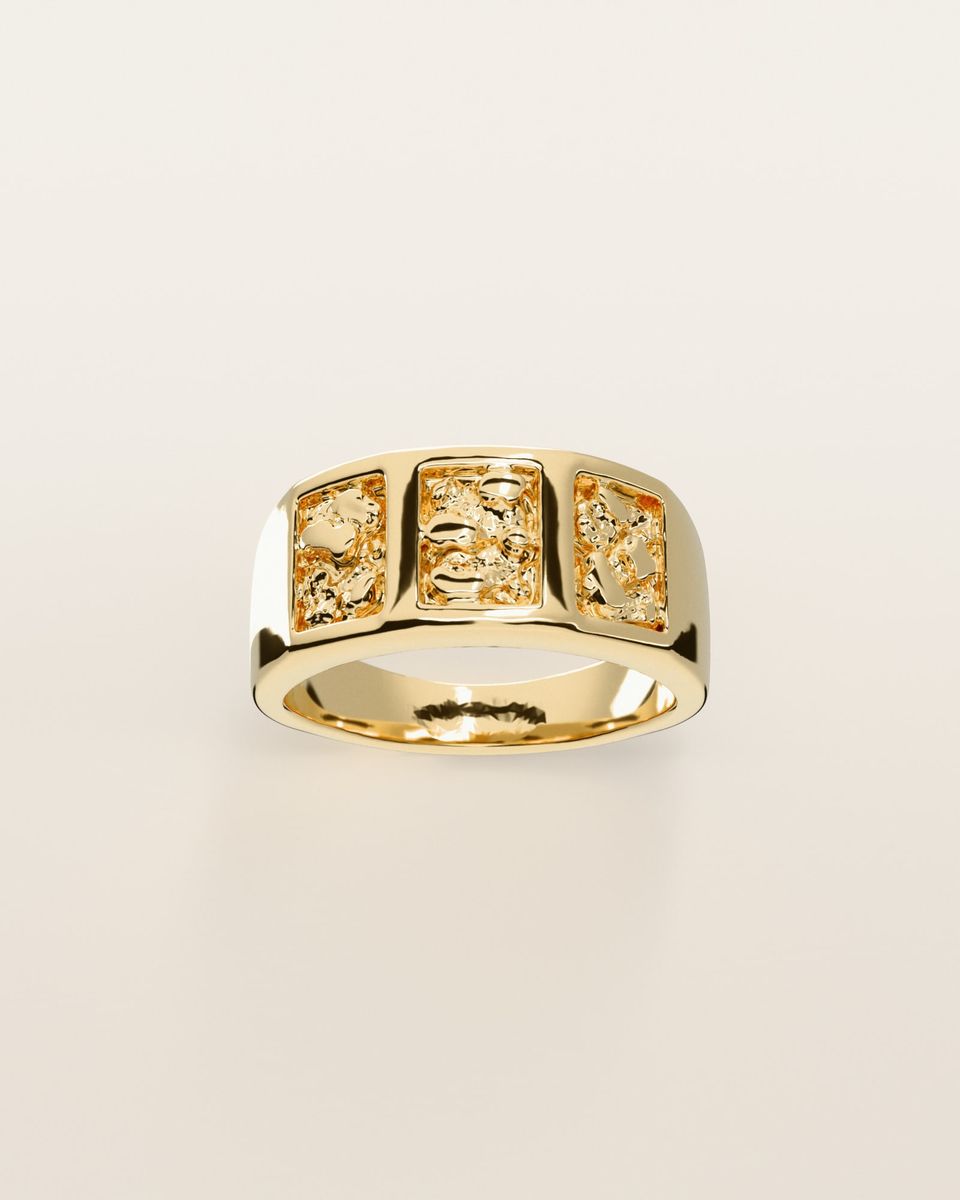
Both are cast to order in your size by our workshop. How a nugget ring is made, and what the name means, is in what is a nugget ring.
More on the same subject: famous gold nuggets.
Sources
- R. Brough Smyth, The Gold Fields and Mineral Districts of Victoria (Melbourne, 1869), Appendix F, “Large nugget found near Dunolly,” pages 600 and 601: date, finders, size, ground, the fire in the hut, 2,268 oz 10 dwt 14 gr melted, 2,280 oz with the pieces given away, 98.66 percent gold, £9,534, the Fearn and Webber sketches, no cast or photograph. Internet Archive scan, read 18 October 2026. Excerpted in Scientific American, October 23, 1869, page 260.
- Johnny O’Shea, Welcome Stranger: World’s largest gold nugget remembered, BBC News, 5 February 2019: Bulldog Gully, the roots of a tree, Deason’s words, the 1851 census, emigration dates, Moliagul in 1862, the Dunolly & Bet Bet Shire Express of 12 February 1869, the scales, the Dunolly replica, Moliagul today, Suzie Deason. Read 18 October 2026.
- Goldfields Guide, The Welcome Stranger gold nugget: the covered find, about 26 kg of quartz, the London Chartered Bank, the blacksmith Archie Walls, the posed photograph with quartz, the later lives of Deason and Oates. Read 18 October 2026.
- Monument Australia, Welcome Stranger Anvil (Dunolly, about 1968, inscription) and Welcome Stranger Obelisk (Moliagul, 19 November 1897, inscription). Read 18 October 2026.
- Australian Geographic, Golden glory: Australia’s biggest gold nuggets, 10 November 2016: largest alluvial nugget, £9,381, the replicas, the Welcome Nugget (1858). Read 18 October 2026.
- Ross Pogson, Glitter restored: the Holtermann Nugget, Australian Museum, 12 December 2017. Read 18 October 2026.
- The Pepita Canaã: UAI(9 September 2026) and Diário do Pará: 60.82 kg gross, Serra Pelada, 1983, bought by the Banco Central do Brasil in 1984. Read 18 October 2026.
- NIST, Handbook 44 (2026), Appendix C: 1 troy ounce = 31.1034768 grams.
- Images: State Library Victoria, engraving from The Illustrated Australian News, 1 March 1869 and William Parker, Unearthing the Welcome Stranger Nugget, 1869 (H13298), both public domain.

