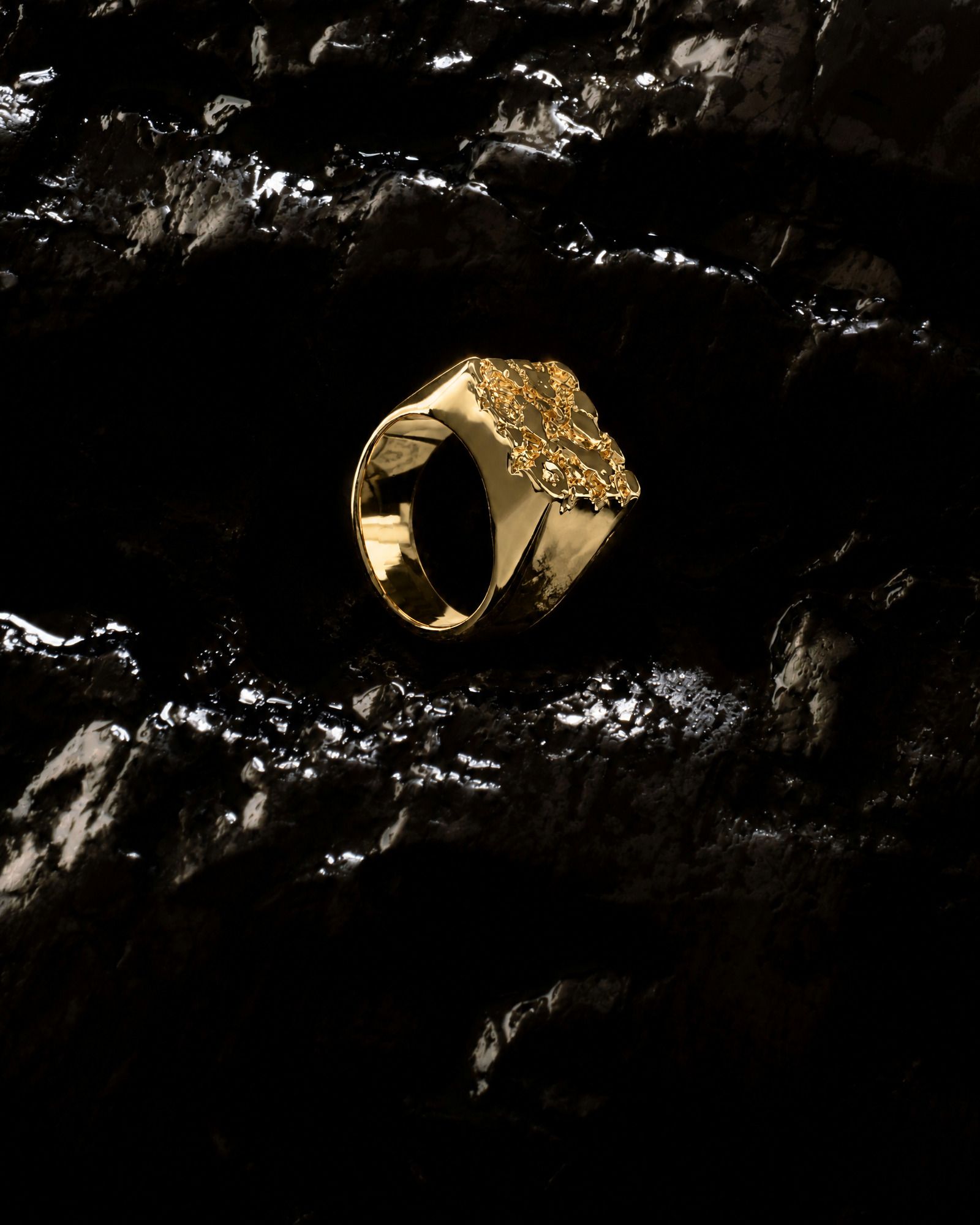
Guide · Gold rush words
What is a mining claim?
In the gold camps a claim was the one piece of paper that mattered: a few stakes in the ground and a notice with your name on it. The word has kept its legal meaning in the United States, and the way to make one has barely changed since the 1870s.
What is a mining claim?
A mining claim is a piece of public land on which someone has asserted the right to develop and extract a valuable mineral deposit they have found. In the United States it is made by staking the corners, posting a notice and recording it. It gives the right to mine, not ownership of the land and not exclusive use of its surface.
That is the Bureau of Land Management’s definition, and the federal regulations spell out the steps. The land must be federal land open to mineral entry. The claim is not valid until a discovery is made inside its boundaries. The locator stakes and monuments the corners, posts a notice in a visible place on the claim, with the locators’ names, the date, a description and the claim’s name or number, then records it with the county and with the BLM.
In 1968 the US Bureau of Mines’ dictionary put the old definition more simply: the portion of public mineral land “which a miner, for mining purposes, takes and holds in accordance with mining laws.”
What did a claim mean in the gold camps?
It meant ground held under the miners’ own rules. Before Congress wrote a mining law, the miners of each district proclaimed rules on how to locate a claim, how to record it and how much work kept it. Those rules, from 1849 on, became the basis of the law that followed.
The 1968 dictionary records the camp vocabulary that went with it. The discovery claim is the first claim where the deposit was found; on a creek, the other claims are numbered from it, up or down the stream. A claim jumper staked ground inside someone else’s claim, betting that the first locator had not followed the rules. In Australia, a block claim was a square claim marked out by a post at each corner.
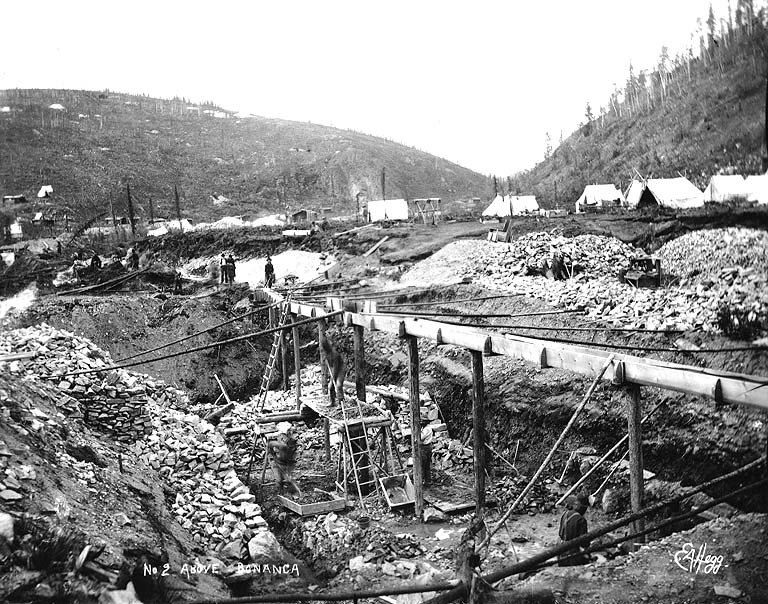
The Klondike shows the system at work. Parks Canada records that gold was found on Rabbit Creek, renamed Bonanza, on August 16, 1896. George Carmack, Skookum Jim and Dawson Charlie staked the first claims the next day. Carmack registered the Discovery Claim in his own name at Forty Mile on September 24, with one claim each for his two partners. The Discovery Claim measured 500 by 2,000 feet. Then Bonanza and Eldorado creeks were staked from end to end.
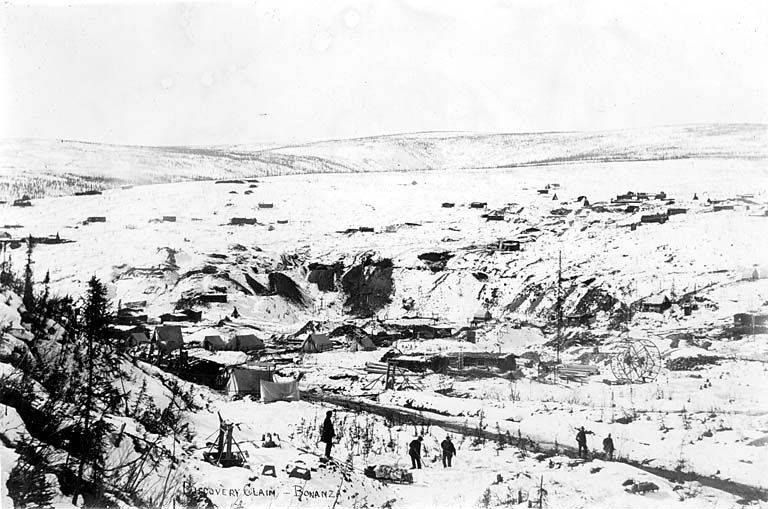
The Discovery Claim is now a national historic site of Canada, recognized in 1998. Its owner, the Klondyke Centennial Society, manages it with Parks Canada and the Yukon government; a trail with replica equipment runs through a valley still scarred by dredge tailings.
Where does US mining claim law come from?
From the General Mining Law of 1872, which is still in force. It opened federal land with valuable minerals to exploration and purchase “according to the local customs or rules of miners in the several mining districts,” so the camp rules were written into federal law.
The law, as it stands in the US Code today, sets two kinds of claim. A lode claim follows a vein: at most 1,500 feet along it and 300 feet on each side of its middle, and no claim before the vein is found inside it. A placer claim covers loose deposits: at most 20 acres for each claimant. The BLM adds mill sites, up to 5 acres, and tunnel sites, up to 3,000 feet long. The difference between the two kinds of gold is in lode vs placer gold.
The law also kept a rule the miners cared about most. The holder of a lode claim owns every vein whose top, its apex, lies inside the claim, “throughout their entire depth,” even where the vein dips under the neighbor’s ground.
What does a mining claim cost to hold today?
As of October 2026, recording a new claim with the BLM costs a one-time location fee of $49, a processing fee and a first maintenance fee of $200. After that, each lode claim costs $200 a year, due on or before September 1; a placer claim pays $200 for each 20 acres.
Paying the fee stands in for the assessment work the mining law requires on a claim, and a waiver is available in some cases. Not every federal acre is open: national parks, for example, are closed to prospecting, and the USGS advises checking the official land records at the BLM state office before staking a tract.
The survey grid that claims are described on has its own gold rush history. In the summer of 1851 the surveyor Leander Ransom set the starting point of a meridian on the summit of Mount Diablo. The public land surveys of two-thirds of California and all of Nevada are still measured from it. Our No.520 Meridian is named after that line: a cushion-square face split by a straight line, nugget relief on one side and flat polished gold on the other.
Which ring is named after a claim?
No. 014 The Block is named after the block claim, the Australian square claim with a post at each corner. It has a rectangular face with clean edges, irregular nugget relief inside it and broad shoulders around it, like a staked square with the gold still in the ground.
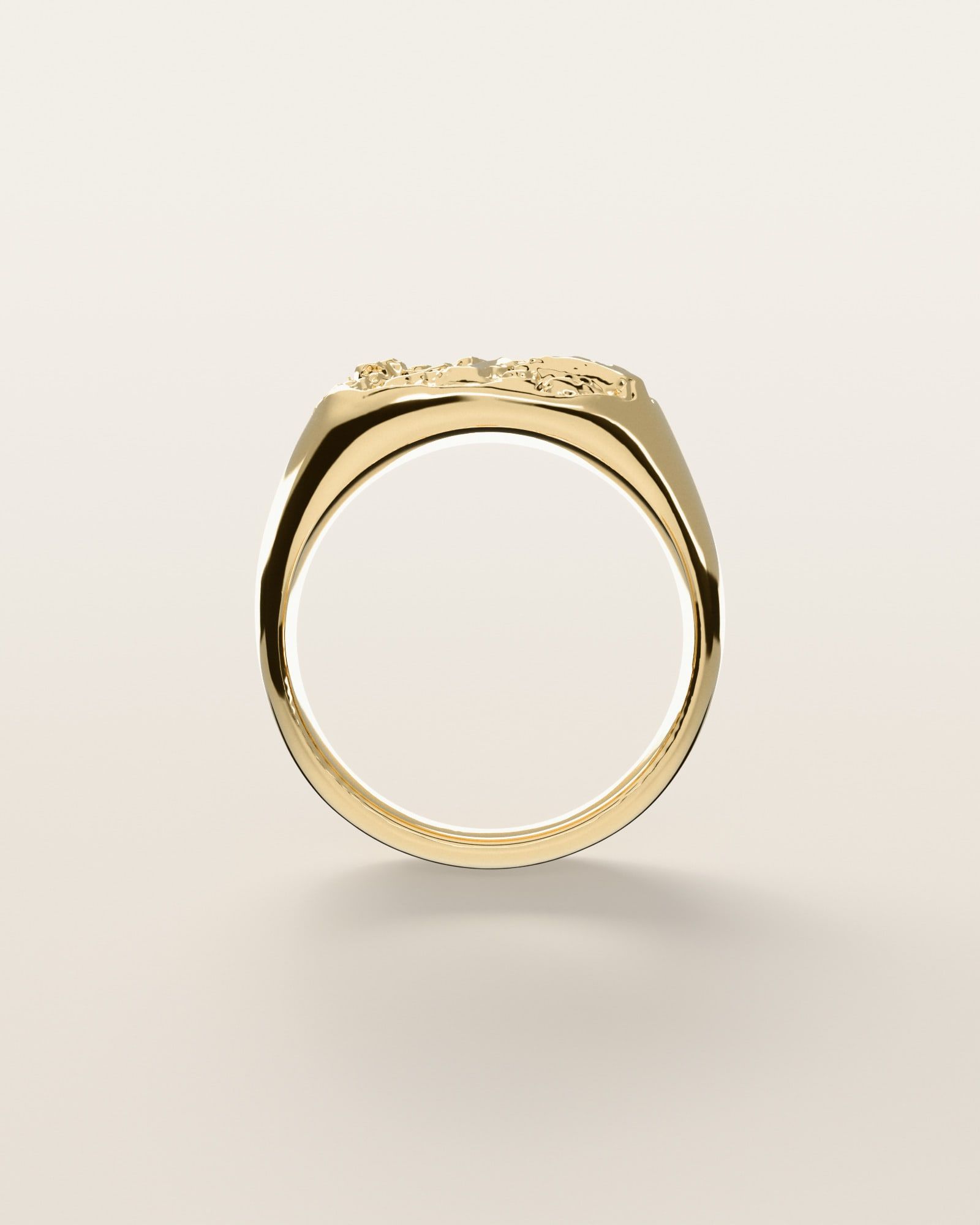
The story behind it is Californian. In November 1854, at Carson Hill in Calaveras County, a single mass of gold weighing 195 troy pounds was found, recorded on the state landmark as the largest gold nugget in California. The Block keeps the square plot and the gold inside it: a face 15.3 mm across on top, narrowing to 6.95 mm underneath, rising 4.27 mm above the finger.
The Block is made in vermeil at $450, the same price at every size. Want it in solid 14K gold? At size 10 it weighs 21.4 to 22.2 g. A face this wide fits closer than a thin band, which nugget ring sizing explains.
The Block belongs to The Claim collection: our signets, a square, oval or wide face of nugget plates set on plain shoulders like a staked plot. A signet was made for signing, pressed into wax to seal a document; for a gold seeker, the document that counted was the claim notice. The collection runs from Signet XS, the smallest, to Statement XL, about 21 mm along the finger. Each ring is modeled as a 3D file and cast to order in your size by our workshop.
Everything else to check before you buy is in the gold mining terms.
Sources
- Bureau of Land Management, Mining Claims: definition, no exclusive surface rights, lode, placer, mill site and tunnel site sizes. Read 18 October 2026.
- 43 CFR § 3832.11 (how to locate a claim), § 3834.11 (maintenance fee due September 1) and § 3830.21 ($49 location fee, $200 maintenance fee, waiver), eCFR, current text read 18 October 2026.
- 30 U.S.C. § 22 (“local customs or rules of miners”), § 23 (lode claims), § 26 (apex), § 35(placer claims). Read 18 October 2026.
- US Bureau of Mines, A Dictionary of Mining, Mineral, and Related Terms (1968): mining claim, miners’ rules, discovery claim, claim jumping, block claim. Internet Archive, read 18 October 2026.
- Parks Canada, Discovery Claim National Historic Site. Read 18 October 2026.
- Harold Kirkemo, Prospecting for Gold in the United States, US Geological Survey: national parks closed, BLM land records. Read 18 October 2026.
- California Office of Historic Preservation, Carson Hill, California Historical Landmark No. 274 (195 troy pounds, November 1854). Read 18 October 2026.
- Mount Diablo Surveyors Historical Society, Leander Ransom and the Mount Diablo initial point; V&A, signet ring (pressed into hot wax to seal a letter). Both cited in the stories of our rings.
- Images: Eric A. Hegg, No. 2 above Bonanza, and George G. Cantwell, Discovery Claim, Bonanza, University of Washington Libraries. Both public domain.

