Guide · Metals
14K gold vs vermeil vs sterling silver
Our designs have options for 14K yellow gold, vermeil and sterling silver, in the same shape. Below: what changes from one metal to the next.
Why 14K and not 10K?
10K is 41.7% gold: less than half of the ring. 14K is 58.5% gold, the first common karat where gold is the majority. The rest of the metal is alloy, and the more alloy, the paler the yellow; 14K keeps the warm color of our pictures.
10K costs less and is a little harder. We chose to cast our gold rings in 14K only. If you want the look for less, vermeil is the same ring in solid 925 sterling silver covered with 18K gold.
| Metal | What it is | Gold content | How we price it |
|---|---|---|---|
| 14K yellow gold | 14 parts gold in 24, made to the 585 standard | 58.5% | Follows the gold price, with weekday updates |
| Vermeil | Solid 925 sterling silver, covered with a layer of 18K gold. The gold layer can wear with use. | Surface layer only | Fixed price per design |
| Sterling silver | 92.5% silver. Darkens with time and needs polishing | None | Fixed price per design |
Fourteen parts in 24 is 58.3%. The fineness standard for 14 karat is 585 parts per thousand, or 58.5%, and our prices use that figure.
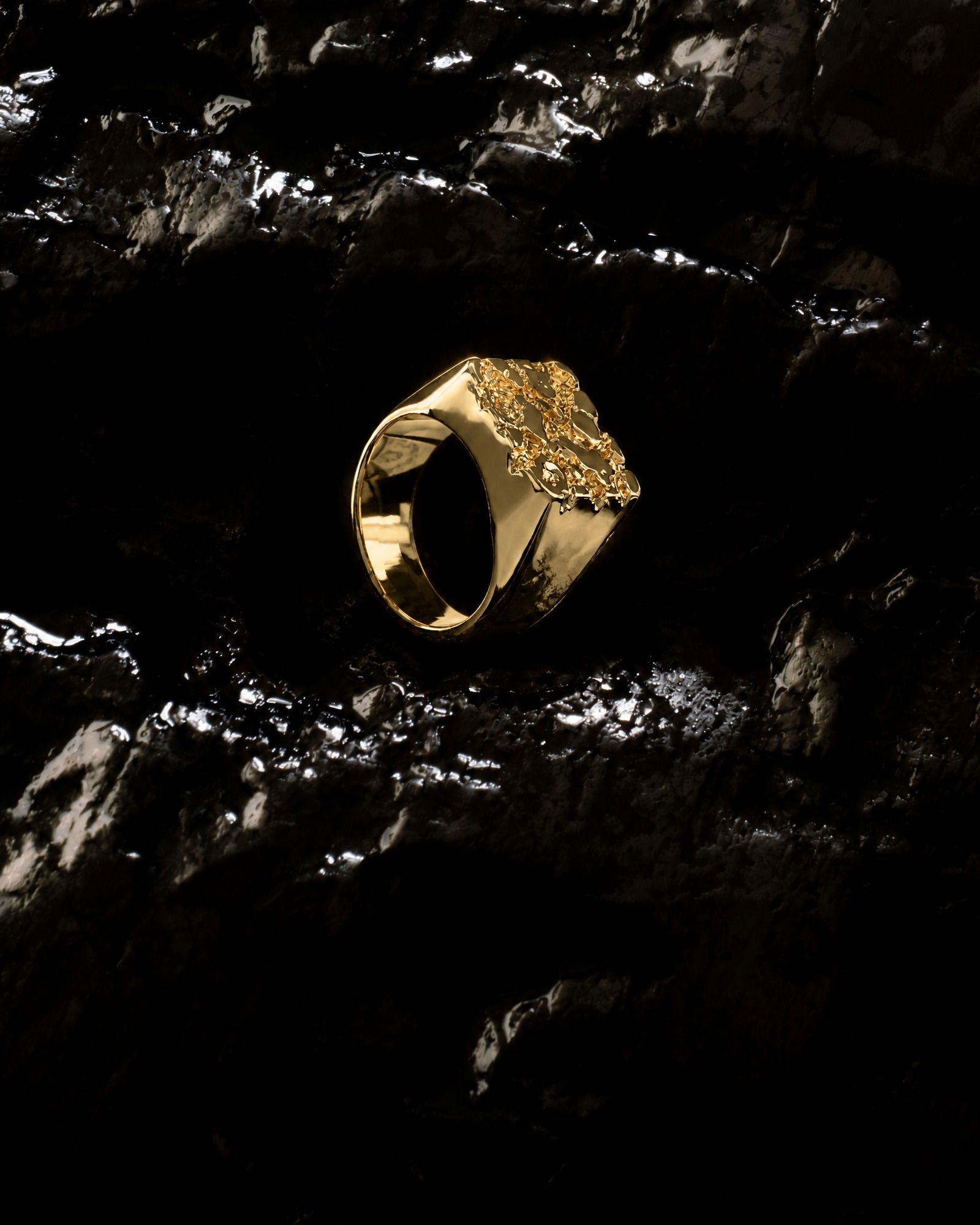
14K prices follow the gold price and have updates scheduled on weekdays. Sterling silver and vermeil have one fixed price per design. See the 14K gold nugget rings.
One design in each metal, priced today
One design in every metal, weighed at one ring size. Each price is the same at every size. The 14K price follows the gold price every day. Sterling silver and vermeil have a fixed price per design.
| Metal | Weight | Pure gold | Price today | Metal price date |
|---|---|---|---|---|
| 14K yellow gold | ||||
| Vermeil | ||||
| Sterling silver |
Why not 24K? The FTC’s buying guide notes that pure gold is soft, which is why jewelry gold is mixed with other metals. More on purity in how to tell if a nugget ring is real.
What does 1 gram of 14K gold look like?
Small. One gram of 14K yellow gold takes up about 76 cubic millimeters, a cube about 4.2 mm on each side. Spread across the face of a dime, it would be 0.3 mm thick, under a quarter of the dime’s 1.35 mm. It holds 0.585 g of pure gold.
A dime weighs 2.268 g, so a gram of 14K weighs less than half a dime. At US size 10, our rings weigh 3.1 to 33.8 g, across every design in vermeil and 14K. Each ring page shows the weight range in every metal and size before you order. Themen’s nugget rings page lists every design heaviest first, thewomen’s nugget rings page lightest first.
Gold vermeil vs gold plated: what’s the difference?
Vermeil requires a sterling silver base, with gold of at least 10K on all significant surfaces. The coating must be reasonably durable, with a minimum thickness throughout equivalent to 2.5 microns of fine gold. Any base-metal layer between the silver and gold must be disclosed. The Guides’ gold-electroplate example uses a minimum equivalent to 0.175 microns of fine gold; these are gold-content equivalents, not a comparison of physical thicknesses at different karats.
The Guides also define “heavy gold electroplate”: a minimum throughout equivalent to 2.5 microns of fine gold, over a base metal. “Gold flashed” and “gold washed” mean a very thin electroplating, which the FTC says wears away faster than gold plate. Any gold layer wears eventually, depending on its thickness and how the piece is worn.
Our vermeil is 925 sterling silver covered with a layer of 18K gold, made by my uncle’s workshop: thegold vermeil nugget rings. For a later change to 14K, ask about upgrade availability and terms.
Sterling silver vs gold vermeil
Underneath, they are the same metal: 925 sterling silver, cast in the same shape. Vermeil adds a layer of gold meeting the coating requirements above. Sterling silver looks like silver and is the least expensive of our three metals, because it holds no gold.
Sterling silver and vermeil each have one fixed price per design, vermeil set above the same design in silver. Ask about upgrade availability and terms before planning a change to 14K gold.
What does 925 mean on a ring?
925 parts of silver per thousand: 92.5%. Under the FTC Jewelry Guides, a ring can only be called sterling silver if it is at least 925/1,000 silver. A stamp alone proves nothing, though:anyone can strike 925.
Does sterling silver tarnish?
Yes. Silver reacts with sulfur compounds in the air, such as hydrogen sulfide, and forms a dark layer of silver sulfide. A silver polishing cloth removes it, and each polish takes a little silver with it. Keeping the ring in a closed bag when you are not wearing it slows tarnish down.
If you would rather not polish, vermeil keeps the silver under gold for as long as the layer lasts, and 14K gold is gold all the way through. See the sterling silver nugget rings.
White gold, platinum and colored gold
We make our 14K rings in yellow gold only. For the other metals people compare them with:
White gold or yellow gold: which is more classy?
That is taste, and there is no measure for it. What can be measured is color. White gold is gold alloyed with whitening metals: in the US, nickel 95% of the time or more, otherwise mostly palladium. An industry index grades its whiteness, and the yellowest grade needs rhodium plating to look white.
Does platinum turn yellow like white gold?
No. Platinum is white without plating. On the yellowness index set by an industry task force (MJSA and the World Gold Council among its members), platinum scores 9.5. The best white gold grade is under 19, and the grade from 24.5 to 32 requires rhodium plating. When a thin plating wears through, the alloy’s own color shows.
Under the FTC’s guidance, an item called “platinum” without qualification should be at least 95% platinum.
What is the rarest color of gold?
There is no official ranking of gold colors. Purple and blue are the ones you will almost never see in a ring. Purple gold is the compound AuAl₂, about 79% gold; blue gold is AuIn₂, 46% gold. Both are usually brittle, which researchers Cretu and van der Lingen say makes their use in traditional jewelry virtually impossible.
They are cut and set like gemstones or used as inlays instead.
Sources
- FTC, Guides for the Jewelry, Precious Metals, and Pewter Industries, 16 CFR 23.3 (gold content, plating thicknesses), 16 CFR 23.4 (vermeil) and 16 CFR 23.5 (sterling silver, 925/1,000).
- FTC Consumer Advice, Buying Platinum, Gold, and Silver Jewelry (24K is soft; 14K is 14 parts in 24; gold flashed and washed; platinum at 95%).
- Hallmarking Act 1973 (UK), Schedule 1: 14 carat is 585 parts per thousand.
- Stuller, Where can I find the specific gravity of various materials? (2012): 14K yellow 13.07.
- U.S. Mint, Coin Specifications: dime 2.268 g, 17.91 mm across, 1.35 mm thick.
- C. Cretu and E. van der Lingen, “Coloured gold alloys,” Gold Bulletin 32 (1999), 115–126, doi:10.1007/BF03214796; reprint on Ganoksin.
- L. Selwyn, Canadian Conservation Institute, Silver – Care and Tarnish Removal, CCI Notes 9/7 (tarnish is mostly silver sulfide, from sulfur compounds such as hydrogen sulfide; each cleaning removes some silver).
- D. Ballard, The New MJSA/WGC White Gold Color Index, Ganoksin (updated 2017).
Volumes on this page are our arithmetic from these figures: 1 g ÷ 13.07 g/cm³ = 76.5 mm³.