Guide · Gold rush words
Lode vs placer gold: what is the difference?
Every gold rush began with one of two kinds of ground. Either the gold was still locked in the rock, or a river had already broken it out and dropped it in the gravel. Miners had a word for each, and US mining law still uses both.
Lode or placer gold: what is the difference?
Lode gold is still in the solid rock where it formed, usually in veins of quartz. Placer gold has been freed from that rock by weathering and carried by water into sand and gravel, as dust, flakes, grains or nuggets. Placers come from lodes: the US Geological Survey calls lode deposits primary and placer deposits secondary.
The USGS explains the chain in its booklet on gold. Gold barely weathers, so when the rock around it breaks down, the gold is left as loose metal. Streams carry it off, and because it is heavy it settles where the water slows: on or near bedrock, in hollows, and in bars of sand and gravel. Those concentrations of gold in gravel are called pay streaks.
So one is the source and the other is what a river made of it. Placer gold in a creek is made of pieces of lodes that the water has worn out of the rock upstream.
Lode vs placer gold, side by side
| Lode gold | Placer gold | |
|---|---|---|
| Where it is | In solid rock, in veins or lodes, often of quartz | Loose, in the sand and gravel of streams, beaches and old riverbeds |
| What the USGS calls it | Primary deposit | Secondary deposit, derived from lodes |
| What it looks like | Gold in quartz veins, often with pyrite | Dust, flakes, grains and, rarely, nuggets |
| How it is worked | Hard-rock mining: the ore is dug out of the rock and processed | Washing: pan, rocker, sluice, dredge |
| How it is measured | Troy ounces of gold per ton of rock, by fire assay | The free gold that washing recovers, by the free gold assay |
| US claim, at most | 1,500 feet along the vein, 600 feet wide | 20 acres per locator, 160 for an association of eight |
| A famous example | California’s Mother Lode, a belt of quartz veins about 120 miles long | The Klondike creeks, found in 1896 in the sands and gravels of a stream |
What does lode mean?
A lode is a vein, or a group of veins, of valuable mineral in solid rock. The US Bureau of Mines’ 1968 dictionary traces the miners’ word to the verb lead: “whatever the miner could follow, expecting to find ore, was his lode.”
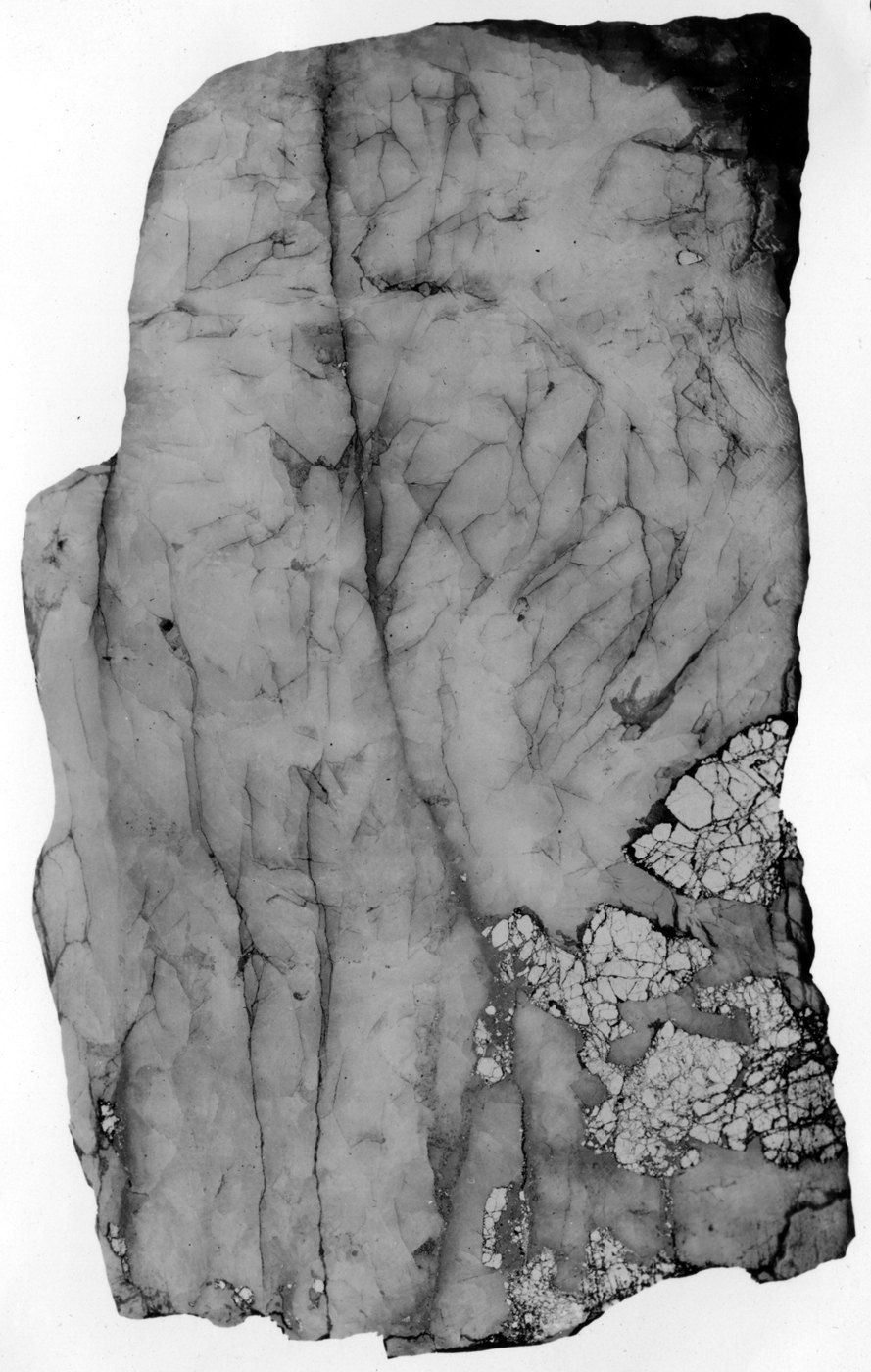
The same dictionary notes that in miners’ use, lode, vein and ledge mean nearly the same thing: a sheet of valuable mineral between definite walls of rock. What matters in law is the opposite case. A lode “must not be a placer”: it must be quartz or other rock in place, carrying the mineral.
The best-known lode in the United States is a whole region. The USGS describes California’s Mother Lode as a belt 1 to 4 miles wide of mineralized rock and quartz veins, running about 120 miles through El Dorado, Amador, Calaveras, Tuolumne and Mariposa Counties. Most of its ore bodies lie in or near the Melones fault zone. The veins are simple: milky quartz, a little pyrite, and free gold.
What does placer mean?
A placer is a deposit of sand or gravel holding loose particles of gold or another heavy mineral. In US mining law, every deposit that is not a vein in rock counts as a placer, whatever it holds.
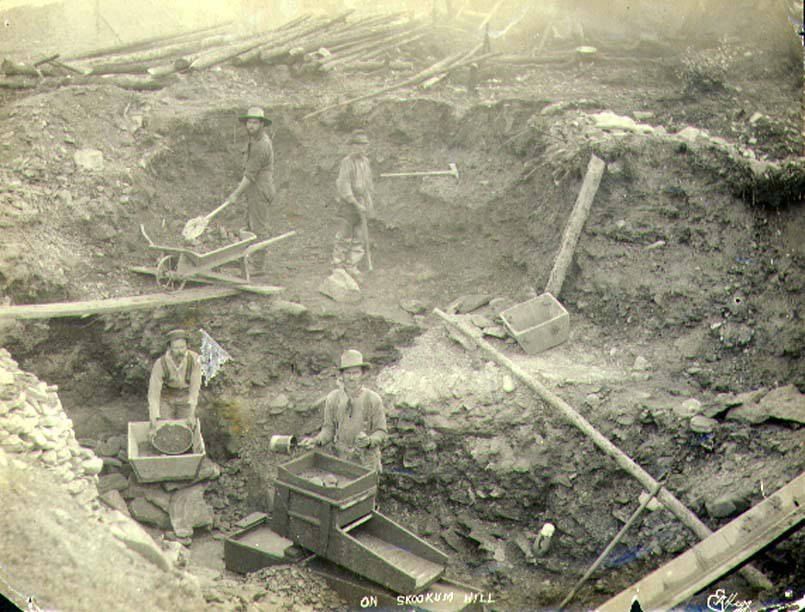
The 1968 dictionary describes placer gold as gold in “more or less coarse grains or flakes,” obtained by washing the sand and gravel it lies in. A USGS fact sheet on Alaska adds where to dig: as much as 90 percent of the gold recovered from stream placers lies in the lowest 3 feet of gravel and in the cracks of the top foot of bedrock. Nuggets are rare; most placer gold is flattened fragments.
The word, the discovery at Sutter’s Mill and our ring named after it are in what is placer gold.
Which has produced more gold, lode or placer?
Placers, by the USGS’s estimate: as much as two-thirds of all the gold ever mined may have come from placer deposits, and the rest from lodes. In Alaska, 72 percent of the gold mined came from placers.
Lode gold takes money to reach. The USGS’s prospecting guide is blunt about it: the ground likely to hold lodes has been explored so thoroughly that an inexperienced prospector without ample capital has little chance of finding a new one worth developing. Most future lode discoveries, it adds, will come from districts that have produced before.
Lode or placer: what does US mining law say?
The law treats them as two kinds of claim. A lode claim follows a vein: at most 1,500 feet along it and 300 feet on each side of its middle. A placer claim is an area: at most 20 acres for each person, and up to 160 acres for an association of eight or more.
The lode rule comes from the Mining Law of 1872, still in force. It gives the holder of a lode claim every vein whose top, or apex, lies inside the claim, “throughout their entire depth,” even where the vein dips under the neighbor’s ground. Placer claims have no such right. They are called placers in the statute itself, which covers “all forms of deposit, excepting veins of quartz, or other rock in place.”
A claim of either kind is still staked at its corners and recorded today, as it was in the camps.
Lode or placer: which rings carry which?
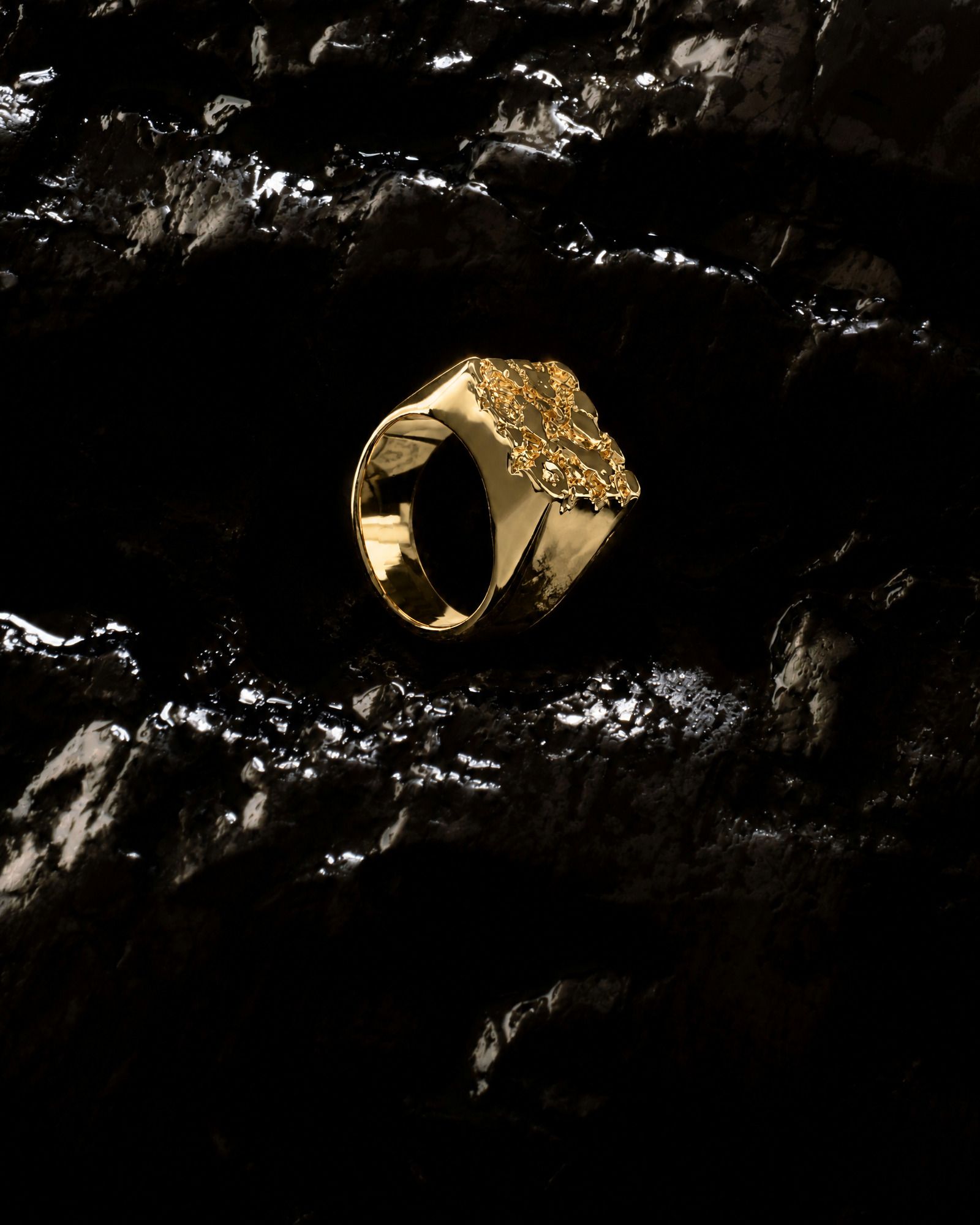
Our collections are named after the two kinds of ground. The Lode is mostly polished gold with one run of nugget relief through it, the way a vein crosses rock. The River is textured all the way round, like gold spread through gravel.
No. 518 Fault Line is the clearest lode ring. Its story starts from the USGS report on the Mother Lode: most of its deposits lie in or near a fault, where gold settled in the fractures. Fault Line sets a single strip of nugget relief on a diagonal across a polished band, like a vein cutting through rock along a fault. The band measures 9.75 mm across the top and 5.2 mm underneath.
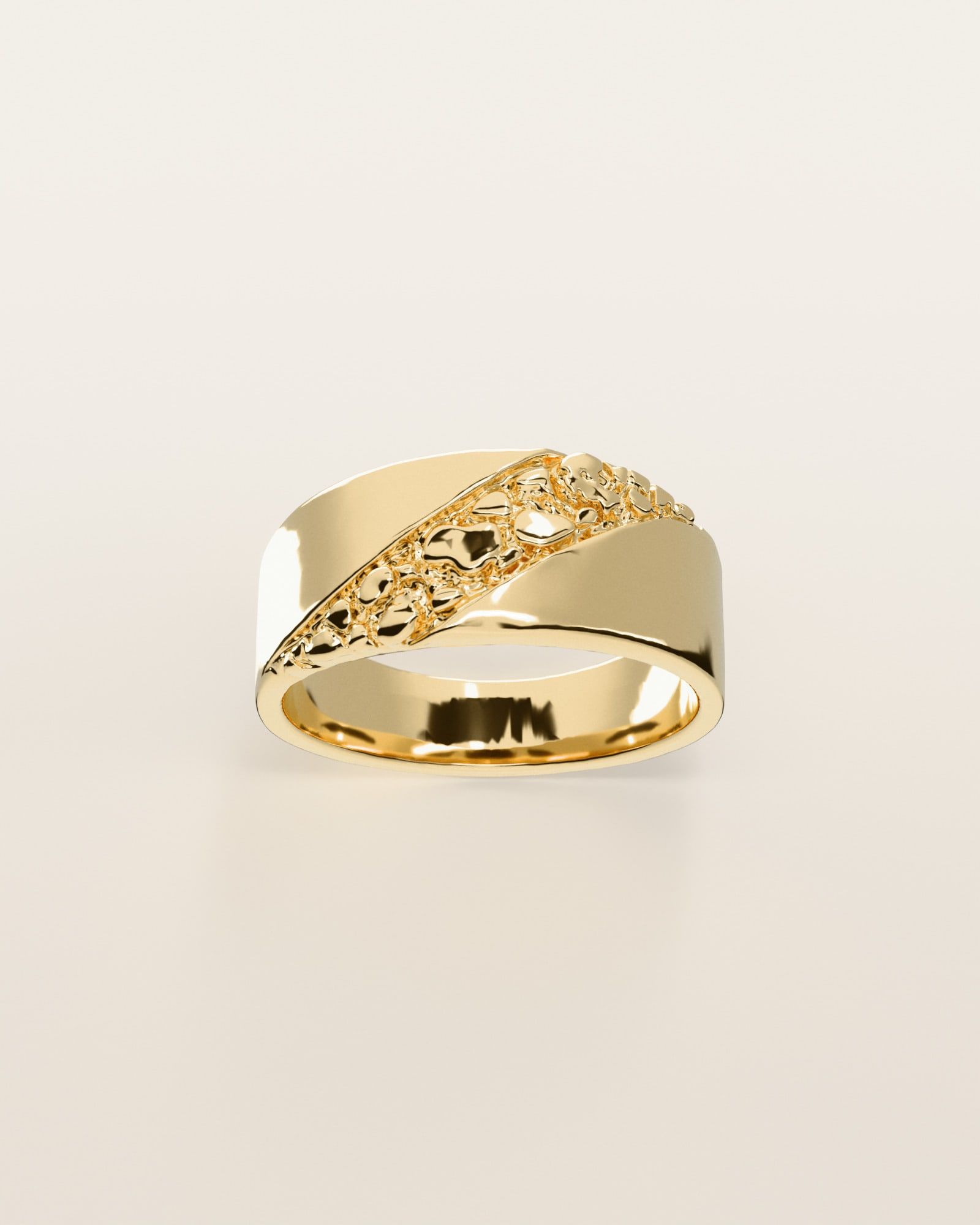
Fault Line is made in vermeil at $405, the same price at every size. Want it in solid 14K gold? At size 10 it weighs 11.2 to 11.6 g. The metals are compared in 14K gold vs vermeil vs sterling silver.
No. 508 Placer is the placer side: small, dense grains cover a band about 10 mm wide all the way round, between two narrow polished edges.
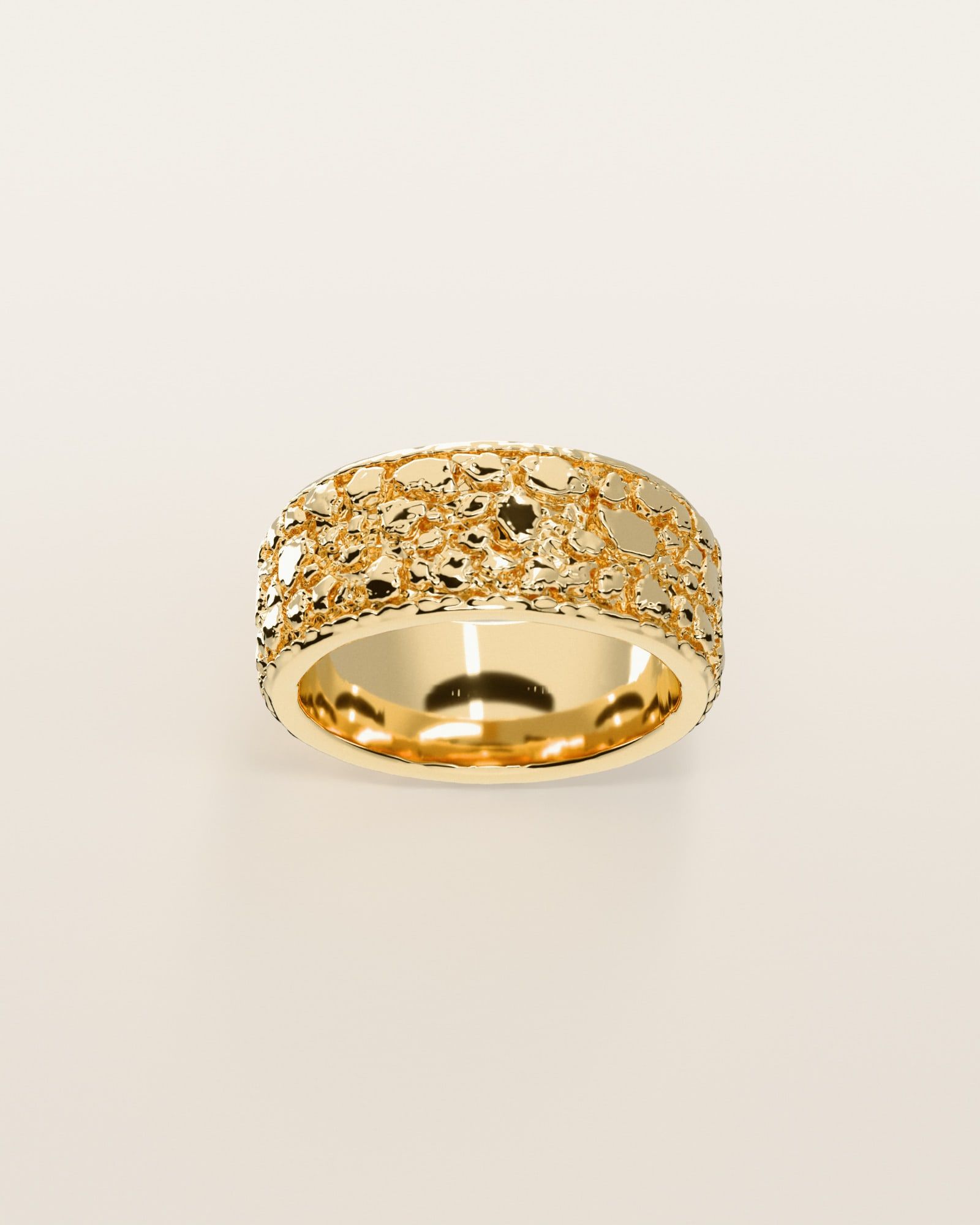
When to choose a lode ring: you want mostly smooth, polished gold, with the texture in one place.
When to choose a placer ring: you want the texture everywhere, on every side of the finger. There is no front to turn back into place.
All the rings of the first kind are in The Lode collection; the textured bands are in The River. Every one is modeled as a 3D file and cast to order in your size by our workshop.
Everything else to check before you buy is in the gold mining terms.
Sources
- US Geological Survey, Gold (general interest publication): lode (primary) and placer (secondary) deposits, gold on or near bedrock, pay streaks, fire assay. Read 18 October 2026.
- Harold Kirkemo, Prospecting for Gold in the United States, US Geological Survey: lode gold within solid rock, placers from lodes, the chances of a new lode. Read 18 October 2026.
- US Geological Survey, Rivers of Gold: Placer Mining in Alaska, Fact Sheet 058-98 (1998): two-thirds from placers, 72 percent of Alaska’s gold, 90 percent in the lowest 3 feet and the top foot of bedrock, flattened fragments. Read 18 October 2026.
- F. C. W. Dodge and R. C. Loyd, Gold deposits of the western Sierra Nevada, field trip guide, US Geological Survey Open-File Report 84-169 (1984): the Mother Lode, 120 miles, the Melones fault zone, milky quartz. Read 18 October 2026.
- US Bureau of Mines, A Dictionary of Mining, Mineral, and Related Terms (1968): lode, placer, placer gold, placer claim. Internet Archive, read 18 October 2026.
- 30 U.S.C. § 23 (lode claims, 1,500 feet, 300 feet each side), § 26 (veins “throughout their entire depth”), § 35 (placers, 20 acres); BLM, Mining Claims (association placers, 160 acres). Read 18 October 2026.
- Images: US Geological Survey, Professional Paper 194, plate 11-A; Eric A. Hegg, On Skookum Hill, University of Washington Libraries. Both public domain.
- California State Parks, Marshall Gold Discovery State Historic Park brochure (2013): gold flakes in the streambed, January 24, 1848. Read 18 October 2026.

