Guide · Words
Gold mining terms: the words of the gold rushes
The gold rushes of California, Australia and the Klondike gave English a working vocabulary: placer, lode, pay streak, grubstake, sourdough. Most of our rings are named after one of those words. Here is what each one meant to the people who used it.
What are gold mining terms?
They are the words prospectors and miners used for the ground, the gold and the work: where gold lies (placer, lode, pay streak), how it was found and washed (colors, sluice, cleanup), how ground was held (claim, apex) and how gold was measured (grain, assay office, bullion). Many came from mining law and geology; some only from the camps.
Gold rush words from A to Z
- Apex
- The top of a vein. Under the US Mining Law of 1872, whoever holds the apex inside their claim can follow the vein down, even under the neighbor’s ground. Our rings: No. 408 Statement XL, No. 008 Ridge.
- Assay office
- The office where loose gold was melted, tested for fineness and cast into stamped bars or coins. In 1851 the United States Assay Office of Gold in San Francisco struck octagonal fifty-dollar pieces. Our rings: No. 502 Bullion, No. 531 Octagon.
- Bedrock
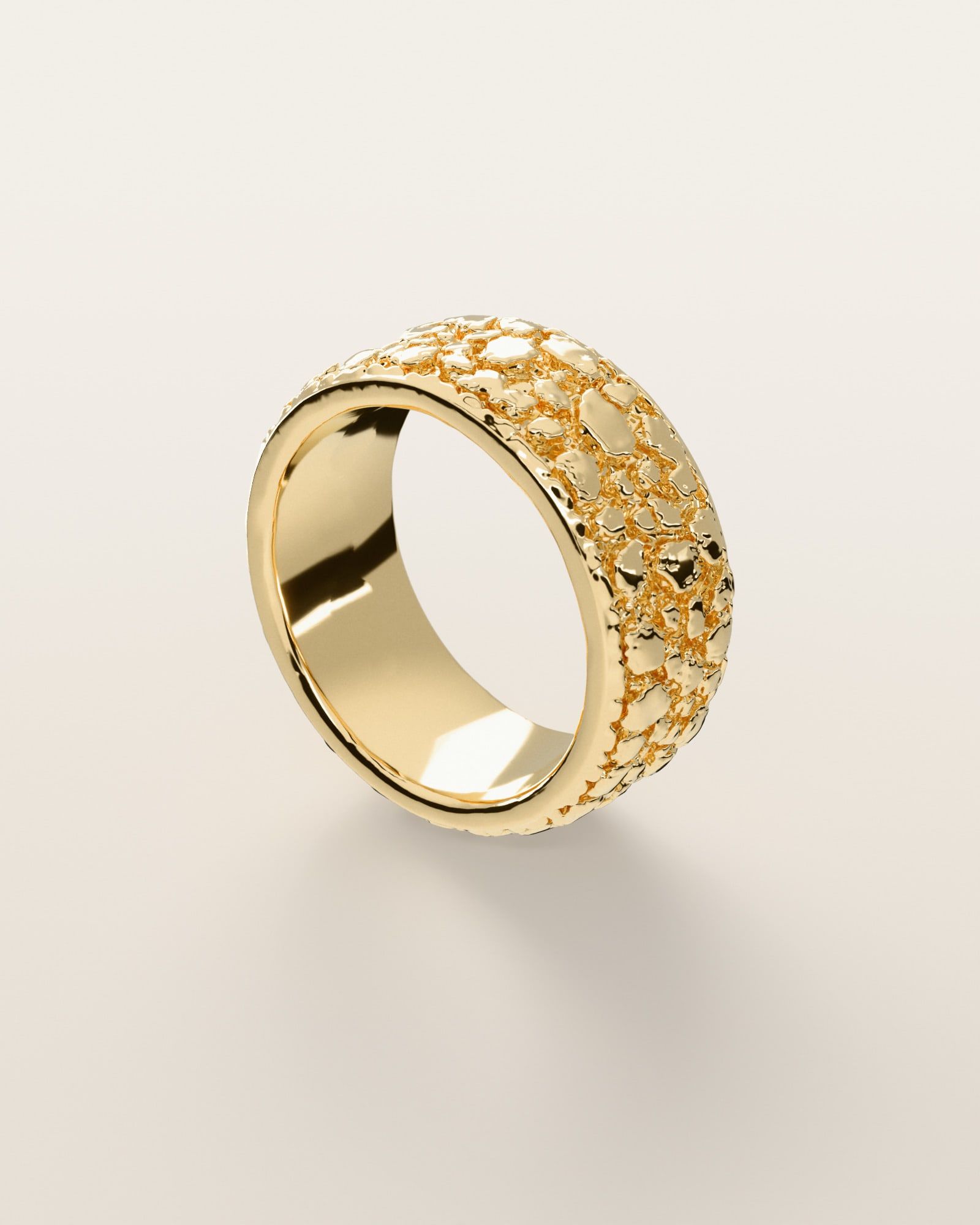
- The solid rock under the gravel of a river. Gold is heavy, works down through the gravel and collects on or just above it. Our rings: No. 441 Nugget Band 6 mm, No. 443 Nugget Band 10 mm.
- Bench claim
- In the Yukon and Alaska, a claim staked on old river gravel left high on the side of a valley, above the present stream. Our rings: No. 406 Wide Face, No. 001 Low & Wide.
- Block claim
- An Australian miners’ term for a square claim marked out by a post at each corner. Our ring: No. 014 The Block.
- Bullion
- Gold in bars. In 1850s San Francisco, assayers stamped each bar with their name, a number, its weight, its fineness and its value. Our ring: No. 502 Bullion.
- Channel
- An ancient, buried riverbed holding gold. In the Sierra Nevada, some of these old beds lie under lava flows; miners called their blue-gray gravel the blue lead. Our ring: No. 011 Channel.
- Claim
- Ground a prospector has staked, marked at the corners and recorded in their name. In the United States it still starts with a notice posted on the ground. Our rings: No. 409 Signet M, No. 430 Signet S, No. 401 Signet L.
- Cleanup
- The end of a run of work, when everything caught behind the riffles of the sluice is gathered up: the day a miner found out what the work had paid. Our ring: No. 442 Nugget Band 8 mm.
- Colors
- The specks of gold left at the bottom of a pan after washing. Prospectors judged ground by how many colors it gave to the pan. Our ring: No. 407 Stack Band.
- Drift
- A horizontal tunnel that follows a vein underground. Our ring: No. 102 Drift.
- Fault
- A break in the rock where the two sides have moved. Most of California’s Mother Lode deposits lie in or near the Melones fault zone. Our ring: No. 518 Fault Line.
- Flake
- A piece of gold under about 4 mm, picked up with tweezers. Most of the gold in river placers comes as flattened flakes, not nuggets. Our ring: No. 444 Stacking Band 3 mm.
- Floaters
- In New South Wales, the broken pieces of a vein that work down a slope. Prospectors followed them uphill to find where the vein comes out. Our ring: No. 514 Spill.
- Flour gold
- The finest gold, light enough to float on the water and slip away with the current. Our ring: No. 527 Thread.
- Gossan
- The rust and ochre rock that forms where a vein weathers at the surface. Prospectors read it as a sign of what lies below. Our ring: No. 521 Outcrop.
- Grain
- The smallest unit of gold weight: 480 grains make a troy ounce, so one grain is 64.79891 milligrams. Our ring: No. 525 Grain.
- Grubstake
- Food and gear advanced to a prospector by someone else, in return for a share of whatever turned up. Our ring: No. 445 Pinky.
- Hardpan
- A layer of gravel cemented by iron oxide, often a few feet below the surface of a placer, that does not give easily to a pick. Our ring: No. 433 Wide Face.
- Ingot
- Metal as it comes from the mold, made to be handled, stored or melted again. Our ring: No. 533 Ingot.
- Ledge
- A projecting outcrop or vein, often of quartz. The US Mining Law still grants “all veins, lodes, and ledges” whose top lies inside a claim. Our ring: No. 509 Ledge.
- Lode
- Gold still in the rock, in veins, as opposed to placer gold that a river has already freed. Our rings: No. 518 Fault Line, No. 024 Slim.
- Miner’s right
- In Victoria, Australia, the cheap paper that replaced the miner’s licence in 1855 and gave its holder the right to dig and the right to vote. Our ring: No. 431 Signet M.
- Monument
- To a surveyor, the physical mark at the corner of a piece of ground, built to last. US mining claims are still marked at their corners. Our ring: No. 432 Signet L.
- Mother Lode
- California’s belt of gold-bearing quartz veins, about 120 miles long, from El Dorado County to Mariposa County. Our ring: No. 518 Fault Line.
- Nugget
- A lump of natural gold, bigger than a flake or a picker. The word appears in English in the early 1850s, during the rushes in Australia and California. Our ring: No. 441 Nugget Band 6 mm.
- Offset
- The distance a fault moves a vein. A miner who sees a vein stop dead looks for it again on the other side of the break. Our ring: No. 513 Offset.
- Outcrop
- The place where a rock formation, or a vein, shows at the surface. Our ring: No. 521 Outcrop.
- Pay streak
- The richer band of gravel where the gold of a placer gathers, often on the bedrock or just above it. Our ring: No. 447 Cigar Band.
- Picker
- A piece of gold bigger than a flake but smaller than a nugget: big enough to pick out of the pan with your fingers. Our ring: No. 446 Signet XS.
- Placer
- Sand or gravel that holds loose gold, freed from the rock by a river. The USGS says up to 90 percent of the gold in a river placer lies in the lowest 3 feet of gravel and the top of the bedrock. Our ring: No. 508 Placer. Read more about placer.
- A small concentration of gold near the surface. In California’s Mother Lode districts, the prospectors who looked for them were called pocket hunters. Our ring: No. 063 Off-Center.
- Prill
- The bead of precious metal left at the bottom of the cupel, a small cup of bone ash, at the end of a fire assay. Also called the button. Our ring: No. 435 Oval.
- Reef
- The Australian word for a gold-bearing quartz vein, brought to the diggings by sailors who saw quartz standing out of the ground as rock stands out of the sea. Our ring: No. 434 Statement XL.
- Riffle
- A bar set across the bottom of a sluice. The water drops from one riffle to the next and the heavier gold stays behind each bar. Our ring: No. 526 Cascade.
- Seam
- A thin layer or vein running through rock. Our ring: No. 519 Seam.
- Slug
- The octagonal fifty-dollar gold piece struck in 1851 by the United States Assay Office of Gold in San Francisco, when California had gold but no federal coinage. Our ring: No. 531 Octagon.
- Sluice
- A long wooden trough set on a slope. Water carries the gravel down it and the riffles catch the gold. Our ring: No. 526 Cascade.
- Sourdough
- In the Klondike, an old hand: a miner who had spent at least one winter in the North. The word came from the sourdough bread of the camps. Our ring: No. 405 Pinky.
- Stringer
- A thin vein, often one of several that together make up a lode. Our ring: No. 024 Slim.
- Tailrace
- The channel that carries water away from a mill wheel. James Marshall saw the first California gold in the tailrace of Sutter’s sawmill on January 24, 1848. Our ring: No. 440 Classic Taper.
- Track
- At Bendigo, in Australia, the miners’ word for a vein whose walls close in before it opens out again. Our ring: No. 403 Classic Taper.
- Wash dirt
- The Australian miners’ word for gold-bearing gravel, washed to free the gold. Our ring: No. 443 Nugget Band 10 mm.
Where do these words come from?
Each rush left its own. California and US mining law give us claim, apex, ledge and the Mother Lode; the Australian goldfields, from 1851, reef, wash dirt, track and the miner’s right; the Klondike and Alaska, from 1896, sourdough and bench claim.
The words travelled with the miners. Sailors who left their ships for Ballarat and Bendigo in 1851 called a quartz vein a reef, as they would a rock standing out of the sea. Some terms are still law: a US mining claim is still staked with a notice and corner monuments, and the 1872 text on “all veins, lodes, and ledges” still applies.
Sources
- 30 U.S.C. 26, General Mining Law: “all veins, lodes, and ledges”
- US Bureau of Mines, A Dictionary of Mining, Mineral, and Related Terms (1968)
- Smithsonian NMAH, 50 Dollars, United States Assay Office of Gold, 1851
- USGS, Gold (general interest publication)
- USGS Professional Paper 772, Tertiary gravels of the ancestral Yuba River
- 43 CFR 3832.11, How do I locate mining claims or sites?
- BLM, Mining Claims
- USGS Fact Sheet 2005-3014, mercury and gold mining (sluice boxes)
- USGS, Prospecting for Gold in the United States
- USGS Open-File Report 84-169, the Mother Lode gold belt
- Gold Prospectors Association of America, Gold Prospectors magazine, “Gen ED” (flake, picker, nugget)
- USGS Fact Sheet 058-98, How gold nuggets and placers form
- NIST Handbook 44 (2026), Appendix C
- Museums Victoria, gold licence and miner’s right
- Dictionary.com, nugget (origin)
- NPS Yukon-Charley Rivers, Burning down to northern gold
- NPS Klondike Gold Rush, the ton of goods
- California State Parks, Marshall Gold Discovery State Historic Park