Guide · Gold rush words
What is placer gold?
Most of the gold rush stories people know, from Reed’s doorstop to Marshall’s flakes, are placer stories. The word sounds technical, but it describes something simple: gold the river has already dug out for you.
What is placer gold?
Placer gold is gold found loose in sand and gravel, in grains, flakes or nuggets, rather than locked inside rock. Weathering frees it from its original vein, water carries it, and because it is heavy it settles in stream beds. Miners recover it by washing the gravel, not by crushing rock.
The US Geological Survey sorts gold deposits into two kinds. Lode deposits are the primary ones: gold in veins, often of quartz, inside solid rock. Placer deposits are secondary: concentrations of gold derived from lodes “by erosion, disintegration or decomposition of the enclosing rock, and subsequent concentration by gravity.” The Bureau of Mines dictionary of 1968 puts it in a miner’s terms: placer gold is gold in coarse grains or flakes, “obtainable by washing the sand, gravel, etc., in which it is found.” The two kinds side by side:lode vs placer gold.
Where does the word placer come from?
From Spanish. The American Heritage Dictionary traces placer to the Spanish word for a shoal, which came from Catalan placer, also a shoal, from plassa, “place”. It rhymes with “passer”, not with “racer”.
The word was in use in California before the Gold Rush. The state’s landmark for the first authenticated gold find in California, in 1842, speaks of the “San Fernando placers”, worked by miners from Sonora with pans, sluices and dry washing. In the eastern United States, the North Carolina historic site at the Reed mine uses the same word for the creek gold of 1799: “Placer, or creek, gold mining.”
Where does placer gold collect?
At the bottom. The USGS says that as much as 90 percent of the gold recovered from stream placers lies in the lowest 3 feet of gravel and in the cracks and holes of the top foot of bedrock. Gold is heavy, so it works down while the sand and pebbles around it keep moving.
The USGS explains the mechanism: gold particles move downward during high water, when the whole bed of sand, gravel and boulders is stirred up and carried downstream. Most of what is left is small. In its fact sheet on Alaska, the USGS notes that “gold nuggets are rare”: most placer gold is flattened fragments or flakes less than 1/8 inch across. A placer can also be a beach, like the ones at Nome, Alaska, or an old river channel buried and hardened into rock.
How was placer gold mined?
With water. The simplest tool is the gold pan; a sluice washes far more gravel through a wooden trough with riffles that catch the heavy gold; hydraulic mining blasted whole hillsides into sluices with jets of water. All of them use the same fact: gold is heavier than the gravel it sits in.
The Bureau of Mines dictionary describes the miner’s pan as a steel dish 10 to 16 inches across the top and 2 to 2½ inches deep, with sides sloping at 35° to 40°. You stir a panful of gravel in water, pick out the stones, swirl it so the heavy particles settle, and tip off the light material on top until a little black sand is left with the gold. The same dictionary says an experienced man could pan about 1 cubic yard of gravel in 10 hours.
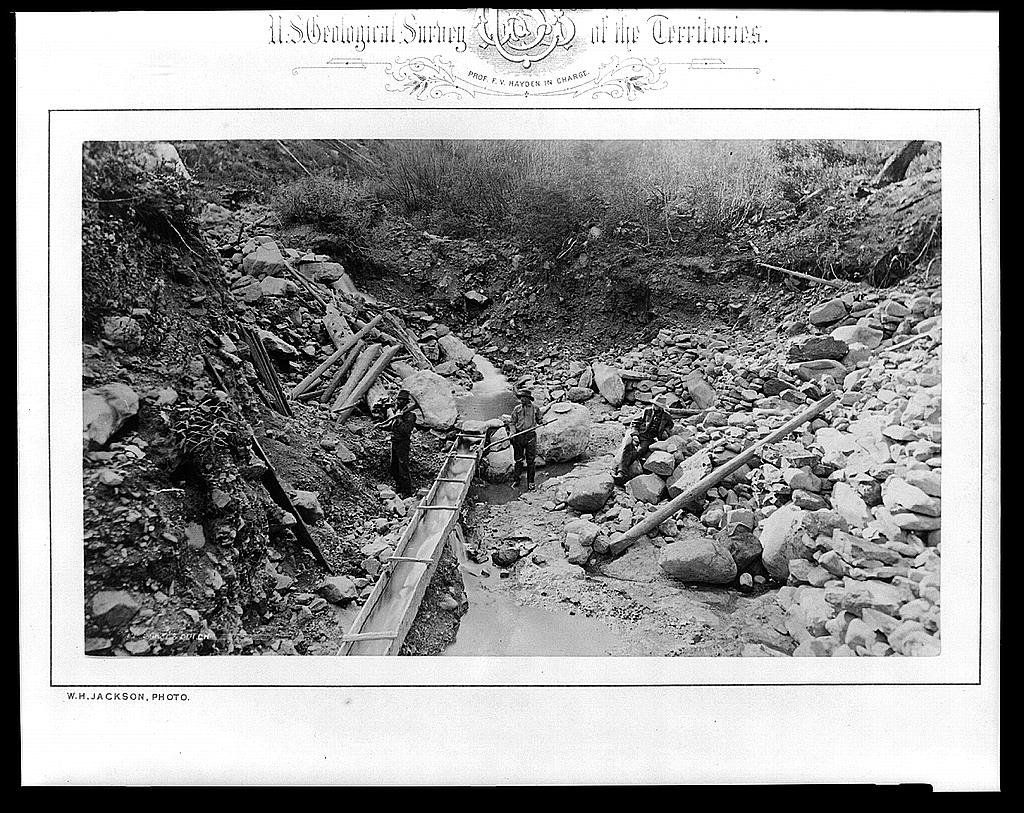
Hydraulic mining had a cost the miners did not pay. The debris went into the rivers: in California it filled river beds, flooded farm towns like Marysville and raised the bottom of parts of San Francisco Bay. On January 7, 1884, in Woodruff v. North Bloomfield Gravel Mining Co., a federal court in California ruled the dumping a nuisance. Hydraulic mining itself stayed legal, but the mine had to keep its debris on its own land and could no longer dump it into any river.
The other cost was mercury. Miners poured liquid mercury into the riffles of their sluices because it binds with gold. The USGS estimates that about 26 million pounds of mercury were used for gold recovery in California, and about 10 million pounds were lost to the environment from placer mining, mostly in the Sierra Nevada. In its 2005 fact sheet, it reported that fish in the Bear and Yuba watersheds had taken up enough mercury to pose a risk to human health.
What does placer mean today?
It is still a legal category. Under US mining law, a placer claim covers every mineral deposit that is not a vein or lode in rock, up to 20 acres per person, or 160 acres for an association of eight or more. Most of Alaska’s gold has come from placers.
The Bureau of Land Management quotes the law: placer claims include “all forms of deposit, excepting veins of quartz, or other rock in-place.” The USGS says 72 percent of Alaska’s gold came from placer deposits, and that as much as two-thirds of all the gold ever mined may have come from placers. You can also try it as a visitor: at the first gold find in the United States, in North Carolina, and at Coloma, where gold was discovered in California, both state parks let you pan.
The ring named Placer
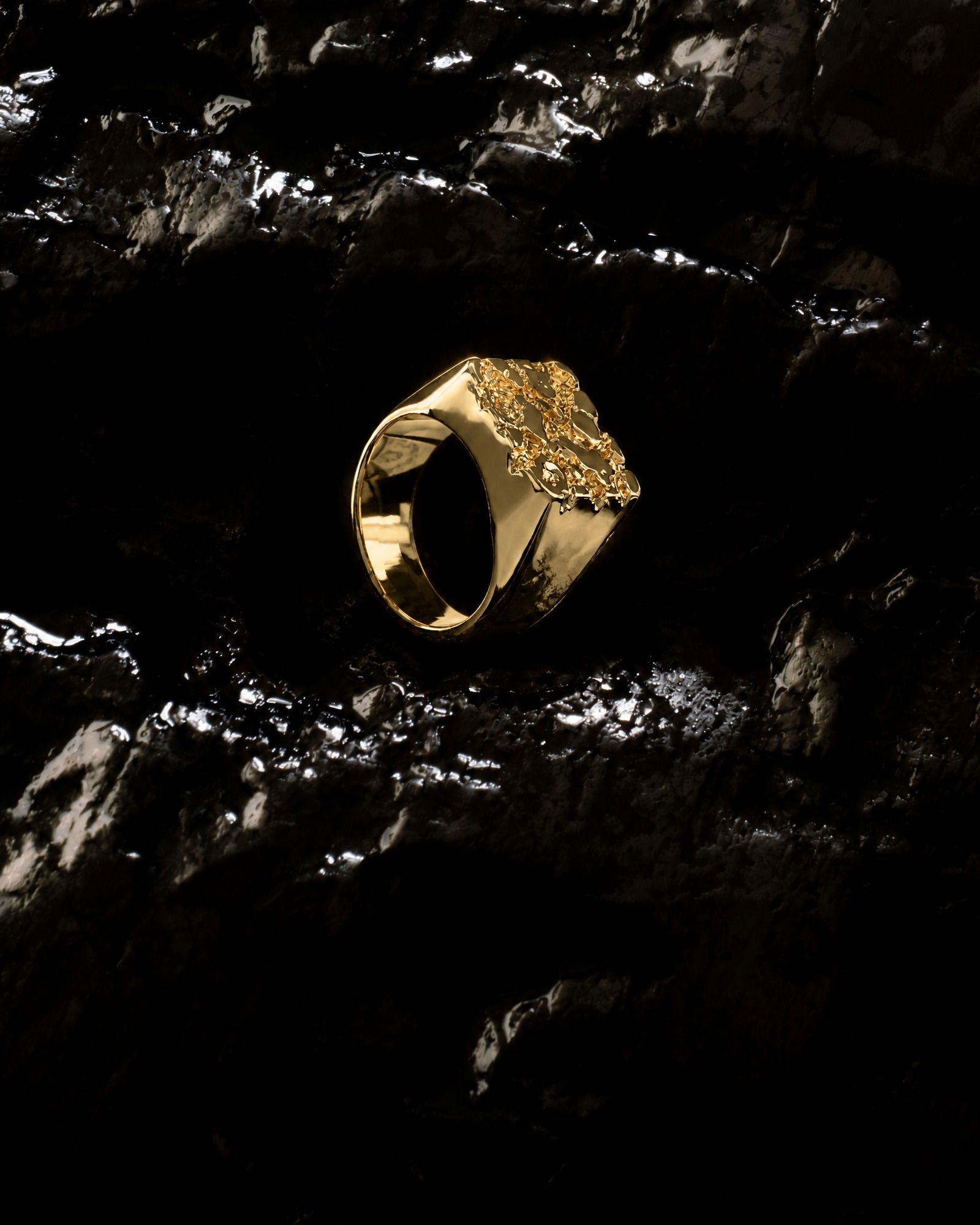
No. 508 Placer is named for this gold. Small, dense grains cover a 10 mm band all the way round, between two narrow polished edges, like a bed of gold-bearing gravel between two riverbanks.
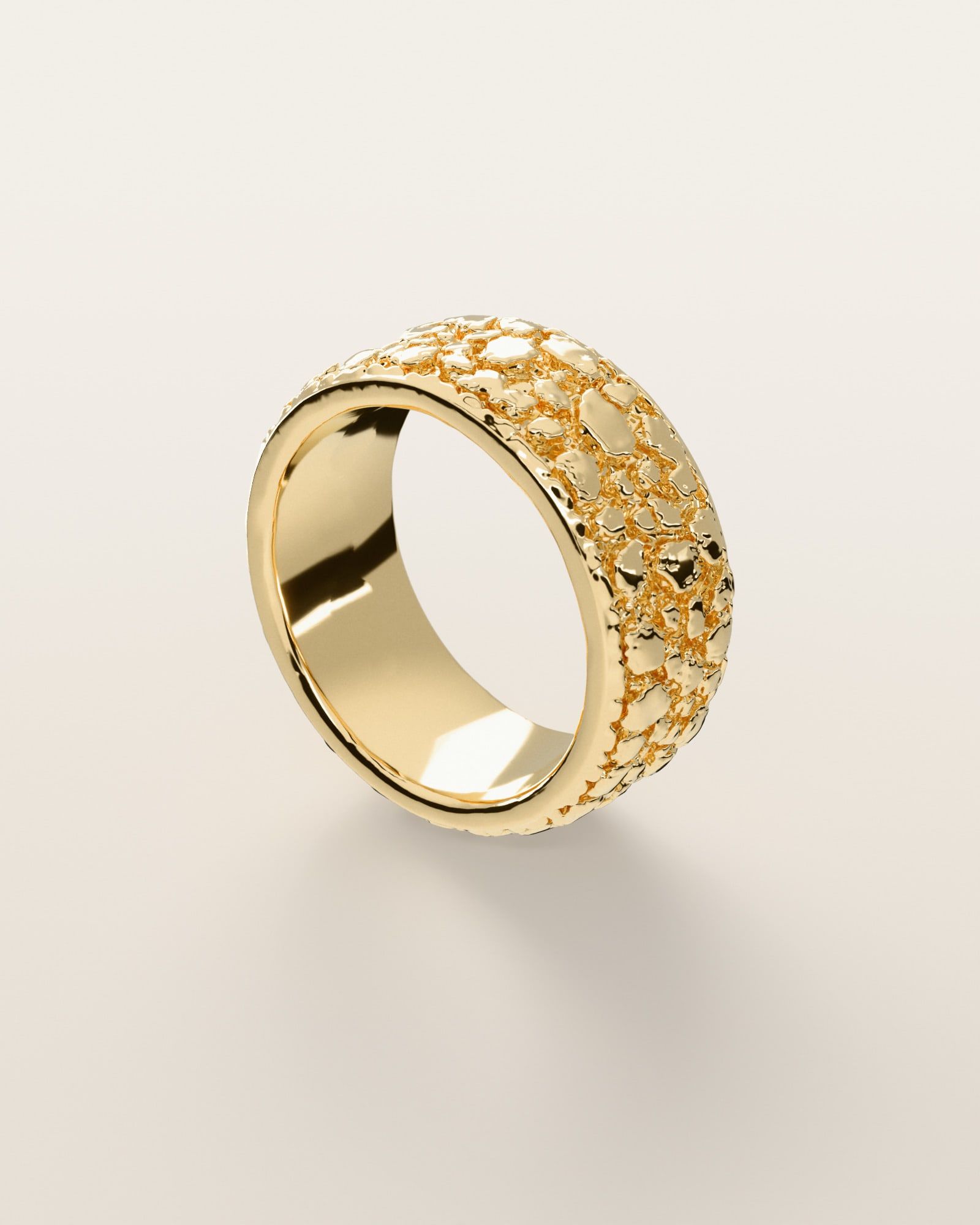
Its story starts in a placer. On January 24, 1848, checking the tailrace of a sawmill on the South Fork of the American River, James Marshall saw bright flakes in the water, bent them with a fingernail and struck them with a stone: placer gold, freed from the rock by the river. The USGS says most of that gold lies low in the gravel as flattened flakes. Placer carries that texture: dense grains all the way round, between two smooth edges like two riverbanks.
The ring is modeled as a 3D file and cast to order in your size by our workshop, then finished: the high points polished, the hollows between the grains cleaned. Placer comes in vermeil, sterling silver covered with a layer of 18K gold, at $435: same price at every size.
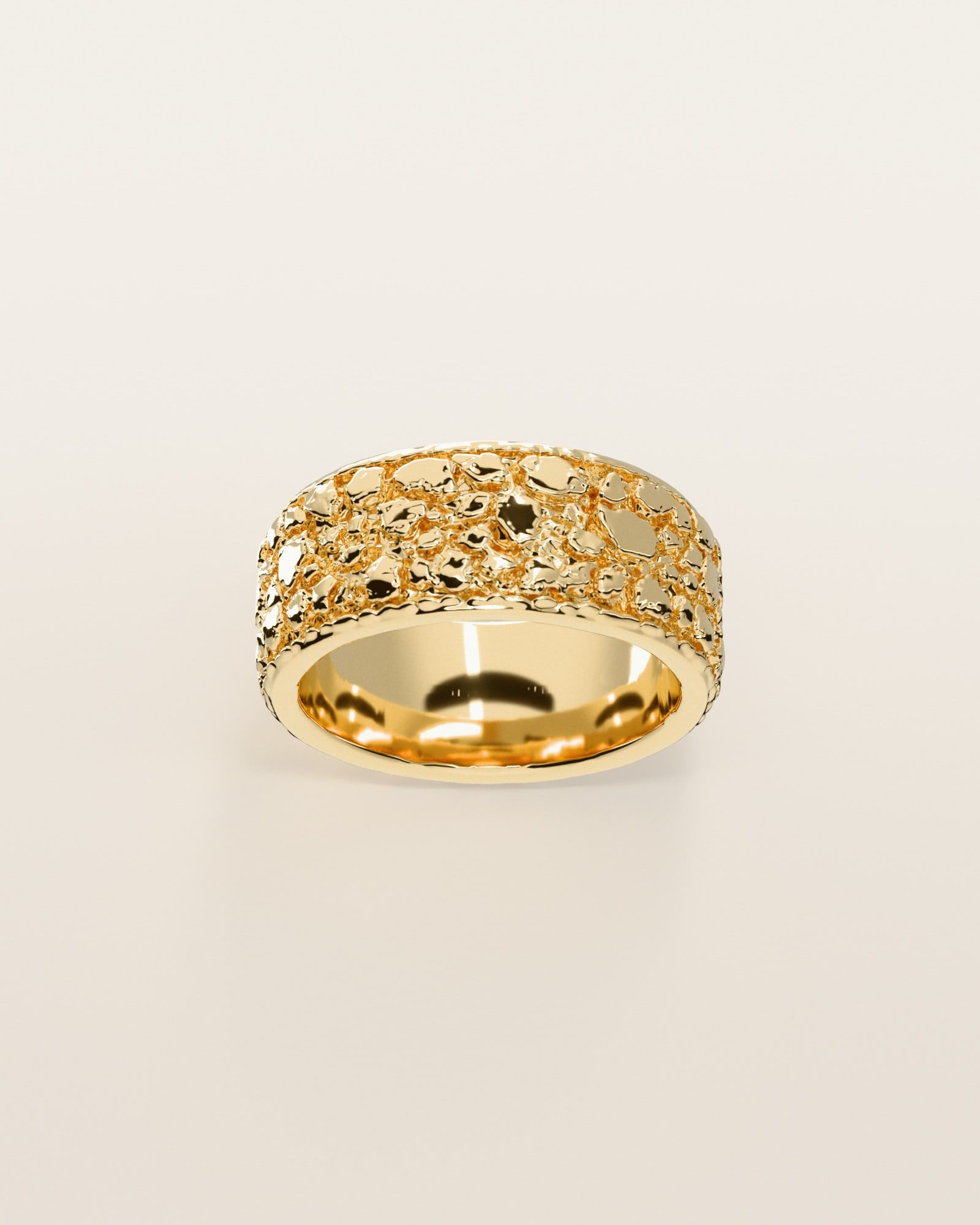
Want it in solid 14K gold? In 14K, Placer weighs 17.7 to 18.4 g at US size 10, and its price follows the gold price, shown on the ring page. It also comes in sterling silver.
Placer is one of the bands of The River collection, named for placer gold and textured like a gold-bearing riverbed. See the ring, its sizes and its metals:No. 508 Placer.
Everything else to check before you buy is in the gold mining terms.
Sources
- Harold Kirkemo, William L. Newman and Roger P. Ashley, Gold, US Geological Survey general interest publication: lode and placer deposits, gold concentrated on or near bedrock during high water, fossil placers. Read 18 October 2026.
- US Geological Survey, Rivers of Gold: Placer Mining in Alaska, Fact Sheet FS-058-98 (1998): 90 percent in the lowest 3 feet and the top foot of bedrock, nuggets rare, flakes under 1/8 inch, 72 percent of Alaska’s gold, up to two-thirds of all gold mined, Nome beaches. Read 18 October 2026.
- Harold Kirkemo, Prospecting for Gold in the United States, US Geological Survey: definition of a placer deposit, the gold pan. Read 18 October 2026.
- US Bureau of Mines, A Dictionary of Mining, Mineral, and Related Terms (1968, public domain): “placer”, “placer gold”, “placer claim”, “pan”.
- The American Heritage Dictionary of the English Language, placer(etymology and pronunciation). Read 18 October 2026.
- California Office of Historic Preservation, landmark No. 168 (the San Fernando placers); North Carolina Historic Sites,Reed Gold Mine: History (“Placer, or creek, gold mining”). Read 18 October 2026.
- Woodruff v. North Bloomfield Gravel Mining Co., 18 F. 753 (Circuit Court, D. California, January 7, 1884); Online Archive of California,Malakoff Diggins State Historic Park Collection(debris, Marysville, San Francisco Bay, the ruling’s terms). Read 18 October 2026.
- Charles N. Alpers and others, Mercury Contamination from Historical Gold Mining in California, USGS Fact Sheet 2005-3014: 26 million pounds used, about 10 million pounds lost. Read 18 October 2026.
- Bureau of Land Management, Mining Claims: placer claims, 20 acres per locator, 160 acres for an association. Read 18 October 2026.
- No. 508 Placer: the ring’s story and its sources (US Bureau of Mines; USGS; California State Parks, Marshall Gold Discovery State Historic Park brochure, rev. 2013). Measurements from the 3D file.