Guide · Gold explained
How much gold is in an Olympic gold medal?
Six grams. That is the amount of gold the Olympic rules have asked of a gold medal, and it is smaller than most people guess. Below: where the number comes from, what it looks like on a table, when the medals were still gold, and what the same rules mean when you buy gold jewelry.
How much gold is in an Olympic gold medal?
About 6 grams. A modern Olympic gold medal is a silver medal covered with a coat of pure gold: at Rio 2016 the winner’s medal held 494 grams of sterling silver and 6 grams of gold, out of 500 grams. That is 1.2% gold by weight.
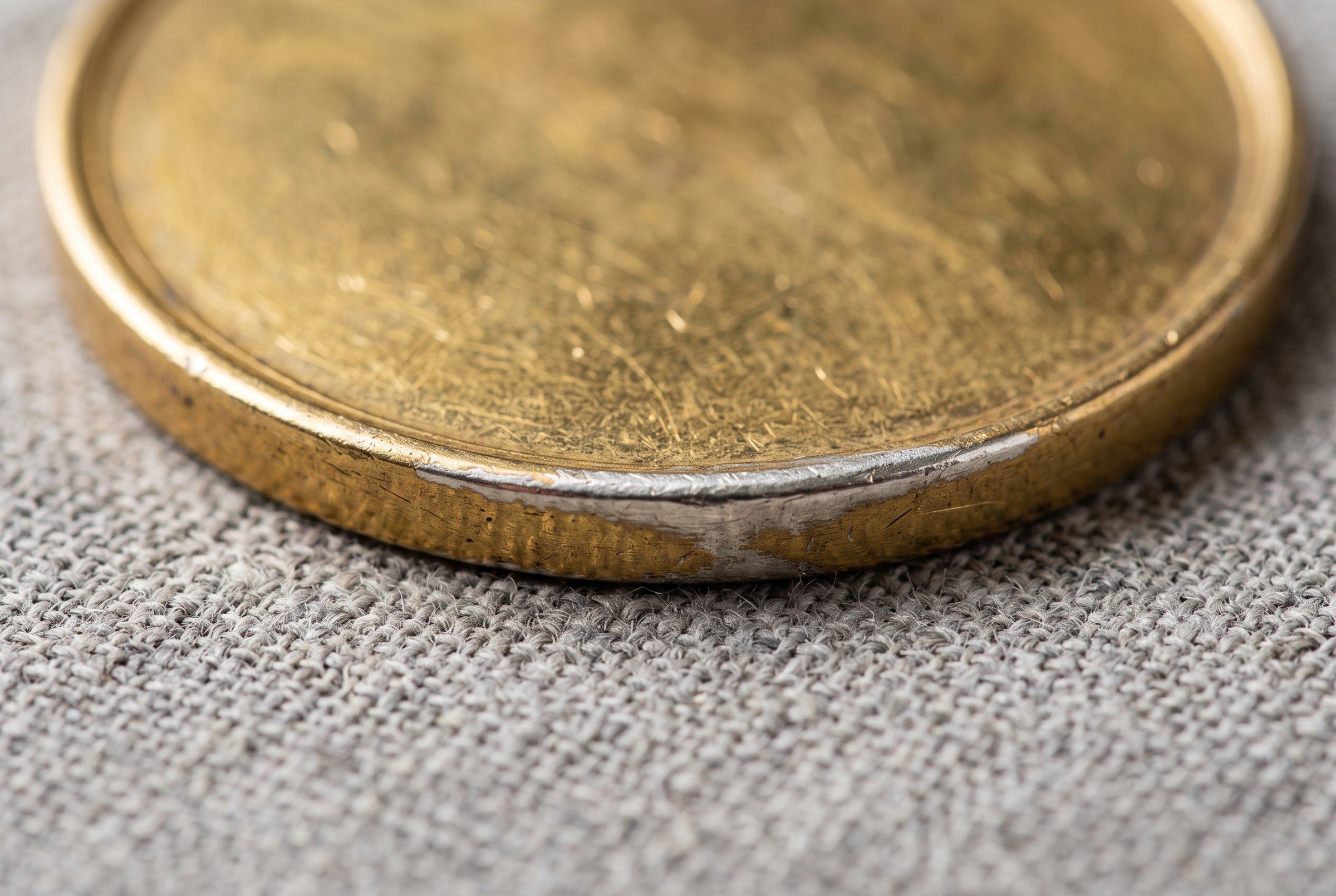
The figures come from the Olympic Studies Centre, the International Olympic Committee’s own reference service. Its 2019 document on the Summer Games medals lists the Rio winner’s medal as “Silver (494g - 92.5% pure), Gold (6g - 99.9% pure)”, 85 mm across. Rio’s organizers gave the total weight, 500 grams, in their release of June 15, 2016.
Paris 2024 kept the same 6 grams. The Associated Press reported that the Paris gold medal weighs 529 grams, is made of silver plated with 6 grams of gold, and carries in its center an 18-gram hexagon of iron cut from pieces of the Eiffel Tower replaced during renovations. A Paris champion went home with three times more Eiffel Tower than gold.
| Games | Winner’s medal | Source |
|---|---|---|
| Beijing 2008 | 6 g of gold, silver and jade; 70 mm | IOC |
| London 2012 | gold 1.34%, sterling silver, copper; 85 mm | IOC |
| Rio 2016 | 494 g of sterling silver, 6 g of gold; 500 g in all | IOC, Rio 2016 |
| Tokyo 2020 | “more than 6 g” of gold on silver; 85 mm | IOC |
| Paris 2024 | 6 g of gold on silver, 18 g of Eiffel Tower iron; 529 g in all | AP |
How small is 6 grams of gold?
A cube under 7 mm on each side. Gold is dense, 19.3 grams per cubic centimeter according to the US Geological Survey, so 6 grams melted into a cube would measure about 6.8 mm on each side, roughly a quarter of an inch.
Gold is priced in troy ounces, and one troy ounce is 31.103 grams (NIST). Six grams is 0.19 troy ounce, less than a fifth of the unit every gold price is quoted in.
Spread over a medal, the same gold becomes a skin. If you lay 6 grams evenly over both faces of an 85 mm disc, it comes out at roughly 25 microns thick, about a fortieth of a millimeter. That is our arithmetic, and it is generous: it ignores the relief and the rim, which take some of the gold. Every bit of yellow you see on the podium is that skin. Bite the medal and your teeth go through the gold in the first fortieth of a millimeter; the rest is silver.
Where does the 6-gram rule come from?
From the Olympic Charter. The 2003 edition, in its bye-law to Rule 70, says the first- and second-place medals “shall be of silver of at least 925-1000 grade” and that the medal for first place “shall be gilded with at least 6g of pure gold”.
The same bye-law sets the minimum size: at least 60 mm across and 3 mm thick. It calls the first prize “a silver gilt medal”, which is the plain description of what the athletes receive. Third place gets bronze, with no rule on its content.
The 6 grams show up in the IOC’s own table long before 2003. Its entry for Tokyo 1964 reads “Gilt silver; fine gold (6g)”, the first Games in that document where the gold is given in grams. Sydney 2000 and Beijing 2008 are listed with 6 grams, Rio 2016 with the full split. We quote the 2003 Charter because it spells the rule out word for word.
Sterling is the word for silver at 925 parts per thousand. In the United States, the Federal Trade Commission reserves “sterling” for metal at least that pure, so the Charter’s minimum and the American jeweler’s sterling are the same standard.
Were Olympic gold medals ever solid gold?
Briefly, and not for everyone. The IOC lists the first-place medals of St. Louis 1904 and London 1908 as gold. At Stockholm 1912, individual winners received gold medals and members of winning teams received silver-gilt ones. From Antwerp 1920 on, every winner’s medal in the IOC’s table is gilt silver or silver with a few grams of gold.
The first modern Games did not give gold at all. At Athens in 1896, the IOC says, the winner received “an olive branch and a silver medal”, and the runner-up a bronze or copper medal with a branch of laurel. James B. Connolly of Massachusetts was the first champion rewarded that way. The IOC lists the Paris 1900 winner’s medal as gilt silver. St. Louis 1904 was the first Games to give gold, silver and bronze to the first three places.
Stockholm’s own report, published in 1913, gives the count. The Swedish Olympic Committee had 845 prize medals struck by C. C. Sporrong & Co.: 90 gold, 200 silver-gilt, 285 silver and 270 bronze. Each was 33 mm across, the size of the London 1908 medal. It explains the IOC table’s entry for Stockholm’s first prize, “Gold / Gilt silver”: both kinds went to winners.
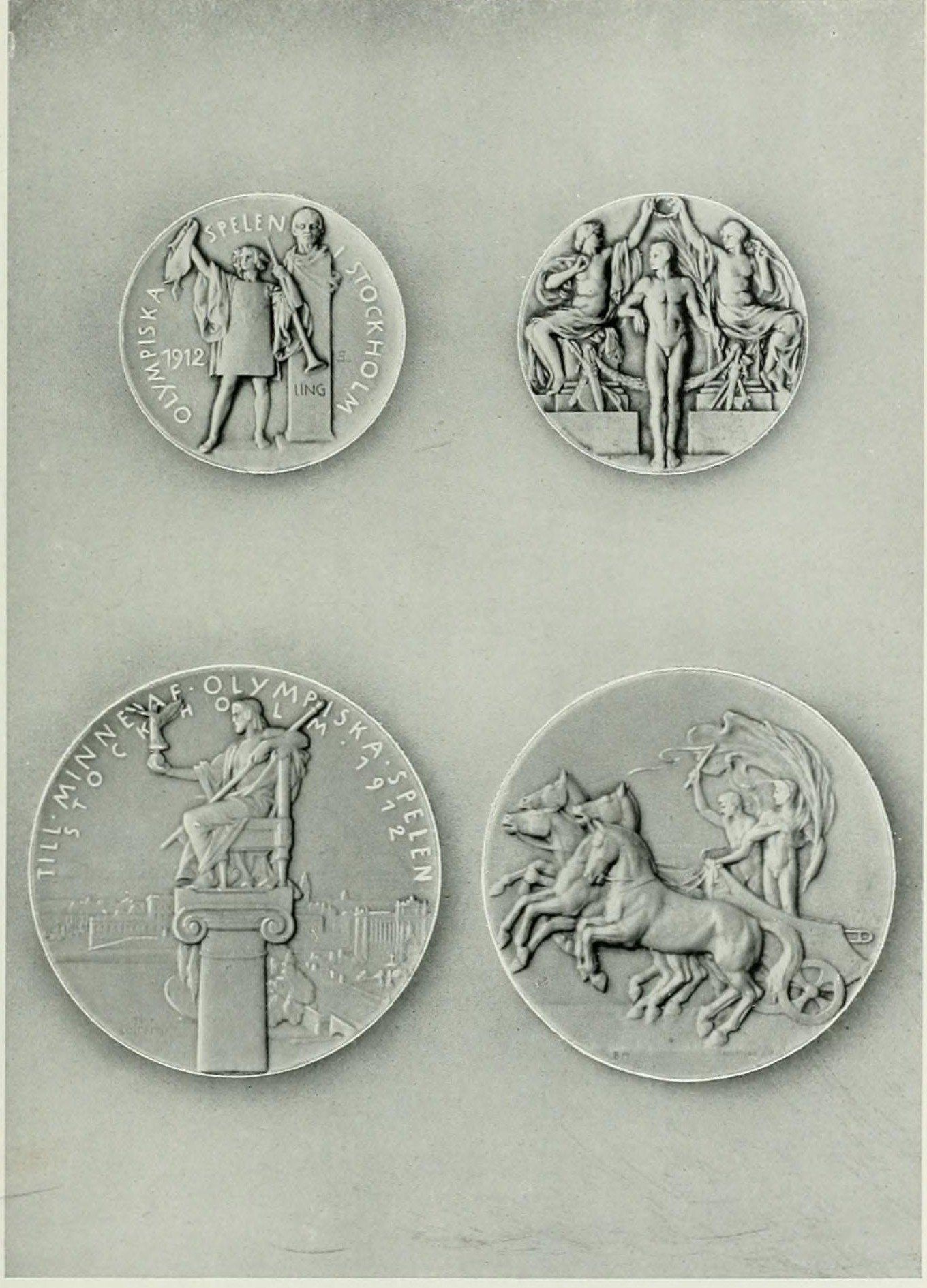
The 33 mm detail matters for any comparison. A solid gold medal of 1912 was a small object; the 85 mm gilt medals of today are much larger. If Rio’s 500-gram medal had been solid gold, it would have held about 83 times the gold it did (500 grams against 6, our arithmetic).
Where does the gold in the medals come from?
Recent organizers have made a point of saying. Rio 2016 used gold extracted without mercury, and Tokyo 2020 made all its medals from metal recovered from used electronics collected across Japan: 30.3 kg of gold, 4,100 kg of silver and 2,700 kg of bronze.
The Tokyo figures come from the IOC’s medal document. To get them, the organizers set up collection points all over the country and gathered 78,985 tonnes of old devices. Tokyo’s winner’s medal is listed with “more than 6 gr.” of gold, the only recent entry in that table worded as a floor rather than a figure.
For Rio, the same document says part of the silver was taken from X-ray plates, car parts and pieces of mirror, and the Rio 2016 release put the recycled share of the silver and bronze medals at 30 per cent. Neither changes the recipe: gold on the outside, sterling silver underneath.
What is the gold in a gold medal worth?
Its metal is worth what 0.19 troy ounce of gold plus 14.7 troy ounces of silver are worth on the day. By weight, a Rio medal holds about 76 times more pure silver than gold.
The arithmetic, ours, from the IOC figures: 494 grams of silver at 92.5% purity is about 457 grams of pure silver, or 14.7 troy ounces. The 6 grams of gold are 0.19 troy ounce. Multiply each by that day’s price; our gold price today page shows the gold side.
That is only the metal. A medal is valued for who won it and where, which no scale measures. The same gap between metal and object runs through the whole history of gold: a famous nugget can sell for far more than its gold, as the story of the Hand of Faith nugget shows.
Would a gold medal count as gold at a US jeweler?
No. Under the Federal Trade Commission’s Jewelry Guides, the word “gold” alone describes an item made throughout of 24-karat gold, and a coated item must say it is only plated. A gold medal is sterling silver under a gold coat, so in a jewelry case it would be gold-plated sterling silver.
The FTC also has a name for exactly this construction. Under 16 CFR 23.4, “vermeil” is sterling silver coated on all significant surfaces with gold of at least 10 karats, above a minimum thickness the rule sets. On paper, an Olympic gold medal is vermeil.
We sell vermeil too, and we describe it the same plain way: Solid 925 sterling silver, covered with a layer of 18K gold. The gold layer can wear with use. It is gold where you see it and silver inside, which is what the athletes get. The difference between the metals is laid out in 14K vs vermeil vs silver.
How much gold is in a 14K ring, by comparison?
A 14K ring is 14 parts gold in 24, all the way through. So any 14K ring heavier than about 10.3 grams holds more gold than an Olympic gold medal (6 grams × 24 ÷ 14, our arithmetic).
That is the opposite construction from the medal. On a medal, the gold is a skin and the silver is the mass. In solid 14K gold, the alloy is the same from the surface to the center, so the weight on the scale tells you the gold. This is why a 14K ring should always come with its weight, and why a missing weight is worth a question; the steps to check a ring are in how to tell if a nugget ring is real.
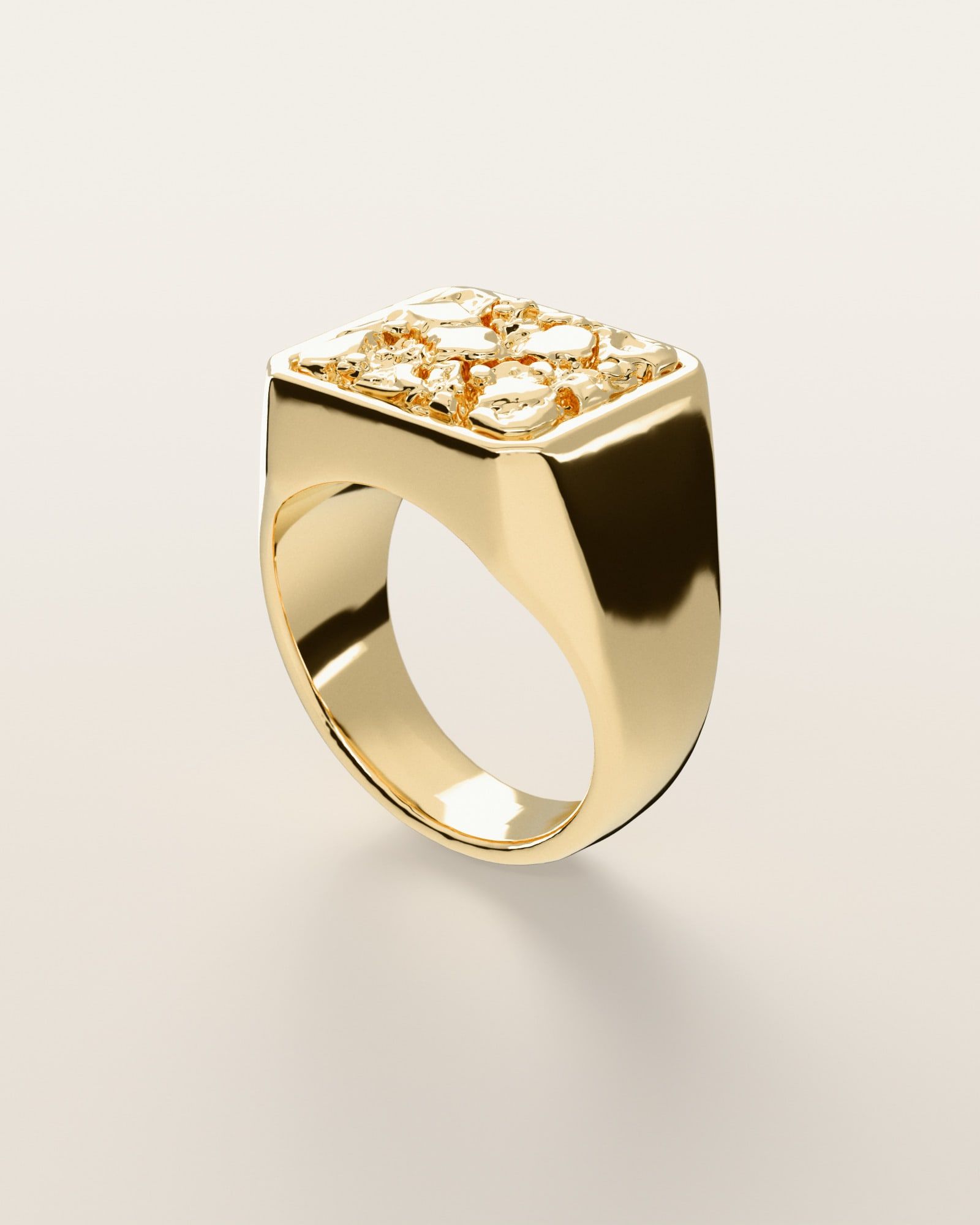
For scale: No. 501 Anvil in solid 14K gold weighs 32.2 to 33.3 g at US size 10. Even at the low end of that range, it holds more gold than 3 Rio medals put together. Every ring page shows the 14K weight range at your size before you order.
More short answers about gold are collected in gold, explained. Rings that are gold all the way through: 14K gold nugget rings.
Everything else to check before you buy is in the gold facts.
Sources
- IOC Olympic Studies Centre, Olympic Summer Games Medals from Athens 1896 to Tokyo 2020 (10 September 2019): pages 6-7 (1896, 1904), 8 (1900), 9-12 (1904-1912), 13 (1920), 25 (1964), 42-47 (2008-2020). Read 18 October 2026.
- International Olympic Committee, Olympic Charter, in force as from 4 July 2003, Bye-law to Rule 70, paragraphs 2.1-2.2. Read 18 October 2026.
- Rio 2016 Organising Committee, Rio 2016 reveals Olympic medals, celebrating nature and sustainability (15 June 2016; 500 g medals).
- Associated Press, Paris Olympics medals made with Eiffel Tower iron (8 February 2024; 529 g, 6 g of gold, 18 g of iron).
- E. Bergvall (ed.), The Fifth Olympiad: the Official Report of the Olympic Games of Stockholm 1912 (1913), pages 160-161, “The Prize Medals”. Internet Archive scan, read 18 October 2026.
- Federal Trade Commission, Guides for the Jewelry, Precious Metals, and Pewter Industries, 16 CFR 23.3 (gold), 23.4 (vermeil), 23.5 (sterling). Read 18 October 2026.
- H. Kirkemo, W. L. Newman and R. P. Ashley, Gold, US Geological Survey general interest publication (density of gold, 19.3).
- NIST, Guide to the SI, Appendix B.9 (1 troy ounce = 31.10348 grams).
- Our arithmetic: cube side = (6 ÷ 19.3)^(1/3) cm; coat = 6 g ÷ 19.3 grams per cm³, spread over two 85 mm faces; pure silver = 494 g × 0.925; troy ounces = grams ÷ 31.103; 14K weight holding 6 g of gold = 6 × 24 ÷ 14.