Guide · Famous nuggets
The Hand of Faith nugget: the 1980 find and its casino sale
On September 26, 1980, a metal detector found a gold nugget 47 cm long standing upright a foot under the bush in Victoria, Australia. It looked like a hand. Forty-six years later it is still the largest nugget anyone has found with a detector, and its sale showed how far a nugget’s price can run ahead of its gold.
What is the Hand of Faith nugget?
The Hand of Faith is a gold nugget of about 875 troy ounces (27.2 kg, 60 pounds) found near Kingower, Victoria, by Kevin Hillier on September 26, 1980. It is the largest gold nugget known to have been found with a metal detector, and it was sold in 1981 to the Golden Nugget casino company in Las Vegas.
It is not the largest nugget ever found. Victoria’s own goldfields gave bigger ones in the 1850s and 1860s, when diggers worked with picks and pans; the biggest of all is told in our guide to theWelcome Stranger nugget. What sets the Hand of Faith apart is how it was found, and when: more than a century after the rush, in ground that had already been dug.
How was the Hand of Faith found?
By a husband and wife with metal detectors, after a morning that had found nothing. Kevin and Bep Hillier stopped at a patch of bush off the main road through Kingower, walked off in different directions, and Kevin’s detector picked up the tip of a large nugget lodged vertically about 30 cm (a foot) down.
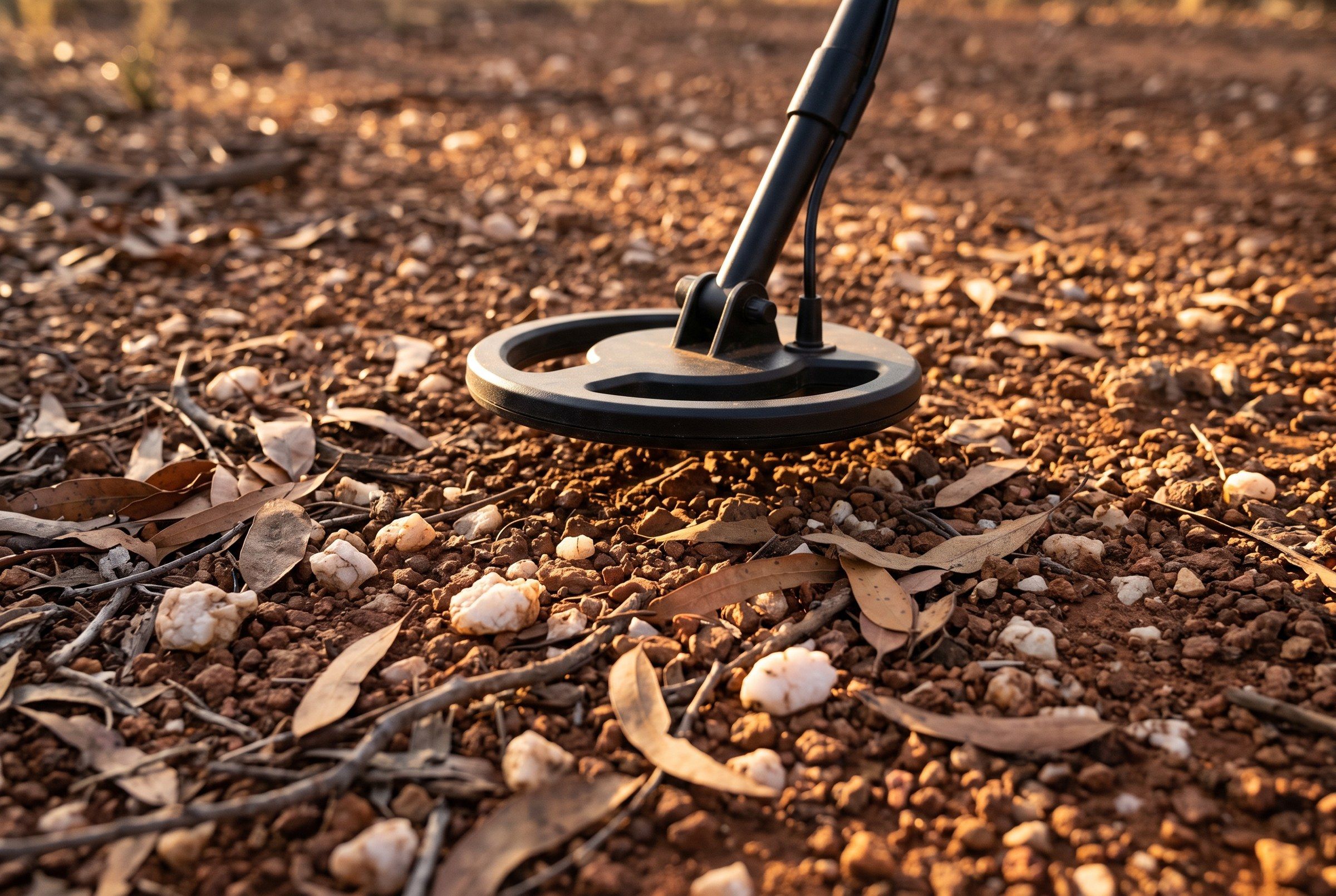
The details come from the people who were there. Bep Hillier told The Catholic Weekly in 2021 that when she reached her husband, “he had a big hole in front of him, about 14 inches wide, and you could just see a bit of gold.” The nugget could not be pried out from above, so they kept digging around it until it came free, according to the account published by Today I Found Out in 2017.
Then came the practical problem of owning 27 kg of gold. The Bendigo Advertiser reported in 2018 that the couple drove past a bank and a police station without stopping, and kept the nugget in a baby bath under their bed at a caravan park in Bridgewater until a sale could be arranged, with the help of the gem dealer Cyril Kovak.
The public heard about it at a televised press conference in Melbourne, where the Premier of Victoria, Dick Hamer, announced the find on October 8, 1980. The Hilliers were not there.
How big is the Hand of Faith?
About 875 troy ounces, which is 27.2 kg or 60 pounds, and about 47 cm long (18.5 inches): about the length of a forearm and hand, by our comparison. Early reports gave 720 ounces; the corrected figure is 874.82 troy ounces.
The weight in troy ounces matters because gold is priced in them. One troy ounce is 31.1 grams, against 28.35 grams for the ordinary ounce (NIST), so 875 troy ounces come to about 60 pounds on a bathroom scale. The “72 troy pounds and 11 troy ounces” some sources give is the same weight in the old troy pound of 12 ounces.
A nugget is not a bar. Natural gold is an alloy, usually with silver, as the US Geological Survey’s study of native gold explains, and the fineness of the Hand of Faith has not been published. For comparison, the Blanche Barkly, found at Kingower in 1857, assayed at 95.58 per cent pure gold when it was melted, according to a mining engineer’s compendium of 1900. A nugget’s weight is therefore always a little more than the gold inside it.
Why is it called the Hand of Faith?
Because of its shape and because of the finders’ faith. The nugget looks like an open hand, and Kevin and Bep Hillier saw in its shape and in the way they found it a blessing from God, so they named it the Hand of Faith.
That is how Bep Hillier put it to The Catholic Weekly in 2021. Big nuggets have carried names since the gold rush: the Blanche Barkly, found at Kingower in 1857, was named after the daughter of Victoria’s Governor. A name turns a lump of metal into an object people can talk about, and that mattered when the Hand of Faith was sold.
Why did a casino pay double for the Hand of Faith?
Because it was not buying gold. In 1981 the Golden Nugget paid about a million dollars for the Hand of Faith, while 875 troy ounces of pure gold were worth roughly $400,000 to $450,000 at that year’s prices. The extra was the price of the only nugget of its kind.
Sources give different sale figures: A$1 million, about US$870,000 at the time (Las Vegas Advisor, 2006); US$1 million (Bendigo Advertiser, 2018); $1.3 million (The Catholic Weekly, 2021). Today I Found Out dates the sale to early February 1981.
The gold side, our arithmetic: the LBMA gold price averaged about $460 an ounce over 1981, and about $506 in February 1981. At $460, 875 ounces of pure gold come to about $402,500; at $506, about $442,750. The nugget is not pure gold, so its gold was worth less than either figure. Against a sale price between $870,000 and $1.3 million, the casino paid about two to three times the metal.
The same gap between metal and object runs through the history of gold. A modern Olympic gold medal holds only 6 grams of it, as our guide on how much gold is in an Olympic gold medal explains, and nobody weighs a medal to decide what it means. Gold has a market price; a named nugget has the price someone will pay for it.
What does the Hand of Faith prove?
That the old goldfields were not finished. Kingower had been dug since 1853, yet a 60-pound nugget lay a foot under the surface until 1980. The diggers of the 1850s had picks, pans and their eyes; a detector reads through the soil.
Kingower was a rush town. Victorian Places records that the goldfield was found in 1853 by John Mechosk, that it held about 5,000 miners by 1854, and that the diggers called it the “potato diggings” for the size and look of its nuggets. By the 1947 census the village had 58 people.
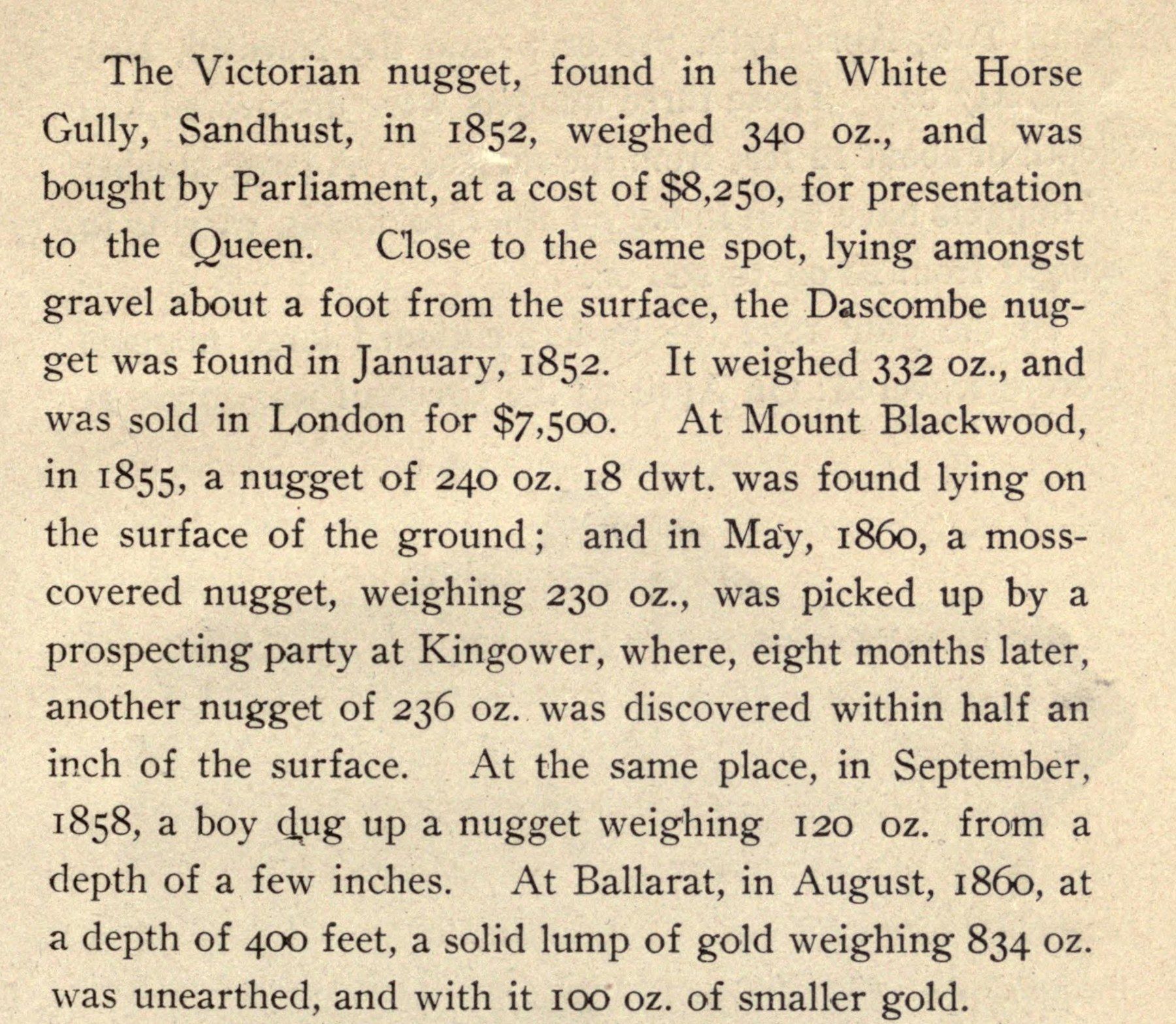
Big gold had come out close to the surface there before. Thomas Jefferson Hurley’s Famous Gold Nuggets of the World, published in 1900, lists a nugget of 805 ounces found at Kingower “within a foot of the surface”, another of 236 ounces “within half an inch of the surface”, and one of 120 ounces dug up by a boy in September 1858 “from a depth of a few inches”. The Blanche Barkly, 1,743 ounces, came from 13 feet down.
So the Hand of Faith did not prove that Kingower had gold: everybody knew that. It proved that a large piece could still be lying in reach of a spade after 127 years of digging. Australian Geographic calls it the world’s largest gold nugget found using a metal detector, and the Bendigo Advertiser says the same.
Where is the Hand of Faith today?
In Las Vegas. Las Vegas Advisor in 2006 and The Catholic Weekly in 2021 both place it on display at the Golden Nugget downtown. Replicas have been shown at the Golden Nugget casinos in Laughlin and Atlantic City and, since 2018, at the Central Deborah Gold Mine in Bendigo, Victoria.
The Bendigo replica was a gift from Bep Hillier, reported by the Bendigo Advertiser in October 2018. Kevin Hillier died in 2014, and Today I Found Out records that a replica of the nugget was placed beside his coffin.
Around Kingower, the hunt never stopped. As of December 2025, Reuters, citing Victoria’s resources department, counted over 100,000 active miner’s rights, Victoria’s prospecting permits; by July 2026 the Tarrangower Times put the number above 115,000. The record from 1980 still stands. More short answers about gold are collected in gold, explained.
Which ring takes its story from the Hand of Faith?
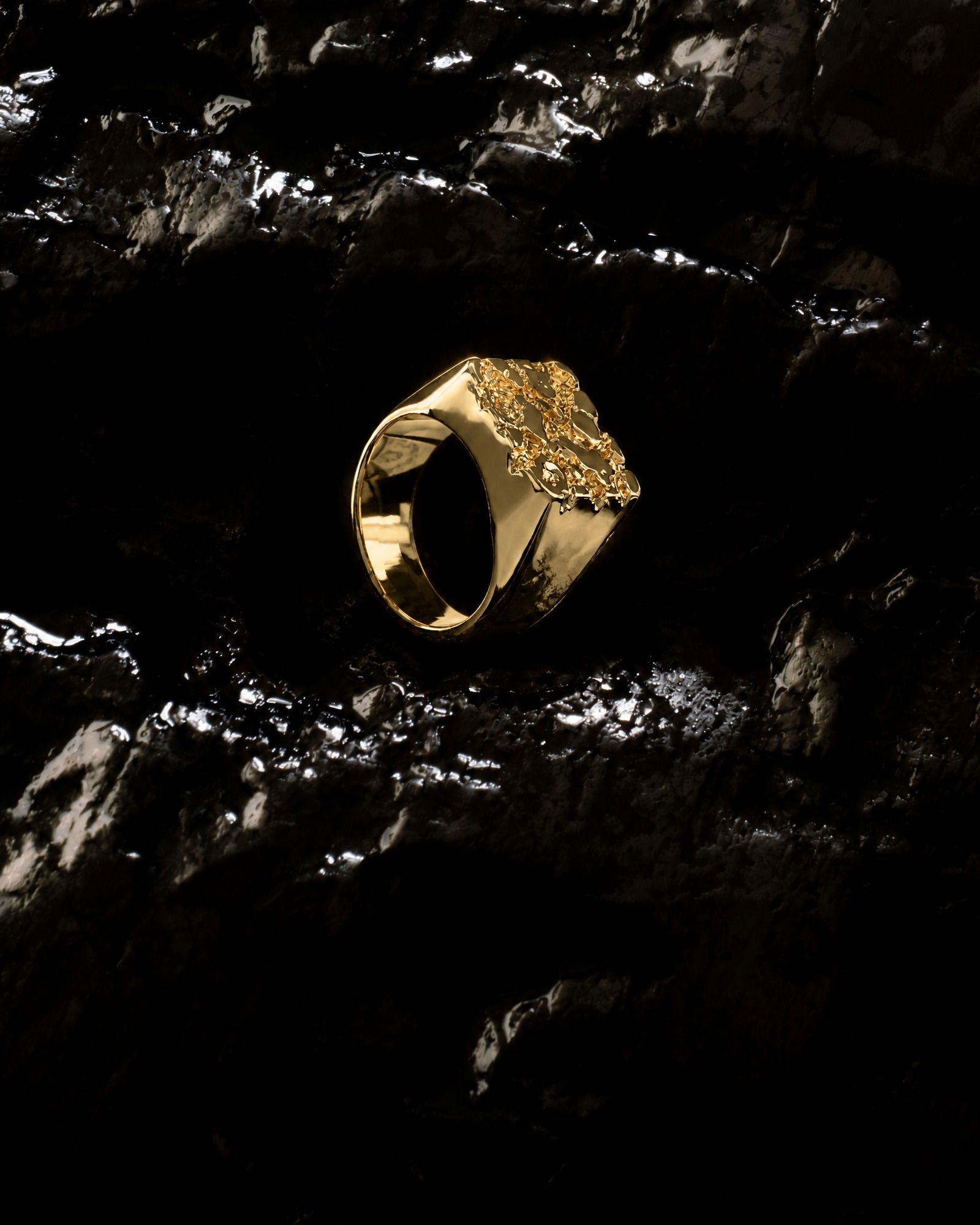
Our No. 104 Knuckle. Its name and its story start from the hand that came out of the ground near Kingower; it does not copy the nugget. It is a small framed face of fine nugget texture, set low, as close to the finger as it gets, on short smooth shoulders.
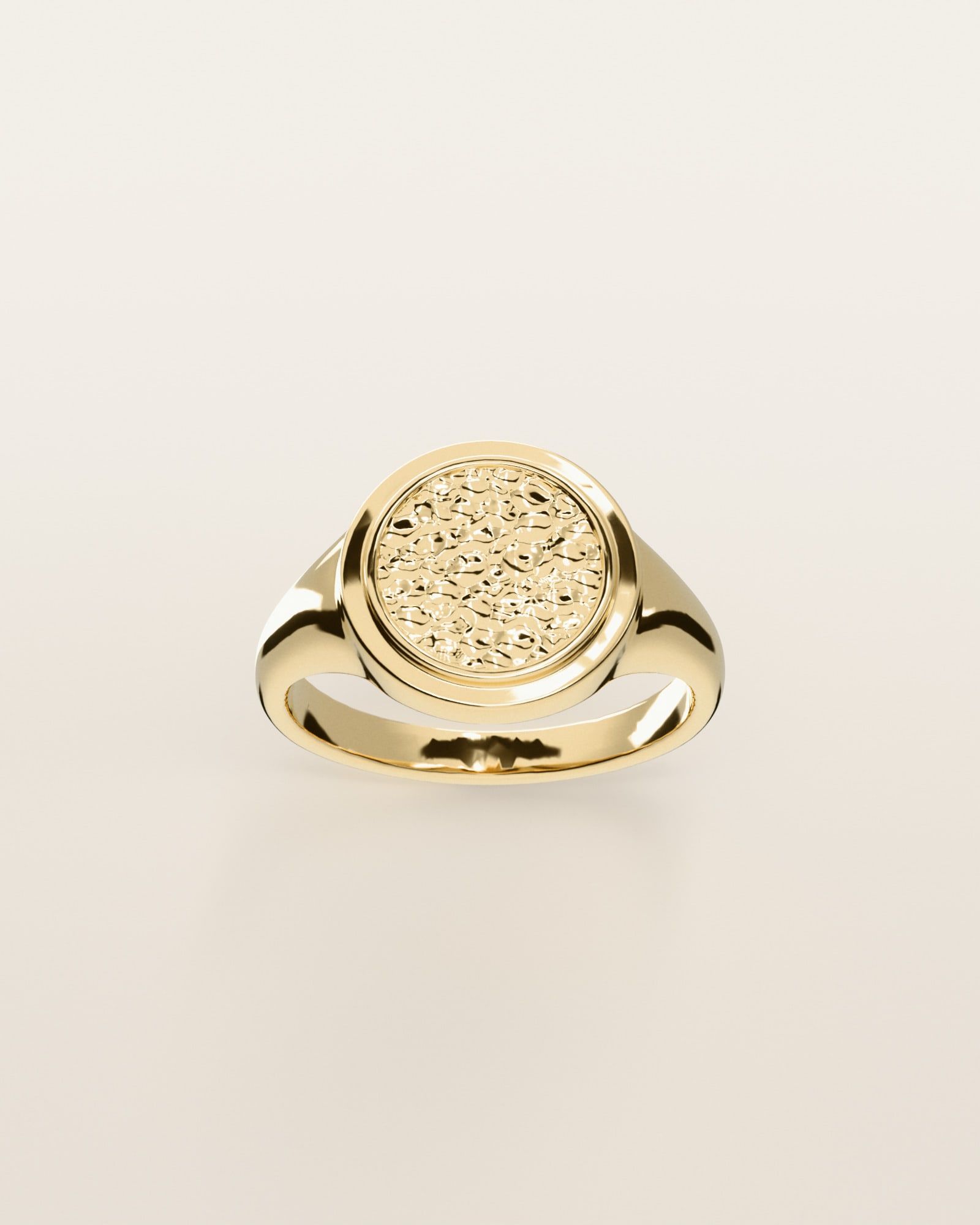
The measurements come from the file we cast from. The ring is 14.1 mm wide at the top and narrows to 2.8 mm underneath, and the top of the face sits 3.0 mm above the finger.
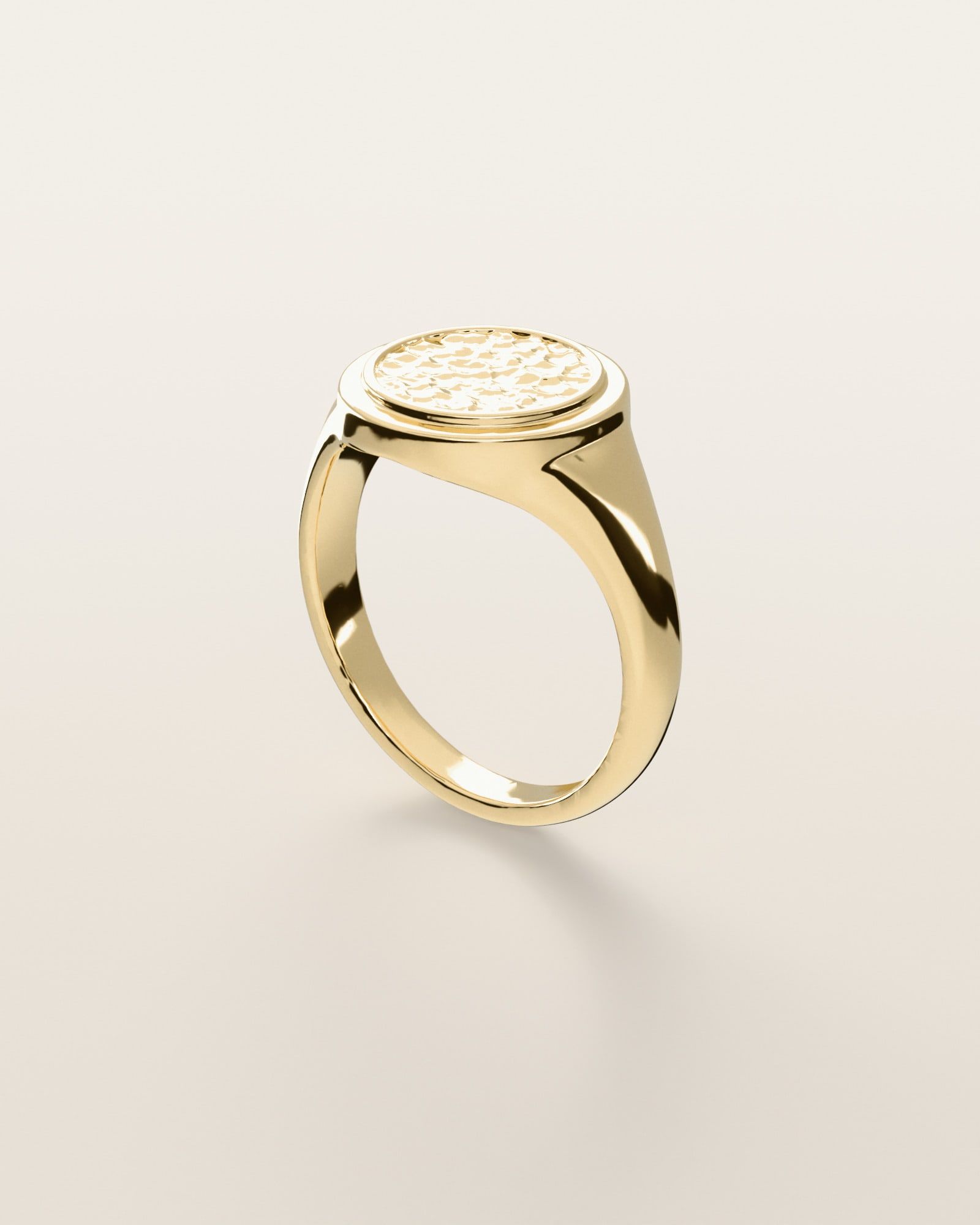
Knuckle is cast to order in your size by our workshop. In vermeil it is $405, the same at every size. Want it in solid 14K gold? It weighs 10.4 to 10.8 g at US size 10, and its 14K price follows the gold price. For what the texture means and how such rings are made, see what is a nugget ring.
Everything else to check before you buy is in the gold facts.
Sources
- Australian Geographic, Australia’s biggest gold nuggets (10 November 2016): date, finder, 27.2 kg, 30 cm, vertical, largest found with a metal detector. Read 18 October 2026.
- M. Rodrigues, The Hand of Faith, The Catholic Weekly (22 December 2021): Bep Hillier’s account, the name, the sale, Kevin Hillier’s death in 2014. Read 18 October 2026.
- M. Blitz, The story of the Hand of Faith, Today I Found Out (25 January 2017): the digging, the press conference, the sale in early February 1981, the replica at the funeral. Read 18 October 2026.
- E. Kernebone, Hand of Faith replica given to Central Deborah Gold Mine, Bendigo Advertiser (16 October 2018). Read 18 October 2026.
- Las Vegas Advisor, Question of the day(23 March 2006): 875 troy ounces, A$1 million (US$870,000), lobby of the Golden Nugget. Read 18 October 2026.
- Hand of Faith, Wikipedia, citing Gold, Gem & Treasure, 2010 Yearbook, pp. 24-26 (874.82 troy ounces, the 720-ounce error, 47 × 20 × 9 cm, the press conference of 8 October 1980). Read 18 October 2026.
- Victorian Places, Kingower (goldfield 1853, 5,000 miners by 1854, “potato diggings”, census populations). Read 18 October 2026.
- T. J. Hurley, Famous Gold Nuggets of the World (1900), pages 36-39 (Blanche Barkley [sic], Kingower finds). Internet Archive scan, read 18 October 2026.
- MetalCharts, Gold price history, 1981 (LBMA annual average $460; February 1981 average $506). Read 18 October 2026.
- Reuters (30 December 2025), citing Victoria’s Department of Energy, Environment and Climate Action, and the Tarrangower Times, Good prospects (3 July 2026): miner’s rights in Victoria.
- R. S. Jones and M. Fleischer, Gold in minerals and the composition of native gold, US Geological Survey Circular 612 (1969).
- NIST, Guide to the SI, Appendix B.9 (troy ounce 31.10 g; ounce avoirdupois 28.35 g).
- Our arithmetic: 875 × $460 and 875 × $506, at 100% gold; 875 ÷ 12 troy ounces to the troy pound; 1980 − 1853 = 127 years.