Guide · History
Where was the first gold found in the United States?
The California Gold Rush is the famous one, but it came half a century late. The first documented gold find in the United States was a heavy yellow rock that a boy picked out of a North Carolina creek in 1799, and that his family used to hold a door open.
Where was the first gold found in the United States?
On the Reed farm in Cabarrus County, North Carolina. In 1799 Conrad Reed found a yellow rock of about 17 pounds in Little Meadow Creek, and the State of North Carolina calls it the first documented gold find in the United States. The farm became the Reed Gold Mine, and North Carolina led the country in gold production until 1848.
“Documented” is the important word. People had seen gold in the colonies before 1799, as the next section shows, but Reed’s find is the first one with a traceable story, a place you can still visit and a mine that came out of it. The rest of this page follows that place year by year, from a lump of ore in Virginia to the $5 panning ticket sold at the site now.
1782: Jefferson’s lump of ore in Virginia
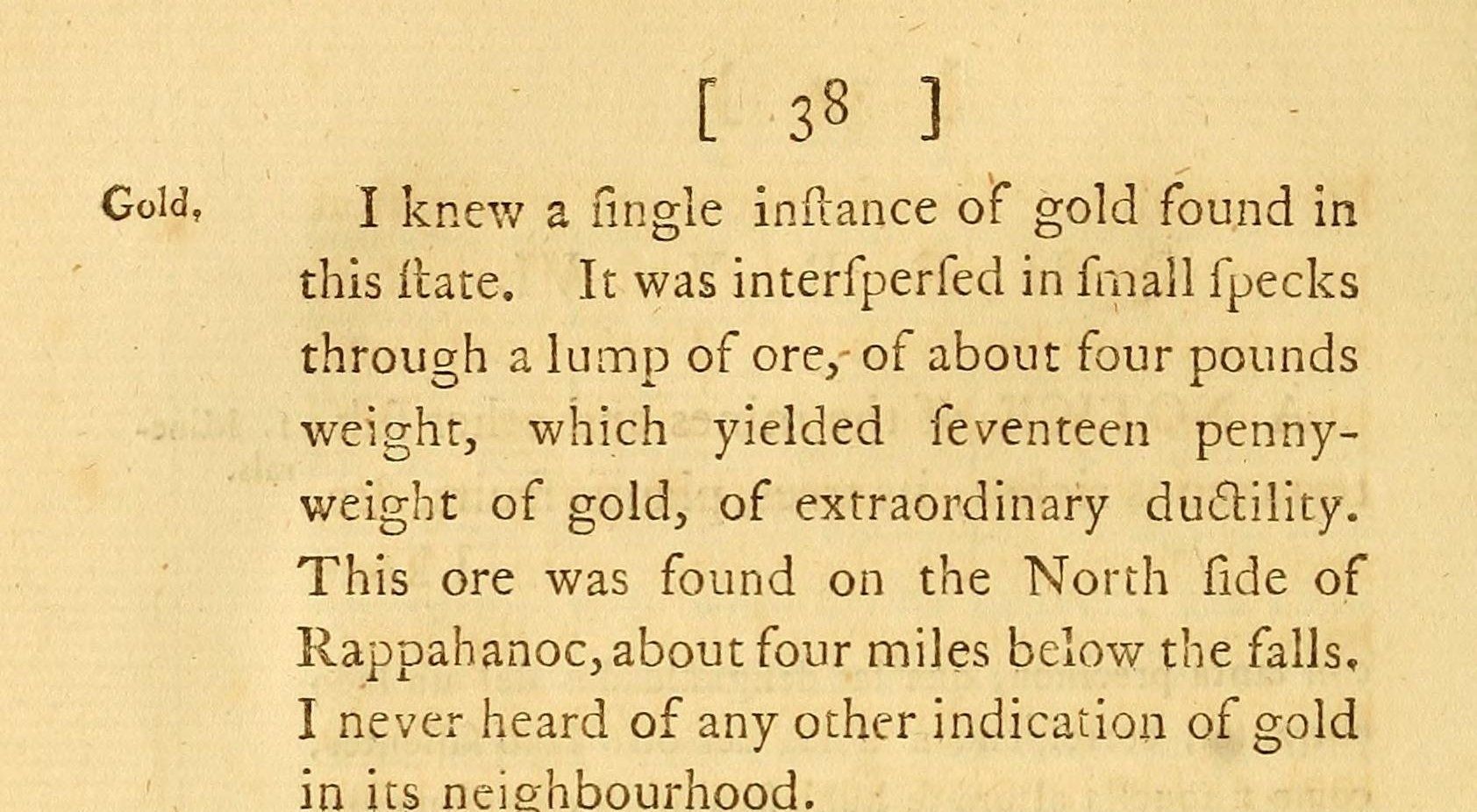
Gold was noticed in the United States before Reed. Thomas Jefferson, writing his Notes on the State of Virginia in 1781 and 1782, recorded one lump of ore of about four pounds that yielded seventeen pennyweight of gold, found on the north side of the Rappahannock River.
Jefferson called it “a single instance”: the gold was “interspersed in small specks” through the rock, and he had never heard of any other sign of gold nearby. Nothing came of it: no mine, no rush. The US Geological Survey also notes that gold was produced in the southern Appalachians as early as 1792, without naming a find. Neither left a story as clear as the one on the Reed farm.
1799: a 17-pound rock in Little Meadow Creek
One Sunday in 1799, while his parents were at church, Conrad Reed found a large yellow rock in Little Meadow Creek on the family farm. It reportedly weighed 17 pounds, about 7.7 kg. Nobody in the house knew what it was, so for about three years it held the door open.
His father, John Reed, born Johannes Reith, was a Hessian soldier who had left the British army near the end of the Revolutionary War and settled among German farmers in the North Carolina Piedmont. The family grew corn and wheat on a small farm. NCpedia gives Conrad’s age as 12; the state’s marker essay calls him only “young Conrad”.
John Reed did try to find out what the rock was. The historic site’s teacher’s guide says he showed it to a silversmith in Concord, who could not identify it.
1802: sold for $3.50
In 1802 John Reed took the rock to a jeweler in Fayetteville, who identified it as gold and asked him to name his price. Reed asked $3.50. The State of North Carolina puts that at one-tenth of one percent of the gold’s true value.
The site’s teacher’s guide adds the details: the jeweler kept the rock while Reed ran his errands, melted it into a bar about nine inches long, and only then made his offer. The $3.50 Reed named was about a week’s pay for a farmer at the time. The state’s historical-marker essay says the jeweler sold the gold for over $3,000; another state article gives $3,600. Family oral tradition says Reed went back later and was paid another $1,000. The jeweler’s name is not recorded.
The state’s own essay tells the sale with a wink: “The Reed family would have the last laugh, however.” Conrad had found a small sample of a large deposit. What came next is not a joke.
1803: the mine, and the men who dug it
In 1803 John Reed formed a partnership with three neighbors: Reed supplied the land, the partners supplied the equipment and enslaved men to dig for gold in the creek bed. Before the end of that first year, an enslaved man named Peter dug up a nugget of 28 pounds, the largest ever found at the mine.
The partners were the Reverend James Love, Martin Phifer and Fredrick Kiser, Reed’s brother-in-law. They worked the creek mainly in the off-season, after the crops, when the water was low. Peter was enslaved by Love. The state’s teacher’s guide puts the nugget at almost $6,000 in the money of the day, and the historic site calls it the largest gold nugget found east of the Mississippi River. It is known as Peter’s Nugget.
The only story about Peter in the state’s account comes from one of Reed’s sons-in-law, George Barnhardt, in later years: Love offered to let Peter keep whatever piece he could pry off the nugget with his dinner fork, and Peter declined. The returns of the mine were divided among the partners. With his wealth, the state’s teacher’s guide writes, John Reed became one of the largest slaveholders of the antebellum Piedmont.
Reed was not the only one. The same guide says Matthias Barringer, who found gold in quartz on his farm in 1825 and followed it underground, dug it out “with help from partners and enslaved peoples”. At both of the mines that started North Carolina’s gold industry, the creek at Reed and the first vein at Barringer’s, the state’s own history records enslaved people doing the digging.
1825 to 1837: gold in the rock, and a mint in Charlotte
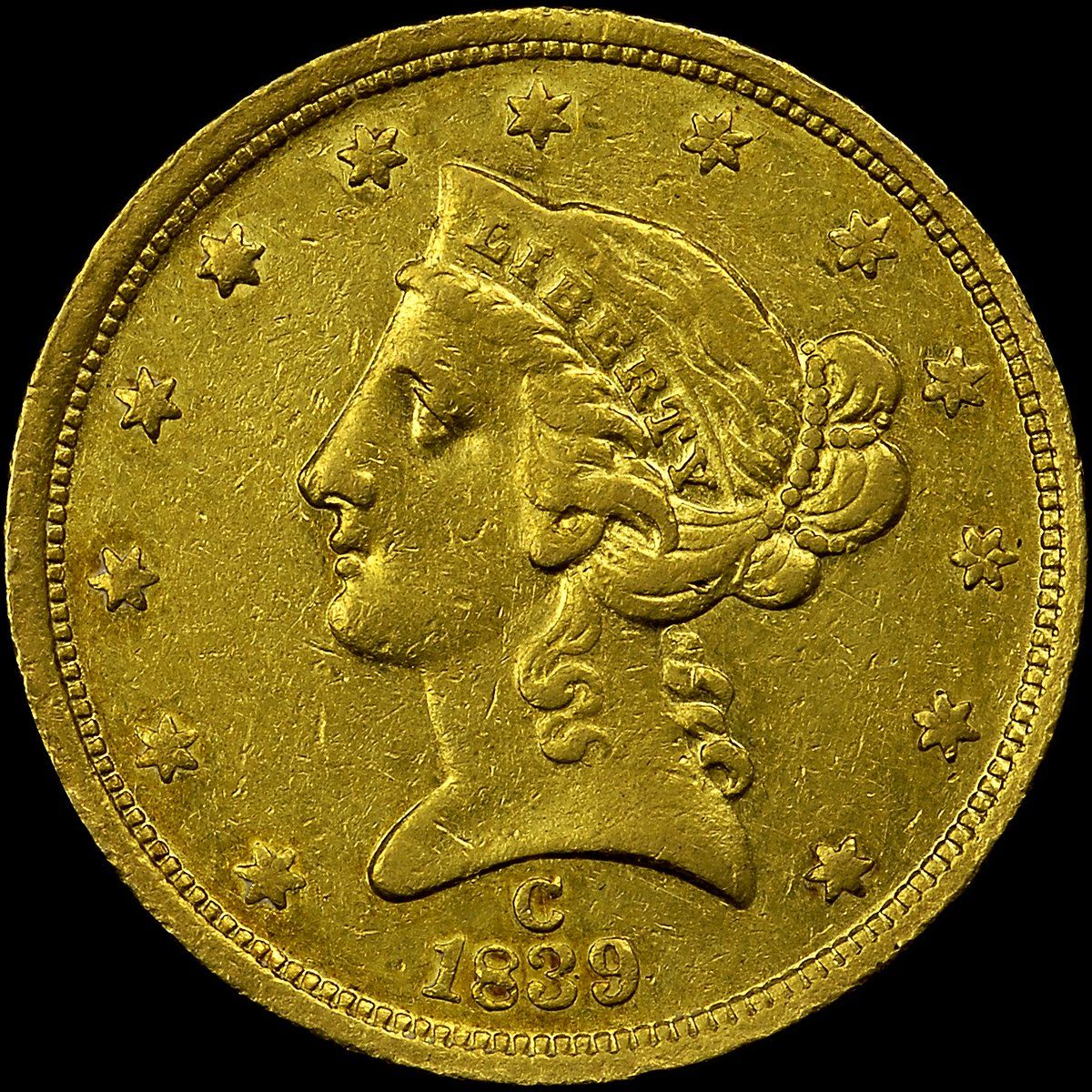
For its first twenty years, North Carolina gold came from creek gravel. In 1825 gold was found in veins of white quartz, and mining went underground. By 1837 so much gold came out of the region that the federal government opened a branch of the US Mint in Charlotte to turn it into coins.
The two kinds of deposit still have the names miners used. Gold loose in sand and gravel is placer gold: the river has already freed it from the rock, and it is recovered by washing. Gold still locked in a vein is lode gold, and it needs digging, crushing and machinery. Our guide to placer goldexplains the word and the methods.
Reed began underground work in 1831. Four years later a family dispute ended in a court injunction that closed the mine for a decade. Across the region, at its peak, gold mining was second only to farming in the number of North Carolinians it employed, and the gold recovered was estimated at over one million dollars a year.
1848: California takes the lead
North Carolina was the leading gold-producing state until 1848, when the rush to California eclipsed it. John Reed did not see it: he died a wealthy man on May 28, 1845, and his mine was sold soon after.
The state’s marker on the highway near the mine puts the change a year later, saying North Carolina “was the chief gold-mining state to 1849”. Either way, the Carolina mines came first, and the USGS notes that many of the pioneers who located the western gold districts were experienced miners from the southern Appalachians. How California’s gold was found, and by whom, is the subject of who discovered gold in California.
The Reed mine kept working on and off. Around 1854 its owners expanded the underground workings and built an engine house with a steam engine and a stone chimney. After the Civil War it ran only now and then.
1896: the last big nugget
In April 1896 four men digging near an old road on the Reed property found a 23-pound nugget. It sold for $4,800, the value of its gold at $20.67 a troy ounce, the price of the time, and it was the last large nugget reported from the mine.
The site credits Jacob L. Shinn, Jesse Cox, his son A. M. “Mack” Cox and Dr. J. R. Jerome. They first threw the rock aside because it did not look right; Shinn washed it in the creek and saw the gold. Plaster casts were made for the North Carolina State Museum and the Smithsonian. Some Cox descendants say Mack found it, and a photograph of the nugget names him.
The owners at the time, the Kelly family of Springfield, Ohio, had bought the property in 1895 for $15,000. They installed a ten-stamp mill to crush quartz, sank the workings to 150 feet, found little, and ended underground mining in 1912.
Today: Reed Gold Mine State Historic Site
The farm is now Reed Gold Mine State Historic Site, in Midland, North Carolina, run by the state. You can tour part of the old underground tunnels and pan for gold at the creek; as of October 2026, panning costs $5.00 per person plus tax.
The site was named a National Historic Landmark in 1966. In 1971 the Kelly family donated 70 acres to the state and sold it the rest well below its appraised value, and the site opened to the public in April 1977, with 400 feet of tunnel restored. Mine tours cost $5 for adults, $4 for seniors and military, $1 for children 3 to 17, as of October 2026. The site closes panning in storms and above a heat index of 103 degrees, so call before you go.
The panning ticket is worth a moment of arithmetic: at $5, it costs more than John Reed asked for a 17-pound lump of gold, in the dollars of each time.
Gold from a creek, in a ring
Reed’s rock was placer gold: freed by the water and left in the creek bed. Our River collection is named for that kind of gold. Its bands carry nugget texture all the way round, like the gravel of a gold-bearing stream bed.
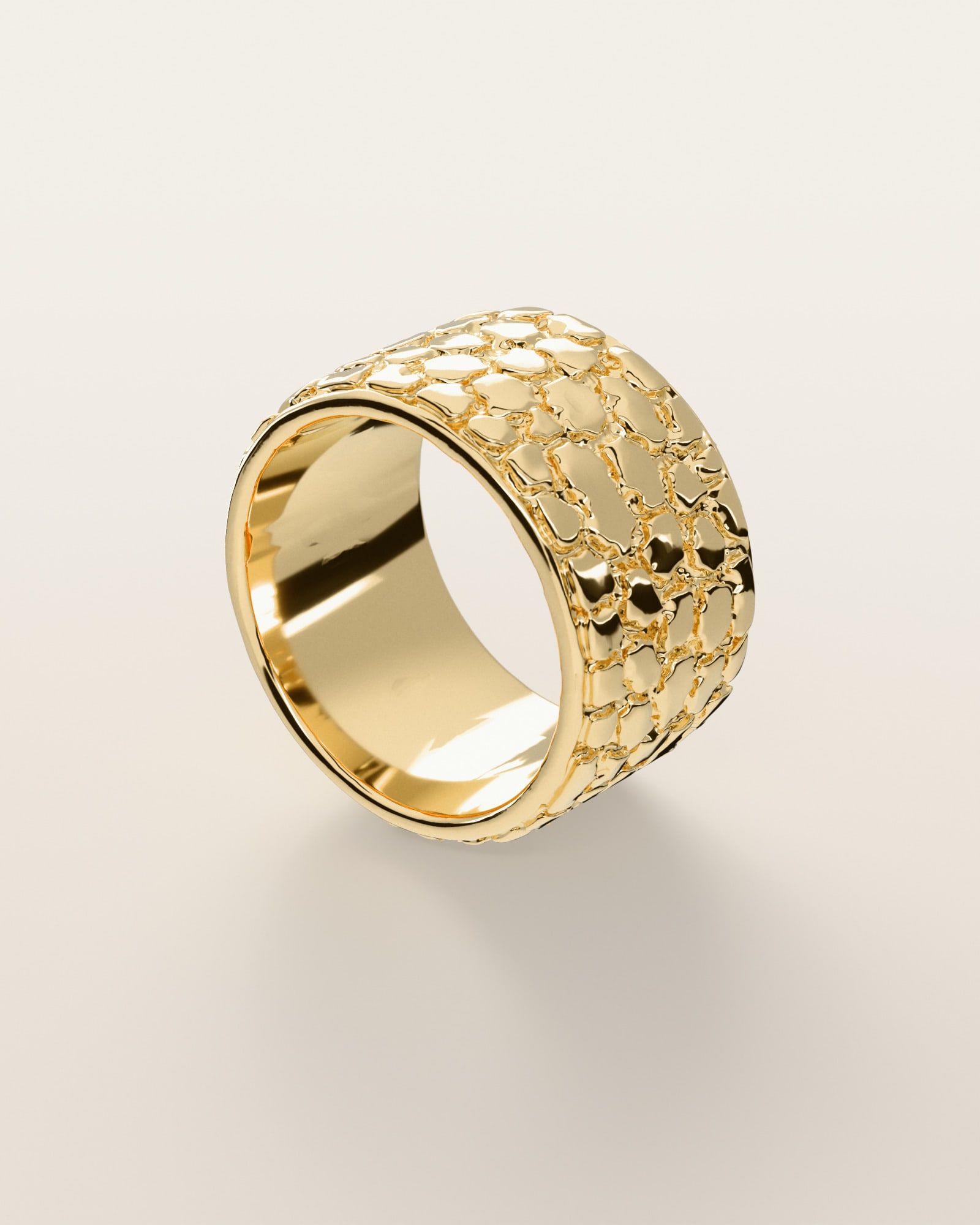
See the bands named for river gold: The River collection. More short answers about gold, its history and its words: gold, explained.
Everything else to check before you buy is in the gold facts.
Sources
- North Carolina Historic Sites, Reed Gold Mine: History (first documented find; 17 pounds; three years as a doorstop; $3.50, one-tenth of one percent; the 1803 partnership and enslaved men; Peter’s Nugget; 1825 vein gold; 1831; the injunction; 1845; North Carolina first until 1848; the 1895 Kelly purchase; the 1896 nugget, $4,800 at $20.67 an ounce; 1912). Read 18 October 2026.
- North Carolina Historic Sites, Reed Gold Mine, Teacher’s Guide: Supplemental Texts (August 2020): the silversmith in Concord, the bar about nine inches long, a week’s pay, the extra $1,000 in oral tradition, the partners’ names, Peter and James Love, the dinner-fork story, Reed among the largest slaveholders of the Piedmont, Barringer in 1825, the 1971 donation. Read 18 October 2026.
- NC Department of Natural and Cultural Resources, Reed Gold Mine, marker L-7 (2024: Sunday, parents at church; “over $3,000”; “chief gold-mining state to 1849”; the 1837 Charlotte branch mint) and John Reed and the North Carolina Gold Rush (2016: $3,600; Reed died May 28, 1845). Read 18 October 2026.
- Richard F. Knapp, “Reed Gold Mine”, NCpedia, from the Encyclopedia of North Carolina (UNC Press, 2006): Conrad’s age, about 1854, National Historic Landmark 1966, the 1971 sale, opening in April 1977, 400 feet of tunnel. Read 18 October 2026.
- North Carolina Historic Sites, Reed Gold Mine, visitor page: panning $5.00 per person plus tax, tour prices, weather rules. Read 18 October 2026.
- Thomas Jefferson, Notes on the State of Virginia (London: John Stockdale, 1787), page 38, “Gold”; the author’s note says the Notes were written in 1781 and corrected in the winter of 1782. Text also at the Avalon Project, Yale Law School.
- Harold Kirkemo, William L. Newman and Roger P. Ashley, Gold, US Geological Survey general interest publication: southern Appalachian gold as early as 1792; placer and lode deposits. Read 18 October 2026.
- Harold Kirkemo, Prospecting for Gold in the United States, US Geological Survey: western districts located by experienced miners from the southern Appalachians. Read 18 October 2026.
- Newman Numismatic Portal, Eric P. Newman Collection, 1839-C $5 gold coin, via Wikimedia Commons (CC0).
